Category Archives: Fashion

How to Have Company (or Repairmen) In Your Home When You Have MCS/ES

Even when people try to be fragrance (and other chemical) free, they can have 2nd and 3rd hand residues from personal care, cleaning, and laundry products all over them. Air “fresheners” and scented candles are other items that leave residues on everything. It can take weeks to get it out of skin and pores, and longer to get it out of clothing and bedding, all the while re-contaminating the body and anything else that has contact with the fragranced surfaces or air.

rigmarole

Fragrance (and other toxic) chemicals are just all-pervasive now. Unless people are completely fragrance-free and stay out of fragrance filled places, they will have some degree of fragrance saturation in their clothes, skin, and hair. Some of the residues are also impossible to remove no matter how hard one tries, because of chemicals that are designed to penetrate and remain active for long periods of time (think of the  laundry commercials where they boast you can smell the fresh scent days later – except some of us can be affected years later, because that’s how permanent those chemicals are).

If people who use those products come to visit, not only can they leave us gasping for air (or worse) during their visit, they can leave chemical residues that will keep off-gassing from the couch and anyplace else they touched for days or weeks to come.
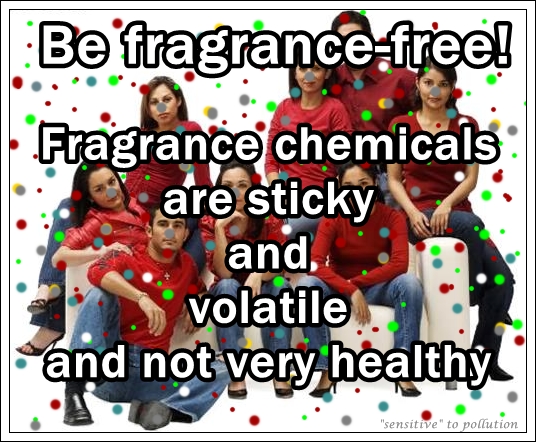
fragrance around a sofa

Depending on how severe one’s MCS/ES is,there are different things that can be done.
Continue reading

Pesticides in Shipping Containers and Contents

Did you know that there can be massive amounts of highly toxic pesticides used in the shipping containers, especially when products and materials are shipped over seas?

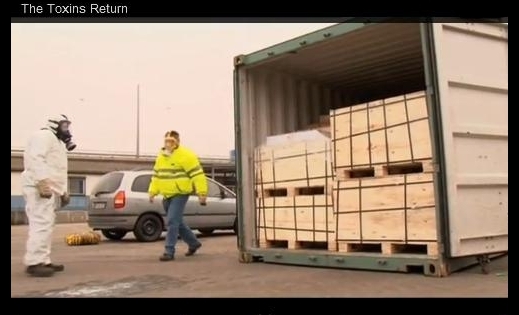
The Toxins Return

In a world where recycling is being encouraged, this presents some potentially serious  problems that aren’t being widely discussed. Some things have simply not been designed to be reused, and recycling toxic materials just spreads the contamination further afield, causing low level poisoning and some kinds of chronic health problems.

The trend to build all kinds of indoor furniture and garden beds out of pallets is quite troubling. The pallets used in these containers would also have absorbed the pesticides and be unsafe for re-use. This article describes other issues with pallets.

potentially dangerous pallet reuse google imagesScreen shot from google image search of reused pallets
Note potentially hazardous furniture for children and food use

Converting shipping containers into homes is another big trend (see below).

The following documentary depicts some serious problems related to clothing (as well as some other items that were shipped long distances) when saturated with health harming levels of pesticides. Manufacturing issues are also examined in this video.

Continue reading

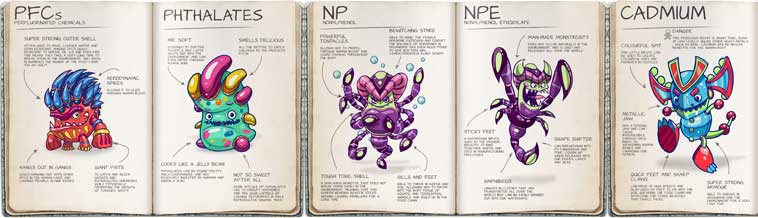
Monsters In Our Closets!

Greenpeace reveals more details about toxic chemicals in clothing:

A new investigation by Greenpeace has found a broad range of hazardous chemicals in children’s clothing and footwear across a number of major clothing brands, including fast fashion, sportswear and luxury brands.

The study follows on from several previous investigations published by Greenpeace as part of its Detox campaign, which identified that hazardous chemicals are present in textile and leather products as a result of their use during manufacture. It confirms that the use of hazardous chemicals is still widespread – even during the manufacture of clothes for children and infants.

greenpeace-monsters-guide

Continue reading

You are what you wear.

“I don’t mean like in “the clothes make the man” kind of way, but in the “our bodies absorb chemicals found in our environment” kind of way.”

We really do need safe products and materials, it shouldn’t be so difficult to find them…
However, the recently revised “Chemical Safety Improvement Act” that had bipartisan support was a chemical industry protection act, and did not protect people or the environment.
We need better!
And we need to be educated about what to look for and what to avoid. OEcotextiles is a great resource!

O Ecotextiles (and Two Sisters Ecotextiles)'s avatarOEcotextiles

In Memoriam: U.S. Senator Frank R. Lautenberg (D – NJ).

Sen. Lautenberg fought valiantly to reform the weak laws protecting consumers in the US from chemical incursions in their lives. He introduced the “Safe Chemicals Act of 2010”, which was defeated, but followed up with the “Chemical Safety Improvement Act” which has been endorsed by the New York Times, the Washington Post and has bipartisan support at this time. It caps eight years of work by Senator Lautenberg to fix the nation’s broken chemical law (the TSCA) which has been proven ineffective and is criticized by both the public health community and industry. Thank you Senator Lautenberg.
******************************************************************************
You are what you wear.

I don’t mean like in “the clothes make the man” kind of way, but in the “our bodies absorb chemicals found in our environment” kind of way.

The new science of biomonitoring has enabled scientists to…

View original post 754 more words

Need Protection?

To Breathe, That Is…

I was looking up masks and found these ads…
I am a bit (but not entirely) speechless…

Find a Mask to Filter Fragrance From Work HVAC Systems

“Companies across the globe are including fragrances in their heating and ventilation systems. It’s part of what emotional branding companies such as DMX call a multi-sensory experience. Retail stores may use scent in combination with audio and visual systems to enhance brand awareness. Smell associations, say DMX, are so strong they can even increase worker productivity. Whatever the reason, these scent systems can make it difficult for employees working in the affected areas who have fragrance sensitivities.”

While it won’t be possible for all workers in controlled scent environments to wear respirators, for those who can, we have a few suggestions:

http://blog.pksafety.com/a-respirator-mask-to-filter-out-fragrance-from-the-hvac/

I do know people who have to wear a mask just to go to work. It’s a horrible way to have to live when toxic chemicals are used everywhere everyday by almost everyone, and so much worse when pumped into the air deliberately. In fact, I don’t think anyone with MCS/ES or respiratory symptoms could work (or visit or shop) in an environment with deliberately pumped in fragrance chemicals, even wearing a mask.

That’s why we have human rights legislation to provide fragrance or scent free policies for working environments (see the sidebar or resources page at the top). These policies actually end up benefitting everyone’s health, not just those of us who are “sensitive”. Soon (but not soon enough) that will change to basic public health legislation, as it has for smoking.

Some multi-unit housing complexes have introduced smoke free rules, but so far there are very few housing options with fragrance free rules. We need them. Wearing a mask all day and night just isn’t feasible or possible, even if we tolerate the (mostly synthetic) materials they are made of, which many of us don’t.

Did you know there are masks for kids? These just make me really sad…

Continue reading

ReBlog: Are YOU drinking the Keratin Complex Kool-Aid?

I just discovered a blog (thanks Women’s Voices for the Earth) dedicated to “create awareness, and protect people from the harmful toxins that are so regularly used in the beauty industry, most notably that of the Brazilian Blowout.”

“Pretty Toxic” was created by Jennifer Arce and Dawn Marino, two hair stylists whose lives have changed after contracting formaldehyde poisoning from the hair smoothing product known as the Brazilian Blowout being used in the salons they worked at. The site serves as an educational and informative tool for stylists, consumers and the general public in an attempt to protect others from toxic exposure to chemicals in beauty products.

From their post on the 13th Annual Stylist Choice Awards:

While Martino Cartier accepted the award on behalf of Keratin Complex he said:  

“Thank you for drinking the Kool-Aid, and thank you for believing in Keratin Complex.”

Oh Martino, Martino, Martino!! We had to rewind it to just make sure we heard him right, but yep, that’s what he said!!

“Drinking the Kool-Aid,” according to Wikipedia, “suggests that one has mindlessly adopted the dogma of a group or leader without fully understanding the ramifications or implications.” And also, “refers to a person or group holding an unquestioned belief, argument, or philosophy without critical examination.” So this made us wonder…

Did you know Coppola/ Keratin Complex has the second most injuries reported to the FDA according to documents made public in 2011? Yep, but don’t take our word for it, check it out for yourself! here:

via Are YOU drinking the Keratin Complex Kool-Aid?.

nails-on-a-chalckboard

Endocrine disruptors – in fabric?

O Ecotextiles is a great blog to follow if you are interested in what’s happening in the textile world. Lots of excellent information about why those of us with MCS/ES and Fibromyalgia can have so much difficulty finding safe (non-toxic) clothing to wear, as well as safe beds and furniture to rest our weary bodies on.

Here’s their latest, a subject that is worth understanding, as endocrine disruptors are found in so many of our everyday products and materials, and our endocrine systems are responsible for regulating so much of our lives, processes that we seem to have taken for granted for far too long…

Endocrine disruptors – in fabric?.

A big thank you to Patty and Leigh Anne who founded O Ecotextiles in 2004 and keep us so well informed.

Fashion victim


In her blog post  Fashion victim,  Alysha writes about discovering the need for precaution when choosing her clothing, and mentions how my blog post on Greenpeace’s efforts to Detox Fashion helped open her eyes.

Thanks Alysha!