Category Archives: Human Rights

Canadian Recognition of MCS/ES (Multiple Chemical Sensitivities/Environmental Sensitivities)

The Canadian Human Rights Commission

Policy on Environmental Sensitivities

Individuals with environmental sensitivities experience a variety of adverse reactions to environmental agents at concentrations well below those that might affect the “average person”. This medical condition is a disability and those living with environmental sensitivities  are entitled to the protection of the Canadian Human Rights Act, which prohibits discrimination on the basis of disability. …

UPDATE 2013: see Canadian Human Rights Documents Archived

Ontario’s Human Rights Code

What is disability?

“Disability” covers a broad range and degree of conditions, some visible and some not visible. A disability may have been present from birth, caused by an accident, or developed over time. There are physical, mental and learning disabilities, mental disorders, hearing or vision disabilities, epilepsy, drug and alcohol dependencies, environmental sensitivities, and other conditions.

The Code protects people from discrimination because of past, present and perceived disabilities. For example, the Code protects a person who faces discrimination because she is a recovered alcoholic. So is a person whose condition does not limit their workplace abilities, but who is believed to be at greater risk of being able to do less in the future.

http://www.ohrc.on.ca/en/disability-and-human-rights

CERA the Centre for Equality Rights in Accommodation

…While environmental sensitivities are not well understood by the general public, they are recognized by Health Canada, the Canadian Health Network, the Canadian Centre for Occupational Health and Safety, the Canada Mortgage and Housing Corporation, the Canadian and Ontario Human Rights Commissions, the Ontario Medical Association and the Environmental Health Committee of the Ontario College of Family Physicians – among others….

http://www.equalityrights.org/cera/?page_id=674

Environmental Health Clinic

The Environmental Health Clinic is a unique multidisciplinary clinic, and the only one of its kind in Ontario. It was established in 1996 by the Ministry of Health and Long-Term Care to be a provincial resource in promoting environmental health, and to improve health care for people with environment-linked conditions such as chronic fatigue syndrome, fibromyalgia and multiple chemical sensitivities.

The Environmental Health Clinic is the clinical part of a joint clinical and research program of Women’s College Hospital and the University of Toronto.

http://www.womenscollegehospital.ca/programs-and-services/environmental-health-clinic469/

This post is in response to a request.

If anyone can provide other links, including the sources mentioned by CERA, I will add them.  Thanks in advance.
MCS/ES Housing Resources From CERA

This information can now be found in the Property Manager’s Guides to MCS

Emergency Preparedness and Disaster Relief for People with Chemical and Electrical Sensitivities

(Thanks to Mary Lamielle)

Providing Services for People with Chemical and Electrical Sensitivities (CS/ES) in Emergency Management

Educate yourself and your agency or organization about the needs of people with chemical and electrical sensitivities (CS/ES).

Identify and work with the CS/ES in your community to determine how to best meet their needs.

Provide notification to people with CS of any toxic event so that they can take precautions or evacuate as necessary.

Establish a registry as a means to provide advance notification.

Keep the needs of those with CS/ES in mind as emergency preparedness plans are developed.

Work to ensure emergency services and shelters are accessible for people with CS/ES.

Be prepared to respond to any emergency affecting the CS even if the balance of the population is not significantly affected.

Provide for the safe evacuation, if necessary, for those who cannot use public transportation.

Provide outreach to people with CS/ES who are unable to get to or be accommodated in a shelter.

Prohibit smoking in the vicinity of people with CS and protect those with CS from exposure to combustion sources including gasoline and diesel exhaust, propane, and similar exposures.

Use least toxic/allergenic cleaning and maintenance products and Integrated Pest Management (IPM) practices with least toxic/low impact products, if necessary.

Adopt and promote best practices policies that restrict the use of fragrances and the purchase and use of fragranced and scented products in emergency services.

Restrict the use of cell phones, smart phones, and similar devices in the vicinity of people with ES.

These tips were provided by Mary Lamielle,
National Center for Environmental Health Strategies, Inc.
“Addressing the Needs of People with Chemical and Electrical Sensitivities and Fragrance-Free Policies in Emergency Preparedness,”
New Jersey GAINED, January 25, 2012.

Continue reading

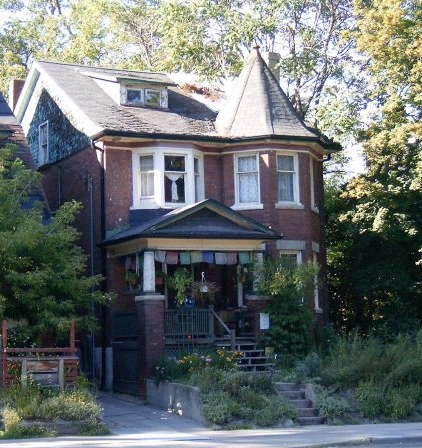
1844 Bloor St. West

1844 Bloor Street West

(1991-2010)

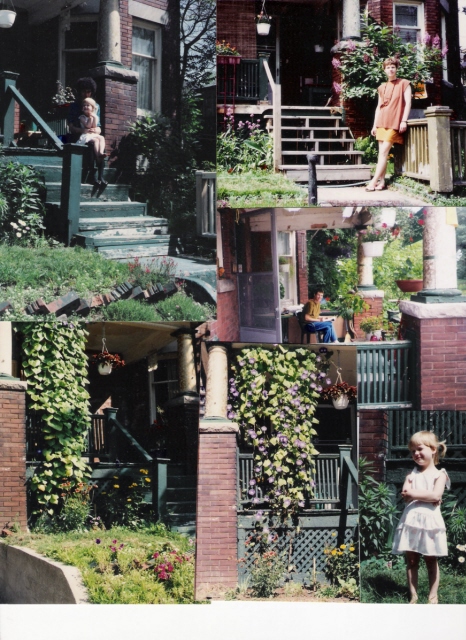
From fixing up the run down house in 1991, to raising my two wonderful children, planting and tending a garden, living and celebrating life with friends and family, to getting sick, to almost dying…

Memories of life at 1844 Bloor St W 1991-2010.

My father, daughter and son on the porch… 91 or 92.

After cleaning and painting inside, I think it took almost 20 bags to remove the weeds and garbage and unearth the garden. Only the hollyhock, a red rose, and some alyssum in the rock garden were there when I moved in.

It took a few years to get the perennial garden going. My father’s old porch railing was re-purposed as a fence for a few years. People used to smile when they went by. More people who lived on Bloor St W started planting flowers in front. People often asked me if it was my garden when I was out shoveling snow, and told me how much they enjoyed seeing the seasonal changes.

When I got too sick to care for it because of the vehicle exhaust and laundry fumes from the apartment buildings, I watched from the windows as people stole plants, rocks and other items I’d placed there.

~

Many birthdays were celebrated in 1844…

Continue reading

Not so Equal Access to Health Care in Ontario or Systemic Barriers to Access for People with MCS/ES

Some places like Ontario, where I live, have disability access laws that state service providers, including those in healthcare, must accommodate people who are disabled.

On a government website, it states:

Barriers to accessibility are obstacles that make it difficult — sometimes impossible — for people with disabilities to do the things most of us take for granted — things like going shopping, working, or taking public transit… 

(or receiving health care services)

When we think of barriers to accessibility, most of us think of physical barriers — like a person who uses a wheelchair not being able to enter a public building because there is no ramp.

The fact is there are many kinds of barriers. Some are visible. Many are invisible:

•    Attitudinal barriers are those that discriminate against people with disabilities.

•    Organizational barriers are an organization’s policies, practices or procedures that discriminate against people with disabilities.

•    Architectural and physical barriers are features of buildings or spaces that cause problems for people with disabilities.
Chemical or “environmental” barriers prevent people like myself who have disabling medical conditions from breathing and functioning properly when exposed to these invisible, toxic and disabling barriers, resulting in both short and long term impacts.

How many of us do not have safe access to healthcare in Ontario?

In the ” Guide to the Accessibility Standards for Customer Service, Ontario Regulation 429/07″,  it says that Hospitals and health services provide goods or services  and as  designated public sector organizations should have been in Compliance by January 1, 2010…

It also states:
Continue reading