Category Archives: Environment

What do tobacco smoke, fragrance chemicals, food, drugs, supplements, health food stores and incense have in common?

Tobacco smoke contains so many harmful chemicals causing health problems, that smoking has been banned from most public indoor environments. Work remains to be done in shared housing, where neighbours are forced to breathe in 2nd and 3rd hand smoke.

Since fragrances  also have  many harmful chemicals,  including too many  of the same chemicals found in tobacco smoke, they should also be banned from indoor environments. Well, (unless  certified organic), they should just be banned period  since they also pollute the outdoor air when expelled from dryer vents, and also pollute our  waterways.

Just like sitting in a smoky room for 10 minutes will make your hair and clothes smell like smoke, sitting in a fragranced room for 10 minutes will do the same. In fact, foods absorb smoke   and fragrance too, including those that can’t be washed (breads, salt, etc) and if you are attending a wine tasting event, you’re asked not to smoke or wear fragrances since they interfere with people’s ability to taste and smell.

Most fragrance chemicals weren’t designed to be eaten (although IFF would probably beg to differ ) and most of us certainly don’t want to be eating plastics, do we? Makes you wonder why phthalates  are found in drugs and supplements?    Especially since so much evidence is mounting regarding harm.

So what to do? One might assume that shopping for food, especially organic food, at health food stores (HFSs) would be safer. One would be thinking wrong if the HFS sell  fragranced products and  incense, which is linked to asthma, dermatitis,   and cancer,    and most HFSs do sell these products.

They don’t sell cigarettes, which are even triple wrapped despite not containing any VOC’s when unlit, yet the incense and other fragranced products are often unwrapped, or sold in flimsy plastic bags which do nothing to contain the VOCs, or keep them from migrating into other foods and products in the store.

I don’t know about you, but when I pay extra for organic foods, I don’t want them tasting like incense or other fragrance chemicals. I don’t want to be eating phthalates and BPA, so I avoid plastics, I don’t want to be breathing in the chemicals in tobacco smoke, yet buying food from most stores means these toxic chemicals are getting into the foods they sell.

Buying veggies and fruit from farmer’s markets,    CSA‘s    or organic delivery services usually eliminates this problem, but some warehouses have so-called air”fresheners”     or allow staff to use scented soaps   etc, which end up leaving residues on the food, and not all kinds of foods are available from these sources.

Food should not be kept in the same air space as these toxic chemicals. Volatile toxic chemicals should be sealed in impenetrable packaging as long as they are still legal. Stores that sell both food and items that contain volatile chemicals  should be required to separate the fragranced items from the foods, including using different ventilation systems.  It shouldn’t be so difficult for anyone, let alone those of us with a medical need,  to find safe, chemical and fragrance free foods.

Healing…

I started noticing changes in September, it didn’t feel like I was living in sludge all the time anymore. It didn’t take all my effort to focus and concentration to think, move and do. I was starting to have a bit of space, a bit of freedom from the constant effort required to survive. Sometimes two thoughts could even co-exist in my mind at the same time again!

I have toxic brain injury symptoms, MS symptoms, carbon monoxide poisoning symptoms, and MCS/ES/EHS and FM. Throw in a bit of adult onset, intermittent relapsing, chemical exposure induced autism too, just to make it more interesting. (Note: Due to the fact that medical offices and professionals are not accessible to people with severe MCS/ES, because they and their offices are still using toxic fragrances and cleaning products among other things that affect indoor air quality, I haven’t been able to get official diagnosis on all these, I’ve had  to try to understand and cope with it on my own)

It’s hard to describe what it was like, but I’ll try, because unless you’ve experienced it, you can’t even begin to imagine what it’s like. I was already in bad shape, but from 2007 on, after the roofing repairs and road asphaltings, my brain almost shut down. It was a struggle to get anything to happen, to keep myself alive. Even thinking took an extraordinary amount of effort, and that is something most of us do incessantly without any effort at all.  In fact, it requires an effort for us to stop thinking! For me, to complete a thought, or to write a complete sentence that made sense, was a huge challenge. And in fact was impossible more often than not, because I couldn’t find enough words to say anything but the simplest things, and what was happening was not simple.

Most of us will stand up when we want to stand up without any bother. I had to find a way to get my brain to complete the message that when I wanted to stand up, my body should move, when I wanted to get dressed, that my arm should move into the sleeve… those things didn’t happen on their own anymore, I had to find ways to make them happen. I did have some occasional better hours, and even a couple of good days a year, but 99% of the time it required an immense effort to survive.

To remember to take the supplements I needed every day was a challenge, in fact, if I didn’t almost  trip over them, I wouldn’t have known they existed. I had to place things in the open based on what part of the day I needed to take thinks or make them, to trigger my memory.

I couldn’t put the kettle on without setting the timer to ring, even in the same room, because the sound of the kettle boiling wasn’t enough to alert me to take the next step.

To cut a vegetable without cutting off a finger was another challenge. My co-ordination was off.

To walk on uneven ground without tripping was a challenge. Stairs were a problem. And the land at the cabin was uneven, and slippery when wet, or in the winter with snow and ice. Lifting my feet was hard.

Walking outside without a cane or walking stick wasn’t possible from 2007 until about a year ago, and  there are times (after some exposures)  when I still need the extra support.

I remember thinking that I got so little done in a day, yet I was exhausted from those few activities that I did do. Communicating in sentences was exhausting. And if I did have any kind of a conversation, where I had to think (not just free-flow which was easier with some subjects), it seemed like I only had a limited number of neuro-transmitters I could use during any given day or week. If I tried to use more, I had none the next day (or weeks). It would take a long time to process info in a way that it made sense and I could remember it or write it down so that the next step could be possible, whatever that would be. More often than not, the next step didn’t happen, because survival got in the way.

At the cabin, getting to the outhouse did take more time and effort than going to an indoor bathroom would take, and the old stove with burners that only half worked did take longer to boil or cook things than a fully functional stove would, and hauling and pouring water from big glass bottles took more time and effort than turning on a tap, but even with all that, I must have been moving in very slow motion… I was lucky to have the time and energy to take some photos of the wildlife through the window.  After making dinner and washing the dishes at night (boiling water to do so) the day was over and it seemed to have just begun, although it also seemed like the same day was repeating more or less endlessly… somewhat like in Groundhog Day, although with perhaps 1/1000th of the activity. Everything, absolutely everything, took a monumental amount of effort.

It did get better while I was at the cabin, but not enough to be hugely encouraging about my future prognosis. During Christmas 2010 I finally did start to feel like I would survive, that death wasn’t more probable than life, that I could leave my back-up plan of a one way walk into the lake behind me, but it wasn’t until a couple of months after moving here to my safer home, that there was a real change in the way my brain was working.

I don’t remember all the details, but I do remember something changed in September. The sludge was slowly lifting. It didn’t take all my effort to do what I needed to do to survive every day. I had moments here and there where I could sit and enjoy something and even feel the enjoyment.

Every month or so since then I’m aware of more changes, sometimes after a very disconcerting week of what seems like re-calibration, where nothing is certain and everything is shifting.

More memories from different parts of my life are coming back, sometimes in surprising ways. I’ve had to work on processing events that I was unable to process for several years because there simply wasn’t the space or ability to connect enough thoughts to understand them in any context. Events that were significant too… I had a lot of them, and some misunderstandings that I wasn’t able to clear up because I simply couldn’t get enough words into my mind at any one time to express a whole thought in any coherent way. The minimal sentences I was able to get out were so often mis-interpreted that I gave up trying. Memories like that are still painful, some situations are still unresolved, but now I have hope that I will regain the ability to deal with a variety of complexities. And someday even mend some bridges…

For now, I’m extremely relieved to have as much of my brain back as I do. I’m now able to sometimes make the effort to read entire articles, things with paragraphs that are longer than two sentences each, some big words, and some subjects I’m not very familiar with, but those are difficult and still hurt, so I don’t do that too often. Re-introducing increasingly more complex material I’m more familiar with seems to be a good step. And words are slowly coming back to me. Even words I didn’t know I knew!

I love learning!  I look forward to learning new things again. Hmm, actually I already have! I learned how to make and bake a simple chick pea flour pan bread, kind of like a pizza crust,  and have experimented with some toppings. I can’t eat tomato sauce, but squash and sweet potato are great substitutes. I’ve tried to make kale chips about 3 times.  That needs more work… I’ve also finally learned how to soak and cook my own kidney beans and chick peas, so I don’t have to worry about finding someone who can shop for the Eden canned beans for me anymore.

Making those simple things was impossible for several years, so I’m thrilled to have made this much progress in such a relatively short time, thanks to living in safe(r) medically required housing…

It gives me hope that I can recover even more!

On being an environmental refugee in Ontario

People with any other disability are allowed appropriate health care and related aids, tax breaks, subsidies, insurance benefits, accommodations, and accessible housing. People with chemical injury, with MCS/ES, are denied access and even obstructed at every turn.

By Linda Sepp.

This is an excerpt from what I sent to Ontario politicians for Earth Day 2009:

People with any other disability are allowed appropriate health care and related aids, tax breaks, subsidies, insurance benefits, accommodations, and accessible housing. People with chemical injury, with MCS/ES, are denied access and even obstructed at every turn.

The same synthetic substances that people with MCS/ES have been disabled by for years (we’re like canaries in the coal mine) now cause cancer and other chronic health problems in too many people. Children are especially vulnerable in so many ways.

This incredible suffering is preventable, and not an acceptable economic activity!

Healthy non-toxic environments allow people with MCS/ES to lead livable lives, instead of struggling to barely survive. Healthy housing, safe food and water are key needs. Simple needs. Basic health care needs. When these are met, everyone benefits.

Healthy people can create healthy economies. Sick people will drive it to a halt.

Almost 25 years ago Ontario had a guidance document to do the right thing. Instead of acting on it, many more people have been made to suffer in unimaginably difficult and trying circumstances. Too many do not make it. And more are discovering the horrors.

It’s time something was done to respect people with MCS/ES, and help them live in safety and dignity. Doing this will also make the environment safer for all citizens.

The Honourable George Thomson, in 1985:

“I chaired a committee on environmental sensitivities established by Ontario’s Ministry of Health. The committee included two eminent teaching hospital physicians and a highly respected epidemiologist. We issued a report that identified existing, publicly funded means of diagnosis, and accepted various methods of patient management, including avoidance of offending agents.

Equally important in our minds were measures, such as income support, that would provide concrete assistance to members of this vulnerable group and reduce the risk of preventable harm.

… We also called for further research and the development of services to support that research, while also helping those who were experiencing a wide range of very difficult symptoms. We did not feel that more research was needed before these and other measures were introduced to protect patients from being caused harm through inappropriate labelling or the denial of reasonable accommodation.”

George M. Thomson, B.A., LL.B., LL.M.

What can you do to make sure safe water, food, clothing and housing are available and accessible to those of us who need them?

Linda Sepp
Toronto

Why am I begging for clean air and water?

Chemical injury can happen to anyone.

(Note: Don’t miss the resources list at the end of the post.)

By Linda Sepp

It’s really hard to allow myself to think about the implications of my current situation. I’m forced to beg for un-petro-chemically-polluted air, water, food, clothing and housing.

Seems most people would rather not change their habits, both belief and practical, that they’d rather stubbornly maintain the belief that the government is protecting them, that this could never happen to them, that there must have been something bad I did to be in this position, that otherwise the safety net would be providing the help I need.

Chemical injury can happen to anyone. Some of us get cancer, or asthma, or alzheimer’s, Parkinson’s or MS, autism, ADD, or ADHD. Others develop Multiple Chemical Sensitivities (sensitivities is a misnomer–multiple chemical hells would be more apt) or Environmental Sensitivities, as it is more commonly called in Canada (MCS/ES).

What this means is that our bodies are negatively affected by minute quantities of chemicals. Sometimes it’s more of an annoyance on par with seasonal allergies, but often, when the body cannot escape exposures, the symptoms become completely debilitating and life threatening. Think being drugged and unable to think or function, in pain for weeks, and the only things that help are clean air, food and water. Things that are in short supply now, things we have no control over unless we are wealthy enough to buy 100 acres in the middle of no-where, so that someone’s dryer vent or pesticides don’t blow toxic chemicals our way, a place to have our own safe home with air and water filtration systems… things most people don’t notice because they are themselves covered in so many chemicals, living and working in neuro-toxic environments, finding it harder and harder to get by themselves, even begrudging our need for those things as frivolous.

So we become the hidden and often homeless. Invisibly disabled, abandoned, ignored and ridiculed. How is it possible that inhaling anyone’s laundry product or body spray could disable someone for over a week? That there are no clothes that are chemical free? That all housing has been allowed to be completely contaminated by useless chemical residues allowed into fragranced personal care or cleaning products, or worse yet, those so called air-fresheners? How could a few inches of some simple caulk render someone semi-comatose for 4 months? How are neuro-toxic, carcinogenic, endocrine disrupting chemicals allowed into things we slather onto our bodies, wash our clothes with, rinse into our water supplies, in our foods, and in building materials? Synthetic petro-chemicals that will injure people’s brains and central nervous systems? How indeed.

Protecting Industry is more important than protecting public health. It is that simple. The same chemical industry that creates all the toxins that cause so many chronic or otherwise debilitating illnesses, also supplies the pharmaceutical companies with synthetic petro-chemical ingredients to make drugs that will hopefully alleviate some of the symptoms of our damaged bodies without killing us completely in the process. This is called making a killing financially and keeping the economy growing.

Continue reading

Making a difference one apple at a time

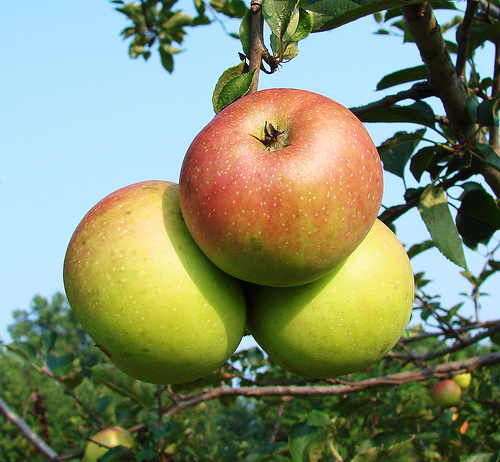
Every choice we make can have an impact that reaches far and wide, even with something as simple as choosing an apple.

By Linda Sepp.

A very few people have managed to run the planet, it’s resources and condition, the systems people use to live together, and almost everything else, into such poor shape that most of us don’t know where to start to make things better. It’s too overwhelming, we can’t fix it all, we can’t even understand it all.

People have lost the ability to remember what it feels like to be in harmony, to be in touch, to care and be cared for. Caring is not a part of the economy, so it has been eliminated from all marketing schemes, and relegated to places it can be made fun of. Same for common sense. That term was co-opted by some greedy people, so now it’s too dirty a word to make any sense. All we’re supposed to do is bicker and snipe and be witty while we hurt our friends while trying to amass the biggest pile of disposable stuff we can get our hands on (according to most tv programming anyway).

If it doesn’t make someone money, it’s not valued anymore. That has been the message. Everything has been so run to the ground that the people who still do care are so overwhelmed and under resourced, that it’s hard to do anything but collapse at the end of the day.

And, since indoor air is so contaminated with neuro-toxic, endocrine disrupting chemicals, embedded in everyday products, marketed like mind altering drugs on tv commercials (which they are), it’s almost impossible to get any real work done during the day too… so everyone who cares ends up struggling, too.

What good are these observations without something that inspires people to do the right thing every moment they can? How do people even know what that is anymore?

Will a story help?

Choosing an Apple

Every choice we make can have an impact that reaches far and wide. But first we have to know we have a choice. We need to know what is going on. We don’t have that now.

If you take an apple as an example: someone planted a seed somewhere, then watered the seed, and watched and tended to it while it grew. Eventually the tree bore fruit, and people picked the fruit. They examined it to see what could be sold, what could be juiced, or composted… People had to transport, weigh and package the fruit, transport them again, unload the trucks and stock the shelves. Cashiers tallied your totals and bagged your foods, all so you could eat an apple.

During the growing process, pesticides and fertilizers may have been applied – where did those come from? Were they from the earth or synthetic petro-chemicals? Who applied them? Did they wear hazmat gear? Did they or their families get sick? Were they paid a decent wage or under the table pittance? Did they live in a nice house with medical insurance? Or in dorms and hovels with no health care?

What if the apple was organic? How is the growing process different? How does it affect the people involved? The air? The water? The birds and insects? Bio-diversity? And the health of all involved when no synthetic pesticides are used? When the people are paid a fair wage and take care of what they are doing?

What if apple A is organic, fair trade and costs 10-30% more than apple B which is dependent on a finite source of fossil fuels, cheap labour, and major profits for folks who just want more, no matter what happens to anyone else?

Your choice to buy apple A or apple B affects each and every person and critter who has come into contact with the life cycle of that apple, as well as the land, water, and air surrounding the apple on it’s journey from the tree to you.

That is how even a small change in your habits will have a huge ripple effect. Toxic or non-toxic, fair or not fair.

We DO have the power to make a change, especially when we choose to exercise it, too.

We do have choices, we can make things better, not just for ourselves, but for others as well.

~~~

Photo credit.