Category Archives: Health Care

Gillian’s Den

Some of you may remember Gillian McCarthy from a few years ago. Her housing situation was atrocious. I lost touch due to my own housing crisis, and only recently started remembering her and wondered what had happened.

To my delight, some people have finally taken it into their own hands to keep her from freezing this winter. Somehow, they are making a small, safe, warm natural den for her, but they need our help. This is so long overdue, it brings tears to my eyes.

Building a Low Impact Den for Multiple Chemical Sensitivity

“Gillian McCarthy is a sufferer from Multiple Chemical Sensitivity caused by organophosphate poisoning early in her career. Without a warm roof over her head she will not survive this winter.

Tony Wrench and a group of natural builders are building her an emergency den. …”

http://www.permaculture.co.uk/news/2711122573/building-low-impact-den-multiple-chemical-sensitivity

The above link has the most recent updates

Gillian McCarthy

Continue reading

MCS/ES Housing Resources From CERA

This information can now be found in the Property Manager’s Guides to MCS

Diagnosing Electromagnetic Hypersensitivity and “The effects of invisible waves”

The Environmental Health Clinic at Women’s College Hospital in Toronto recently held an educational event on the environmental health condition called electromagnetic hypersensitivity (EMS, aka EHS). Dr. Ray Copes, chief, environmental and occupational health, Public Health Ontario, Dr. Magda Havas, associate professor of environmental and resource studies, Trent University, and Dr. Riina Bray, medical director, Environmental Health Clinic, WCH were among the speakers.

“We need to create more awareness about this condition,” said Dr. Riina Bray. “Health-care practitioners need to better understand EMS (EHS) so they can help their patients prevent and manage their symptoms. The public needs to know how to protect themselves from the broad range of health impacts electromagnetic fields have on their minds and bodies.”

Recognition of EHS is slowly growing as more people are affected. The number of wireless devices is growing, and it’s difficult to avoid exposure. Smart meters on every house, cell phones in nearly every pocket, cell towers in every neighbourhood, wifi in every other café and home… Never before in human history have we been exposed in this way.

I personally am lucky that compared to some people, my EHS symptoms are mostly mild to middling, although they have been severe at times.

Continue reading

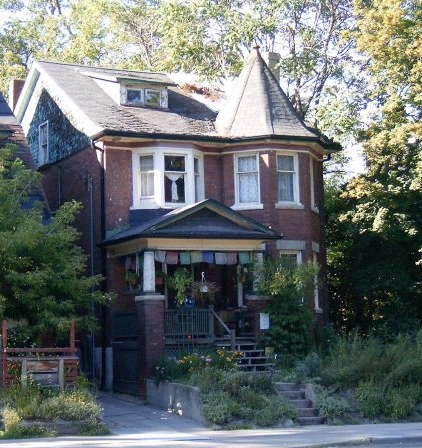
1844 Bloor St. West

1844 Bloor Street West

(1991-2010)

From fixing up the run down house in 1991, to raising my two wonderful children, planting and tending a garden, living and celebrating life with friends and family, to getting sick, to almost dying…

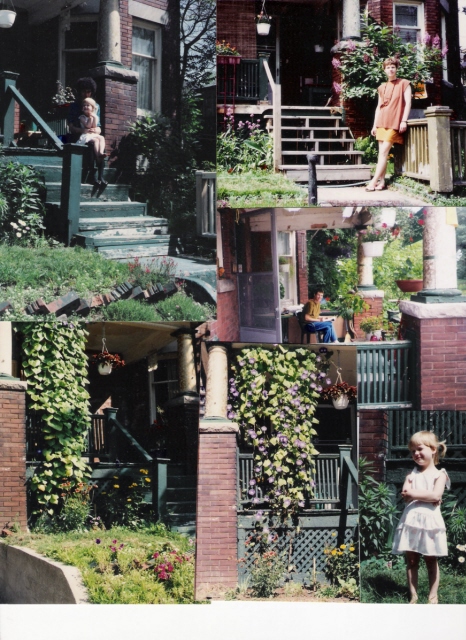
Memories of life at 1844 Bloor St W 1991-2010.

My father, daughter and son on the porch… 91 or 92.

After cleaning and painting inside, I think it took almost 20 bags to remove the weeds and garbage and unearth the garden. Only the hollyhock, a red rose, and some alyssum in the rock garden were there when I moved in.

It took a few years to get the perennial garden going. My father’s old porch railing was re-purposed as a fence for a few years. People used to smile when they went by. More people who lived on Bloor St W started planting flowers in front. People often asked me if it was my garden when I was out shoveling snow, and told me how much they enjoyed seeing the seasonal changes.

When I got too sick to care for it because of the vehicle exhaust and laundry fumes from the apartment buildings, I watched from the windows as people stole plants, rocks and other items I’d placed there.

~

Many birthdays were celebrated in 1844…

Continue reading

Not so Equal Access to Health Care in Ontario or Systemic Barriers to Access for People with MCS/ES

Some places like Ontario, where I live, have disability access laws that state service providers, including those in healthcare, must accommodate people who are disabled.

On a government website, it states:

Barriers to accessibility are obstacles that make it difficult — sometimes impossible — for people with disabilities to do the things most of us take for granted — things like going shopping, working, or taking public transit… 

(or receiving health care services)

When we think of barriers to accessibility, most of us think of physical barriers — like a person who uses a wheelchair not being able to enter a public building because there is no ramp.

The fact is there are many kinds of barriers. Some are visible. Many are invisible:

•    Attitudinal barriers are those that discriminate against people with disabilities.

•    Organizational barriers are an organization’s policies, practices or procedures that discriminate against people with disabilities.

•    Architectural and physical barriers are features of buildings or spaces that cause problems for people with disabilities.
Chemical or “environmental” barriers prevent people like myself who have disabling medical conditions from breathing and functioning properly when exposed to these invisible, toxic and disabling barriers, resulting in both short and long term impacts.

How many of us do not have safe access to healthcare in Ontario?

In the ” Guide to the Accessibility Standards for Customer Service, Ontario Regulation 429/07″,  it says that Hospitals and health services provide goods or services  and as  designated public sector organizations should have been in Compliance by January 1, 2010…

It also states:
Continue reading

Air Quality and Accessibility in Health Care; Why Aren’t All Health Care Providers Fragrance-Free?

Can you smoke in a hospital or doctor’s office? No. Why not? Because smoke adversely impacts air quality and our health (despite what the tobacco industry has tried to claim).


So why then are fragrance chemicals still allowed in these environments?

One would think that with so much information about how harmful most fragranced items are, and how easy it is to find fragrance free substitutes, that the health care profession would be the first to embrace fragrance-free, low to no VOC indoor environments for both themselves and all the sick and vulnerable people they serve. This includes children, people with asthma, autism, heart and respiratory diseases, migraines, chemical and environmental “sensitivities”, and others who are prone to having symptoms greatly exacerbated by fragrance chemicals and poor indoor air quality.

We know some fragrance ingredients cause cancer. We know some are endocrine disruptors. Some are even neuro-toxic.  Fragrance chemicals trigger asthma, allergies, migraines, and mild to life threatening symptoms in people. Some of the chemicals have been linked to early puberty in girls, reduced sperm counts in men, reproductive defects in the developing male fetus (when the mother is exposed during pregnancy),  and hormone disruption which leads to some cancers, thyroid disease, obesity, and diabetes. There is also evidence suggesting that exposure to one of the ingredients that make fragrances last longer and stick to everything may cause liver and kidney failure in young children. What more are we waiting for?

Graphics by Roslyn Rodgers, health effects text by Linda Sepp.

Continue reading

Scared or sacred?

When you encounter suffering, either your own or others’, do you close your heart in discomfort or fear and do whatever you can to distract yourself from feeling whatever comes up?

Or do you open your heart wide and approach whatever arises with compassion and kindness?

“Scared Sacred” is the 1st in a series of three films by Velcrow Ripper. It shows people who have been opening their hearts in the face of enormous suffering.

I am grateful to have run across this film now, available to view for free online via the National Film Board. (I hope the link embeds properly, I’ll also share the page link below in case it doesn’t)

Scared Sacred

In case the film did not embed above, you can find it here:

http://www.nfb.ca/film/scared_sacred


Some may wonder what MCS/ES has to do with the film, and although the connection isn’t direct, most of us who live with MCS/ES will relate. MCS/ES doesn’t exist in a vacuum… it’s all interconnected. All too often, we see and feel how people close their hearts and minds to us, choosing to use toxic and harmful products instead of changing to safer ones that would make our lives so much easier, and are also better for everyone’s health and the environment. I know of many people who are still struggling to access safe housing and health-care, all over the world, while being assaulted by toxic exposures from everyday products and materials, and by people who find it easier to ridicule than help, although fortunately, this is slowly changing as more and more people understand how their own health is also threatened by the harmful ingredients we are all exposed to.

Some very difficult personal memories of events from the past few years have been surfacing lately too, fragmented memories that I don’t know how to process yet, and the brain injury is making more difficult… Some are of human kindness, some of indifference, and others are of cruelty…

I’ve also learned that my dear 101 year old grand-mother whom I haven’t been able to see in years, is preparing to leave her body soon. It fills me with sadness that I can’t be with her, although I am grateful that for months I was able to talk with her more or less weekly until her birthday in March, it’s not at all the same as being there for her in person.

These are some of the things that are challenging me these days, and I often want to retreat from the pain, but there’s no-where to go. I try to open my heart, but it’s not always easy, yet I know my only real option is to find the love within, and to open my heart to the suffering of others, and to practice tonglen (as seen in the film) when I’m able. I also know that if we want more kindness in the world, we have to be kind with ourselves too, and that we are all in this together. I’m very fortunate to have a supportive online community, so I don’t have to feel alone during these difficult times, and I hope for a kinder, more caring world for all.

I’d like to say more, or to have said it better, but my brain isn’t co-operating. The HRV broke down almost 2 months ago and  there’s been a dearth of fresh, unpolluted, smoke-, pesticide-, fragrance- and laundry chemical free outdoor air here so my brain isn’t functioning very well. I have a jumble of thoughts, all connected in my life, without the ability to put them together now, but I can appreciate a good film when I see it.

I hope you find Scared Sacred and Velcrow’s other work as inspiring as I do.

Here’s the website where you can read more about the film: http://www.scaredsacred.org/

 
Velcrow Ripper’s second film “Fierce Light” is here: http://www.fiercelight.org/

 
He is currently editing his 3rd film, “Occupy Love”     http://occupylove.org/


Imagine VOC labels for all products, materials and buildings!

Imagine looking at a product or material and seeing if it was safe to bring indoors, or if a building was safe to breathe in, before buying or entering!

The French have developed a regulation for building materials, with a simple, easy to understand label.

* Information sur le niveau d’émission de substances volatiles dans l’air intérieur, présentant un risque de toxicité par inhalation, sur une échelle de classe allant de A+ (très faibles émissions) à C (fortes émissions).

Approximately translated as “Information on the level of risk from inhalation of toxic volatile substances in interior air on a scale of A+ (very low emissions) to C (high emissions)”

Of course, we wouldn’t NEED anything like this if products and materials were free of toxic chemicals, but since they aren’t, we need to know the risk we’re being subjected to.

So… I LOVE THIS!  And I want it required on every product, material, and building that has a VOC!

Here’s info from the source, we just need to take it a few steps further

French Regulations on VOC emissions from construction products / Compulsory VOC emissions labelling

http://www.product-testing.eurofins.com/information/compliance-with-law/european-national-legislation/french-regulation-on-voc-emissions.aspx


ACCESSIBILITY 1

Toxic chemicals in everyday laundry products!?!

During the last couple of years we’ve  seen a lot of research validating what Canaries (people with chemical sensitivities)  have been telling everyone for years: Everyday laundry products contain harmful toxic chemicals!

see: Toxic Chemicals in Fragranced Laundry Products and Health Effects

Below are links to articles and independently done (and funded) published research  that show SOME (not all) of the toxic chemicals in conventional, everyday laundry products. Chemicals  we  have 24/7 contact with, because not all of them get rinsed out of clothing and bedding… Chemicals  that get washed down our drains and  into waterways, and don’t get adequately filtered out of our drinking water… Chemicals that  if your municipality sells sewage sludge, then also get spread onto farmers fields as fertilizer (for food you buy and eat from  the supermarket)… Chemicals that get blown off laundry lines or pumped out of dryer vents (that were only designed to emit moisture) off your property and into the surrounding neighbourhood air for everyone else to breathe…

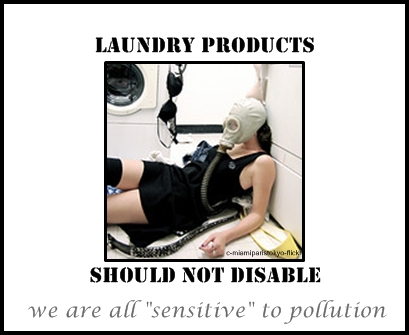
laundry products should not disable

Note that even the “natural” and fragrance-free products can contain toxic chemicals, because the industry is not regulated and they can say and do pretty much what they want.

Links updated October 24, 2015.

Continue reading

Video: Creating Healthy Home Environments for Kids: Top 5 Tips

Great new video and resources from the Canadian Partnership for Children’s Health and Environment (CPCHE). While it isn’t made for people with MCS/ES, following their advice will make the world a safer place for us all.  It should also help convince friends and family that the accommodations we need and have been asking for are good for everyone, especially children.

“Controlling house dust; switching to less-toxic, fragrance-free cleaners; taking extreme care with renovation projects; avoiding certain types and uses of plastics; and choosing fish that are low in mercury are the five priority actions recommended by the Canadian Partnership for Children’s Health and Environment (CPCHE).”

“The 12-minute video – available in English and French and complemented by supporting print resources – is designed to be a “turn-key” solution for prenatal educators and other service providers looking for ways to address growing concerns about toxic substances and associated health risks for children.”

See  www.healthyenvironmentforkids.ca for all their helpful resources, including a brochure that goes with this video.