Category Archives: Health

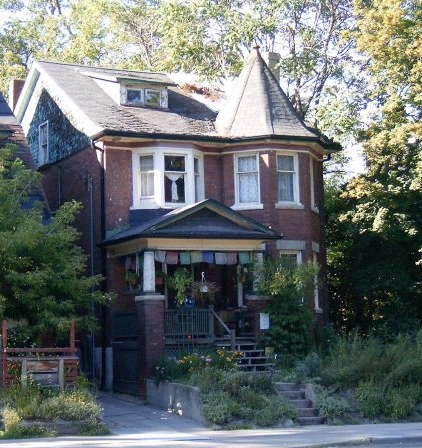
1844 Bloor St. West

1844 Bloor Street West

(1991-2010)

From fixing up the run down house in 1991, to raising my two wonderful children, planting and tending a garden, living and celebrating life with friends and family, to getting sick, to almost dying…

Memories of life at 1844 Bloor St W 1991-2010.

My father, daughter and son on the porch… 91 or 92.

After cleaning and painting inside, I think it took almost 20 bags to remove the weeds and garbage and unearth the garden. Only the hollyhock, a red rose, and some alyssum in the rock garden were there when I moved in.

It took a few years to get the perennial garden going. My father’s old porch railing was re-purposed as a fence for a few years. People used to smile when they went by. More people who lived on Bloor St W started planting flowers in front. People often asked me if it was my garden when I was out shoveling snow, and told me how much they enjoyed seeing the seasonal changes.

When I got too sick to care for it because of the vehicle exhaust and laundry fumes from the apartment buildings, I watched from the windows as people stole plants, rocks and other items I’d placed there.

~

Many birthdays were celebrated in 1844…

Continue reading

Chemical Industry Blocks Attempts to Create Healthier Buildings and Materials

Hot on the heels of several eye-popping reports about how toxic chemicals and industry bought politics are  impacting our health, including the Chicago Tribune’s expose of  how the chemical industry has succeeded in getting toxic flame retardants added to home furnishings in amounts that harm us but do nothing to prevent fires,  indeed making fires more toxic too, from Bill Walsh at the Healthy Building Network comes news of how the chemical industry is blocking efforts to create healthier buildings.

No wonder healthy housing is so hard to find!

Chemical Giants Target the USGBC: Part 1

Bill Walsh
Bill Walsh

By Bill Walsh, Executive Director
Healthy Building Network

May 22, 2012

The credibility of the US chemical industry has taken a beating in the press this month. But instead of apologizing, pledging to reform its ways, or disciplining a “few bad apples,” for being caught lying red handed, the industry has doubled down and launched an all out attack on the US Green Building Council.[1] The focus of the attack – modest amendments to the LEED Rating System, two voluntary credits that address the presence of endocrine-disrupting chemicals and other toxins in LEED-rated buildings.

continue reading at : Healthy Building Network


Air Quality and Accessibility in Health Care; Why Aren’t All Health Care Providers Fragrance-Free?

Can you smoke in a hospital or doctor’s office? No. Why not? Because smoke adversely impacts air quality and our health (despite what the tobacco industry has tried to claim).


So why then are fragrance chemicals still allowed in these environments?

One would think that with so much information about how harmful most fragranced items are, and how easy it is to find fragrance free substitutes, that the health care profession would be the first to embrace fragrance-free, low to no VOC indoor environments for both themselves and all the sick and vulnerable people they serve. This includes children, people with asthma, autism, heart and respiratory diseases, migraines, chemical and environmental “sensitivities”, and others who are prone to having symptoms greatly exacerbated by fragrance chemicals and poor indoor air quality.

We know some fragrance ingredients cause cancer. We know some are endocrine disruptors. Some are even neuro-toxic.  Fragrance chemicals trigger asthma, allergies, migraines, and mild to life threatening symptoms in people. Some of the chemicals have been linked to early puberty in girls, reduced sperm counts in men, reproductive defects in the developing male fetus (when the mother is exposed during pregnancy),  and hormone disruption which leads to some cancers, thyroid disease, obesity, and diabetes. There is also evidence suggesting that exposure to one of the ingredients that make fragrances last longer and stick to everything may cause liver and kidney failure in young children. What more are we waiting for?

Graphics by Roslyn Rodgers, health effects text by Linda Sepp.

Continue reading

Letter to health food store regarding incense

Greetings,

Regarding incense…

I started shopping full time at health food stores because of the unhealthy indoor air in regular stores, and food that tasted like laundry products as a result. More recently, I decided to look up what incense is made of after buying food that tasted like incense from sitting on the store shelf in a store that sold incense, and found some disturbing information.

” A typical composition of stick incense consists of 21% (by weight) of herbal and wood powder, 35% of fragrance material, 11% of adhesive powder, and 33% of bamboo stick. Incense smoke (fumes) contains particulate matter (PM), gas products and many organic compounds. On average, incense burning produces particulates greater than 45 mg/g burned as compared to 10 mg/g burned for cigarettes. The gas products from burning incense include CO, CO2, NO2, SO2, and others. Incense burning also produces volatile organic compounds, such as benzene, toluene, and xylenes, as well as aldehydes and polycyclic aromatic hydrocarbons (PAHs)….”

Additionally “In India, (and possibly elsewhere since it is such a common ingredient in fragrance chemistry) diethylphthalate is used extensively in the incense stick industry as a binder of perfumes. It can be emitted into the air during incense burning.”

Diethylphthalate (DEP), used as a plasticizer and a detergent base (and in many other fragranced consumer products), is a suspect carcinogen.

Like second hand smoke, pollutants emitted from incense burning in a close environment are harmful to human health. As mentioned above, particulate matters, and some of volatile organic compounds, musk ketones, musk xylenes, and musk ambrette, aldehydes, polycyclic aromatic hydrocarbons, diethylphthalate (DEP) are toxic to the lung and allergenic to the skin and eyes.

Read the full study at: http://www.clinicalmolecularallergy.com/content/6/1/3

I’m not sure what other kinds of fragranced products you carry, but hope that if you do, they’d be enclosed in glass cabinets, as they are also known to emit all kinds of health hazardous VOC’s.

see: INDOOR AIR QUALITY: Scented Products Emit a Bouquet of VOCs including some that are classified as toxic or hazardous by federal laws.
http://www.ncbi.nlm.nih.gov/pmc/articles/PMC3018511 /

Incense and other fragranced products are often unwrapped, or sold in flimsy plastic bags which do nothing to keep the VOCs  from migrating into other foods and products in the store.

I would love to be able to purchase a wide array of foods from you but I cannot, because everything that isn’t in glass or thick cellophane tastes like incense after being in the store for a while. Even those will emit incense VOCs because the labels are absorbent.

I have asked for and received some accommodation, like ordering cases of certain things, and trying to have them picked up as soon as possible to avoid cross-contamination, but since I don’t have a variety of people who can shop for me, this isn’t working out as a very effective solution. It would be much better if the foods you sold did not end up with  fragrance chemicals attached to them in the first place.

My main concern however isn’t just for myself, but for everyone who gets exposed, especially to burning incense, which might be more harmful that cigarette smoke, as the above research indicates.

I therefore believe that any store that wants to claim it is a “health” food store, should not be selling incense or any other fragranced products (that aren’t 100% certified organic).

I’m pretty sure that you’d agree after reading the research.

Please let me know if and when you can make your store a healthy incense and fragrance-free indoor environment, so that I and others will know the foods you sell have not been contaminated by harmful VOCs and are truly good for us to eat.

Kind regards,

(I’ll let you know what kind of responses I receive. Please let me know what kind of responses you receive if you use this letter as a template)