Category Archives: Health Care

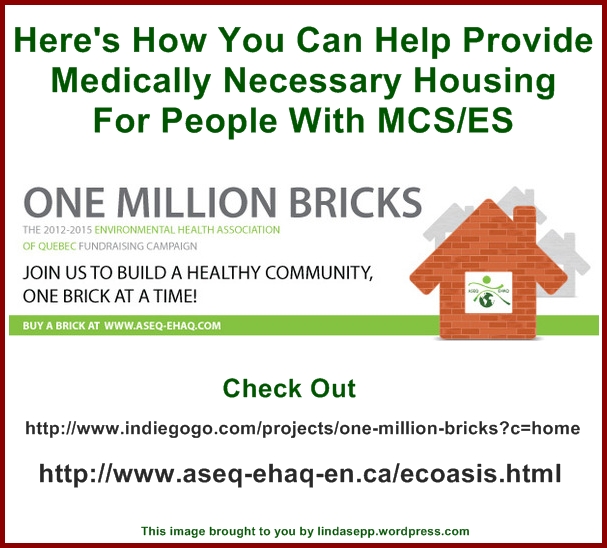
You Can Help Provide Medically Required Safe Housing!

Safe, non-toxic housing is the primary medical need of people with MCS/ES and EHS. The number of lives affected and needing this kind of medically required housing is growing, and far too little is being done by the various governments or medical associations to address the needs of all the people who are being injured and disabled by common everyday chemical and EMF/EMR exposures.

For us, safe housing is like the cast after we break a bone. It protects us and allows us to heal while preventing re-injury, especially if the housing is in an area where the outdoor air is also safe for us to breathe. Especially for those of us who have been repeatedly and seriously injured. That means no dryer vents that emit hazardous laundry chemicals, no pesticide use, or industrial emissions or busy roads nearby.

The good people at  the Environmental Health Association of Québec (ASEQ-EHAQ) see and understand the need and are working to do something about it, by developing an ECOASIS in the Laurentian Mountains of Quebec, but they need your help to make it happen.

Help Provide An ECOASIS

If you are already convinced this is a great cause to support and just want the link to where you can donate, then please click here.

If you need to know more about why this is so important, then please keep reading…

Continue reading

“You Are a Guinea Pig”

We all are!

Three articles that crossed my path today illustrate the challenges we face (trying to stay healthy) while alive. Of course there are more issues, (like fracking, GMOs and processed food) but these three are more than enough to show us that “lifestyle choices” are not enough to keep us healthy.

This article  by David Rosner and Gerald Markowitz is a must read!

You Are a Guinea Pig

How Americans Became Exposed to Biohazards in the Greatest Uncontrolled Experiment Ever Launched

“The culprit behind this silent killer is lead.  And vinyl.  And formaldehyde.  And asbestos.  And Bisphenol A.  And polychlorinated biphenyls (PCBs).  And thousands more innovations brought to us by the industries that once promised “better living through chemistry,” but instead produced a toxic stew that has made every American a guinea pig and has turned the United States into one grand unnatural experiment.”

http://www.huffingtonpost.com/david-rosner/hazardous-chemicals_b_3175796.html

“The groups that produce these miracle substances — like the petrochemical, plastics, and rubber industries, including major companies like Exxon, Dow, and Monsanto — argue that, until we can definitively prove the chemical products slowly leaching into our bodies are dangerous, we have no “right,” and they have no obligation, to remove them from our homes and workplaces. The idea that they should prove their products safe before exposing the entire population to them seems to be a foreign concept.”

Please read the whole article, it’s worth it.

guinea pig

But wait, there’s more!!!

Continue reading

Voices from the Shadows, a Film About ME/CFS From the UK

People with visible and invisible disabilities are often not only discriminated against, but far too often abused. Some of the abuse is from ignorance. Other times it is systemic and sometimes it is political.

ME/CFS, FM, and MCS/ES are often overlapping conditions. Canadian diagnosis stats with more details are here or a simple chart is at the bottom of the page here.

There are 3 dedicated clinics in Canada for diagnosing these conditions (and more, such as EHS). One is in Toronto (with a perpetual long wait list) and a new one just opened in BC with Dr Bested as the clinic director and was immediately overwhelmed with people seeking appointments. There is also one in  N.S.

Some provinces have a diagnostic code for ME/CFS now, and for FM, but not for MCS/ES. The CDC has also recognized it. In the US, people can look for doctors on the AAEM website. (there may be others, I am not as familiar with the US resources).

People in the UK and elsewhere are still trying to get proper recognition and protocols in place so that patients there are also not subjected to more abuse on top of these already devastating conditions.

Watch the trailer of the film here, then  you can link to the full length film from the Voices from the Shadows website. Continue reading

Do No Harm? Disabilities and Discrimination: Elaine’s Story

When we are disabled, we can be vulnerable to discrimination, systemic abuse, and having our basic human rights violated. Like Paul Caune points out in the film Hope Is Not A Plan, “When your civil rights are violated you don’t need a good hug, you need a good lawyer”.

At the very least, we need a good advocate by our side.

Despite Human Rights “recognition”, people with MCS/ES are systemically denied safe access to even the most basic institutions of “care” that most people take for granted  due to chemical (and attitudinal) barriers and discrimination, like with the health-care systems, the very system where our health is supposed to be cared for.  I do believe there’s even an oath that some providers take to “do no harm”, but sadly, as those of us with MCS/ES have experienced, that is rarely the case when chemical and environmental sensitivities are concerned. Add more disabilities, and it can become even more challenging and rare to have our needs met with equality, dignity, and respect.

Take Elaine for example. Elaine has MCS/ES and used a wheelchair full-time for nine years because of a hereditary neurological disorder, Spino-cerebellar ataxia.  With luck, medication, some amazing people, and a reduction in toxic environmental contaminants, her mobility is now much improved.

However, due to these disabilities, she had her basic rights violated at a time when she was most vulnerable, when she required health care.

Elaine’s Story

Continue reading

“Sensitive” to Pollution #3

"Sensitive" to Pollution 3

Is there anyone who isn’t “sensitive” to pollution?

Access to Safe and Appropriate Dental Care for People With MCS/ES: Part 3

Part 3: Things I Need to Do to Survive a Trip to the Dentist     

(I have severe MCS, the measures I need to take are not necessary for everyone)

In addition to making sure I am fully prepared for what I need in order to survive the days following a trip to the dentist (supplies, food, frozen foods, etc), I have to prepare for the actual visit. Depending on my state of brain fog and or brain injury symptoms, this can be very time consuming and challenging.

If possible, I discuss these measures in advance with staff when I make the appointment, to make sure they are prepared to accommodate my disability related needs, and can be comfortable explaining them to other patients who might have concerns when seeing me.

At the cabin, getting ready to go to the dentist
Continue reading

Access to Safe and Appropriate Dental Care for People With MCS/ES: Part 2

Access to Safe and Appropriate Dental Care for People With MCS/ES:

Part 2: Resources and Links

dental tools

What we really need are mobile dental vans that have no-VOC interiors and staff for people with severe MCS/ES, and safe and accessible dental offices and practitioners for everyone else. Until then, we need ways to protect ourselves and must often educate the dentists and staff as to how they can take care of our needs.

From mild to severe MCS/ES, different measures may be required.

Here are useful links that can help you prepare, and a sample office policy:

Continue reading

Access to Safe and Appropriate Dental Care for People With MCS/ES: Part 1

Part 1: The Problems

This is a subject I’ve been meaning to write about for quite some time, as I have my own serious dental issues much like like Doris, whose story follows.

We are dependent on ODSP and their dental program which does not cover our disability related medical needs of materials compatibility testing, safer materials or oxygen, all of which can be absolutely necessary to avoid serious health consequences from chemical exposures in dental offices and from incompatible materials.

Also, as Doris mentions below, most dentists have no experience with our specific needs.

I am aware of other people currently experiencing similar predicaments, in Ontario and elsewhere. I might be posting a few more stories as a part of this series.

We are looking for suggestions on how we can receive appropriate, safe and affordable dental care, which as we know is necessary for more than just dental health.

I will also be posting some steps and solutions available to those with adequate financial means to pay for them, but will start with the problems, and the request for assistance in finding solutions for those of us without adequate financial (and social) resources.

dental tools

What follows is Doris’s story, in her words…

Continue reading

UN and WHO say hormone-disrupting chemicals are a ‘global threat’

“Frankly, for BPA, the science is done. Flame retardants, phthalates … the science is done,” Zoeller said. “We have more than enough information on these chemicals to make the reasonable decision to ban, or at least take steps to    limit exposure.”

Phthalates are found in fragrances, laundry and other personal care and cleaning products, soft plastics, (PVC) and even in time released medications!!!

Exposures to these chemicals are currently very difficult to avoid, and require diligent personal effort and significant financial investments. But even that is not enough to avoid exposure.

edc_cover

Continue reading

Hospital Protocols for People With MCS/ES

hospital

Some hospitals around the world are developing fragrance-free policies and other less toxic practices, but most health-care environments can still be dangerous places to be for people with MCS/ES, presenting enormous challenges if health care services are needed, as I quoted from the ES-MCS Sensitivities Status Report in the post Canadian Statistics on MCS/ES.

“For ES-MCS sufferers the ideal of ‘patient-centred care’ is currently in stark contrast to realities within the health care system. Knowledgeable healthcare professionals and support workers are so few as to be virtually inaccessible most of the time. For moderately or severely chemically sensitive persons, physicians’ offices, clinics and hospitals commonly are unsafe places to wait, consult, or undergo procedures because patients can be exposed to many symptom triggers emitted from furnishings, cleaning and laundry products, disinfectants, and personal care products on staff or other patients, making their conditions worse. Fragrance/scent-free hospital, home care and rehabilitation services are very rarely available, and there are no chemically safe emergency shelters. Consequently, patients with severe chemical sensitivities may avoid seeking care, risking further deterioration and chronicity, thereby being “caught between a rock and a hard place.”

It can be a difficult decision for many of us when we experience symptoms, whether or not to have them checked out. Sometimes we wait too long, other times we just can’t go because the going is too dangerous for our health. Toni Bernhard touches upon it in Psychology Today, although MCS/ES adds another layer of complications to the decisions:  “5 Tough Choices You Face When Chronically Ill or in Pain

If a trip to the hospital is required, it’s best to be as prepared as possible. If it’s not an emergency, then your choice of the following documents can be forwarded and discussed in advance. Otherwise, carrying paper copies or discs with us at all times could be warranted, in case of emergency.

The following is a list of the best protocols and websites I’ve found, with important resources and documents for people willing and able to take the risks to advocate for themselves or to provide to others so they can do it on our behalf if we are not able.

Hopefully you have the time to go through them and choose what is most suitable for you before the need arises. With any luck, you won’t need them, but it’s good to be  prepared “just in case”. It will take a long time to prepare your local health care providers with protocols to reduce harm (we’re nowhere near the eliminate harm stage)  in advance.

A lot more needs to be done, because until the systemic issues are resolved, for too many of us, it’s far too dangerous to try to access health care.  The necessary negotiations are not feasible when severely disabled, ill, and in need of immediate care that does not exist.  These resources require the ability to work to implement. And there’s no guarantees that if you make progress once, the progress can be built on the next time, as far too often, it’s a start all over again from the beginning process.

Continue reading