Tag Archives: fragrance chemicals

Accessible Customer Service – What to do When A Store is Too Polluted to Enter

Having invisible disabilities can present challenges most people don’t think of.

Modified from original image by Eurofin

Modified from original image by Eurofin

Indoor air can be too polluted for some of us to safely breathe. Those of us with MCS/ES can develop serious and life-threatening symptoms from breathing in toxic chemicals commonly found in indoor air. Even a mask may not be enough to protect us.

Or we may be having a bad Fibromyalgia flare and just be in too much pain to shop.

So what can we do when we need something?

Continue reading

Need Protection?

To Breathe, That Is…

I was looking up masks and found these ads…
I am a bit (but not entirely) speechless…

Find a Mask to Filter Fragrance From Work HVAC Systems

“Companies across the globe are including fragrances in their heating and ventilation systems. It’s part of what emotional branding companies such as DMX call a multi-sensory experience. Retail stores may use scent in combination with audio and visual systems to enhance brand awareness. Smell associations, say DMX, are so strong they can even increase worker productivity. Whatever the reason, these scent systems can make it difficult for employees working in the affected areas who have fragrance sensitivities.”

While it won’t be possible for all workers in controlled scent environments to wear respirators, for those who can, we have a few suggestions:

http://blog.pksafety.com/a-respirator-mask-to-filter-out-fragrance-from-the-hvac/

I do know people who have to wear a mask just to go to work. It’s a horrible way to have to live when toxic chemicals are used everywhere everyday by almost everyone, and so much worse when pumped into the air deliberately. In fact, I don’t think anyone with MCS/ES or respiratory symptoms could work (or visit or shop) in an environment with deliberately pumped in fragrance chemicals, even wearing a mask.

That’s why we have human rights legislation to provide fragrance or scent free policies for working environments (see the sidebar or resources page at the top). These policies actually end up benefitting everyone’s health, not just those of us who are “sensitive”. Soon (but not soon enough) that will change to basic public health legislation, as it has for smoking.

Some multi-unit housing complexes have introduced smoke free rules, but so far there are very few housing options with fragrance free rules. We need them. Wearing a mask all day and night just isn’t feasible or possible, even if we tolerate the (mostly synthetic) materials they are made of, which many of us don’t.

Did you know there are masks for kids? These just make me really sad…

Continue reading

How My Descent to Fragrance Hell Began

Manufactured fragrance ingredients have had a huge and mostly negative impact on my life, beginning with the “Chanel No.5 Eau de Cologne” my mother used to douse herself with in the 70’s. I remember running around opening windows and doors to air out the house after my parents went out on the town.

“Chanel No.5” happens to be the first fragrance that was created with synthetic substances. Nice to have a video about that now:

(August 13, 2014: I just watched the Chanel No 5 video that I had posted here, and they have completely changed it to remove all mentions of the synthetic (and toxic) substances that they were first to use!!! I have removed the video from the post, as it is now just an insipid commercial for the perfume.)

I remember as children (in the 60’s) my sister and I were often given tiny bottles of “4711” as gifts, most likely free samples that family members received when purchasing larger bottles of it. I don’t remember it bothering me at the time.

It was during the 70’s that more and more products (shampoos, moisturizers, cleaning products, etc) started to bother me. At the time, I thought it was normal that some products just didn’t agree with me. I had no idea I was actually being poisoned by them. I even ended up in the hospital for a week of tests in my late teens, after developing stroke-like migraine symptoms while applying one of my sister’s scented facial cremes after I had spent the night back home instead of where I was living then.

No connections to products were made at the time… It was also the week I learned to read food labels, as one evening the ice cream I was given for dessert started foaming up instead of melting into a puddle while I was eating my dinner…

As a young adult, I had to search high and low for a perfume or eau de cologne that I could wear on special occasions, because we were taught that it was an important part of the ritual. I don’t think I made it through two tiny bottles of “L’Air du Temp” before having to abandon that ritual. Just reading their evocative description now leads me to a never never land, one I don’t remember if I was influenced by back in those days. (According to the Nina Ricci website’s legal notice, I am not allowed to link to their site without written authorization, so you’ll have to google it for yourself!!! But beware, the site has some annoying hurdles to go through before you get to the perfume’s page).

Now there are hundreds, if not thousands of synthetic, petro-chemical ingredients used in fragrances. And fragrance chemicals are everywhere. It is pretty much impossible to avoid them unless you are alone in the middle of no-where. They are in the air, in our water, even in our supermarket foods.

I am housebound now because fragrance chemicals are everywhere, even in my yard when others are using their dryer vents and the wind blows this way. I have a very difficult time finding even basic essentials (like baking soda, food and clothing) that are un-contaminated by fragrance ingredients. I wrote about how fragrance residues basically left me homeless in the previous post.
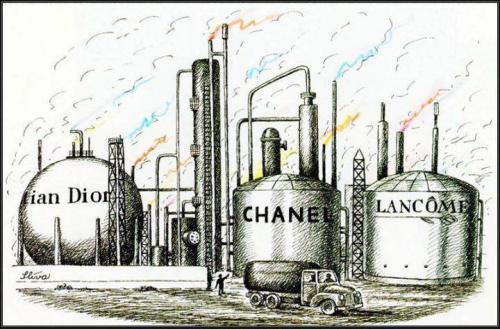
eau de petroleum

The International Fragrance Association (IFRA) reports that 3090 materials have been reported (voluntarily via membership surveys, there was no forced compliance) as being used in fragrance compounds in 2008 and updated in 2011.

Here’s the list. Some are known to be quite hazardous. Most have never been tested for safety.

Check the sidebar here > > > for some links about fragrances and their health impacts. You can also read what I’ve previously posted about them.

Fragrance chemicals are clearly just as bad, if not worse for our health than tobacco smoke. It’s time to ban toxic chemicals from fragrances. At the very least, label them on products, so people know what they are applying to their bodies and forcing everyone else to breathe. Being forced to breathe in toxic chemicals is toxic trespass.

I love clean air

Here are some fragrance free policies from around the world.

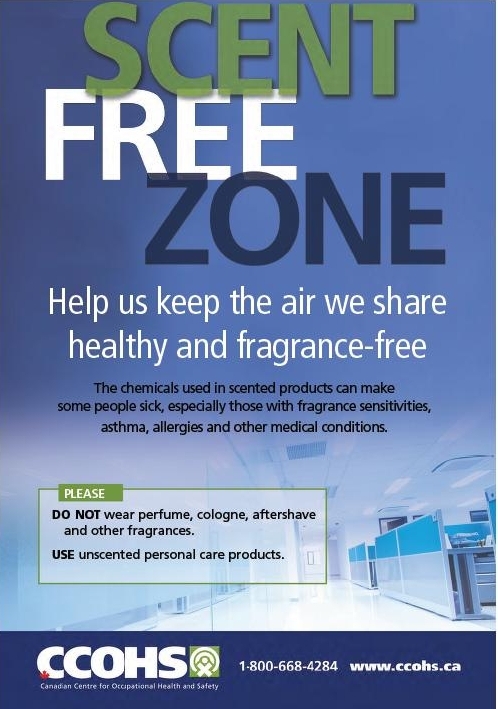
CCOHS Scent Free Zone

Ask Major Retailers to Eliminate the Toxic 100+

Mind the Store

New Mind the Store initiative calls on the largest U.S. retailers to restrict the most Hazardous 100+ chemicals.

“It’s not feasible to ask the average person to keep 100+ chemicals in their head when they go to the store”

In fact, it’s usually impossible for us to find out if and where these chemicals are lurking, and they are lurking almost everywhere! Store buyers can, however, ask their suppliers to provide supply chain information on chemicals used, and can ask for safe, non-toxic products and materials for their customers.

“Our coalition came together around a shared critique of our government’s failure to protect the public from toxic chemicals and a shared platform for how to fix our policies. But most importantly we came together with a shared moral urgency to reduce the suffering caused by chronic diseases like cancer, disabilities and autism that are linked to chemical exposure.”

What is the Hazardous 100+ list?

Continue reading

There’s WHAT in my Baking Soda?

Fragrance chemicals….

Yes, I said it… There are fragrance chemicals in much of the baking soda sold now… Even in the baking soda you bake with. Unless you are extremely lucky… and there’s no rhyme or reason as to when it might be fragrance free, because no-one who might know will tell as to why there are any problems with it in the first place.

For months now, I haven’t been able to get any baking soda that isn’t fragrance (or otherwise) pre-contaminated… and I use it instead of soap products, which I don’t tolerate, to clean me, my teeth, my clothes and everything else that needs cleaning… Because my body doesn’t tolerate soap, even organic olive oil soap, probably because there’s something about modern lye that doesn’t agree with me…

If I lived in a cave, it might not matter, but I’m stuck here in the suburbs, and despite being housebound, there are people who make assumptions on my rare appearances outdoors, like when I have to go to the recycling and garbage bins… And I am just well enough to notice, and to care… And it just doesn’t feel good physically, or emotionally…

P1400358

My local Bulk Barn store owner picking up 50 lbs of fragrance contaminated baking soda during a February snowstorm

The most recent Arm and Hammer bulk sample, was even worse than the previous one, although the type of contamination is different…
The owner/manager says he took the sample from a brand new bag he just cut open and used the jar I had given him when he picked up the 50 lbs of fragrance contaminated baking soda I’d purchased in December. He was even so kind as to deliver the jar full.

Arm and Hammer is saying there is no way their stuff is contaminated before it goes in the bag, Bulk Barn won’t tell me who the middle man is, and the bags are really unlikely to pick up contamination during the time between anyway – but I’ve had fragrance contamination on the INSIDE of the bag, when the outside had no fragrance residue.

Continue reading

Phthalates in Supermarket Foods

Finally.

Someone tested it.

And just like many of us who have MCS/ES have been saying for years:

Supermarket food is contaminated with fragrance and plastic chemicals.

supermarket food contaminated

Continue reading

Women’s Voices for the Earth Report on “Secret Scents”

Women’s Voices for the Earth recently released a new report, called “Secret Scents“. It  highlights the need for ingredient transparency by the companies that create fragranced products, since right now we have almost no way of knowing what is causing the fragrance allergies and other serious health effects people experience when exposed to  fragrances. These adverse health effects are increasing, especially in children.

Amazingly, companies are not required by the FDA or EPA to disclose fragrance ingredients, so it is difficult for anyone to pinpoint specific fragrance allergens and sensitizers among the hundreds of ingredients that can make up a scent.

Another report  was also just released, this one on endocrine disrupting chemicals. Some fragrance ingredients, like phthalates (see below) are also endocrine disruptors, while others are known carcinogens and/or neurotoxic!

Continue reading

Toxic Chemicals in Air “Fresheners” and Health Effects

Some people wonder what the fuss about air”fresheners”  is all about.

Air”fresheners” do not freshen the air. In fact, they make the air harmful to breathe!

Thank goodness we have people like Dr Anne Steinemann to tell us what some of the ingredients that harm our health actually are.

Continue reading

Toxic Chemicals in Fragranced Laundry Products and Health Effects

toxic chemicals in laundry products

Some people wonder what the fuss about laundry products is all about.

What follows is Dr Anne Steinemann’s research on specific chemicals and their health effects. These are not just benign additives. They cause serious harm, and they are accumulating in ourselves and the environment, where they also harm other species.

Toxic Chemicals in Fragranced Laundry Products and Health Effects

Principal Investigator: Anne C. Steinemann, Professor, Civil and Environmental Engineering, and Public Affairs, University of Washington.

Chemicals identified by gas chromatography/mass spectrometry (GC/MS) headspace analysis.

Health and regulatory information obtained from databases compiled by the National Institutes of Health, Environmental Protection Agency, and other federal agencies.

Note that fragranced consumer products are not required to disclose all chemicals, not even ones classified as toxic or hazardous. None of these chemicals were listed on any product label or material safety data sheet.

ACETALDEHYDE (75-07-0)
Recognized Carcinogen
Suspected Developmental Toxicant, Immunotoxicant, Kidney Toxicant, Neurotoxicant, Respiratory Toxicant, Skin or Sense Organ Toxicant
Regulated as toxic/hazardous chemical under the following law(s):
Air Contaminants (OSH Act); Hazardous Air Pollutants (CAA); Hazardous Substances (CERCLA); Regulated Toxic, Explosive, or Flammable Substances (CAA); Toxic Release Inventory Chemicals (EPCRA)

Continue reading

EAA Urges Precaution on Wireless, GMO’s, Nanotechnology and More

For those of you who like to keep up on these things, here’s another new report urging more precaution on wireless, GMO’s, nanotechnology, and more. Our current system allows new things to be unleashed on us without proper safety testing and precaution.  At 750 (free) pages, it’s a bit longer than a tweet or a fb update, but delving into it could change your life, and give you the resources to help create more urgently required changes around you.