Finally.
Someone tested it.
And just like many of us who have MCS/ES have been saying for years:
Supermarket food is contaminated with fragrance and plastic chemicals.


Finally.
Someone tested it.
And just like many of us who have MCS/ES have been saying for years:
Supermarket food is contaminated with fragrance and plastic chemicals.
Posted in Accessibility, Chemicals, Environmental Health, Fragrance, Images, Public Health
Tagged Food, Fragrance, fragrance chemicals, fragrance in food, health, images, phthalates
Some people wonder what the fuss about air”fresheners” is all about.
Air”fresheners” do not freshen the air. In fact, they make the air harmful to breathe!
Thank goodness we have people like Dr Anne Steinemann to tell us what some of the ingredients that harm our health actually are.

“Frankly, for BPA, the science is done. Flame retardants, phthalates … the science is done,” Zoeller said. “We have more than enough information on these chemicals to make the reasonable decision to ban, or at least take steps to limit exposure.”
Phthalates are found in fragrances, laundry and other personal care and cleaning products, soft plastics, (PVC) and even in time released medications!!!
Exposures to these chemicals are currently very difficult to avoid, and require diligent personal effort and significant financial investments. But even that is not enough to avoid exposure.

Simple images with catchy phrases are popular these days. I recently discovered that the photo program on my computer has more features to play with, and my brain is finally capable of a little bit of exploring. Computer graphics is something very different from the manual art I’ve learned and practiced in my life, so my attempts will surely improve over time as I learn more about the technology, as well as recover my visual brain functions and co-ordination.
I thought I’d share some of my early attempts here. Feel free to download and use in a not for profit way if you find them useful. However, if you want to use them in any money making ways, please discuss it with me first.
Dear Canadian Cosmetic, Toiletry and Fragrance Association,
How about not hiding behind lax government regulations?
Sincerely,
Me
In the letter I received from them (included below) they claim that: “it is illegal to sell cosmetics or other personal care products that would cause harm when used as intended”
Really?
Then why are so many people getting asthma, headaches, chemical sensitivities, and some other serious and disabling effects from their products?

CCTFA hides behind lax regulations
Posted in Chemicals, Fragrance and Cosmetics, Government, Health, Images
Tagged beauty, Fragrance, fragrance chemicals, health, images, Story of Cosmetics, toxic chemicals
Some places like Ontario, where I live, have disability access laws that state service providers, including those in healthcare, must accommodate people who are disabled.
On a government website, it states:
Barriers to accessibility are obstacles that make it difficult — sometimes impossible — for people with disabilities to do the things most of us take for granted — things like going shopping, working, or taking public transit…
(or receiving health care services)
When we think of barriers to accessibility, most of us think of physical barriers — like a person who uses a wheelchair not being able to enter a public building because there is no ramp.
The fact is there are many kinds of barriers. Some are visible. Many are invisible:
• Attitudinal barriers are those that discriminate against people with disabilities.
• Organizational barriers are an organization’s policies, practices or procedures that discriminate against people with disabilities.
• Architectural and physical barriers are features of buildings or spaces that cause problems for people with disabilities.
Chemical or “environmental” barriers prevent people like myself who have disabling medical conditions from breathing and functioning properly when exposed to these invisible, toxic and disabling barriers, resulting in both short and long term impacts.
How many of us do not have safe access to healthcare in Ontario?

In the ” Guide to the Accessibility Standards for Customer Service, Ontario Regulation 429/07″, it says that Hospitals and health services provide goods or services and as designated public sector organizations should have been in Compliance by January 1, 2010…
It also states:
Continue reading
Posted in Disability, Government, Health Care, Human Rights, Multiple Chemical Sensitivities
Tagged Accessibility Standards for Customer Service, AOHC Scent-free, Fragrance, health care access for people with MCS/ES, health care discrimination, MCS/ES, MCS/ES systemic discrimination, Med Visit, National Access Awareness Week Ontario 2012, ODSP, safe health care
There have been questions about whether or not the CDC (Center for Disease Control) recognizes MCS.
Their Indoor Environmental Quality Policy from 2009 explicitly states:
“Fragrance is not appropriate for a professional work environment, and the use of some products with fragrance may be detrimental to the health of workers with chemical sensitivities, allergies, asthma, and chronic headaches/migraines.” …
Potential hazards include chemicals, biological agents, fragrant products, and physical conditions that may cause irritation, illness, or exacerbate existing health conditions.
Here are a few more excerpts:
During the last couple of years we’ve seen a lot of research validating what Canaries (people with chemical sensitivities) have been telling everyone for years: Everyday laundry products contain harmful toxic chemicals!
see: Toxic Chemicals in Fragranced Laundry Products and Health Effects
Below are links to articles and independently done (and funded) published research that show SOME (not all) of the toxic chemicals in conventional, everyday laundry products. Chemicals we have 24/7 contact with, because not all of them get rinsed out of clothing and bedding… Chemicals that get washed down our drains and into waterways, and don’t get adequately filtered out of our drinking water… Chemicals that if your municipality sells sewage sludge, then also get spread onto farmers fields as fertilizer (for food you buy and eat from the supermarket)… Chemicals that get blown off laundry lines or pumped out of dryer vents (that were only designed to emit moisture) off your property and into the surrounding neighbourhood air for everyone else to breathe…
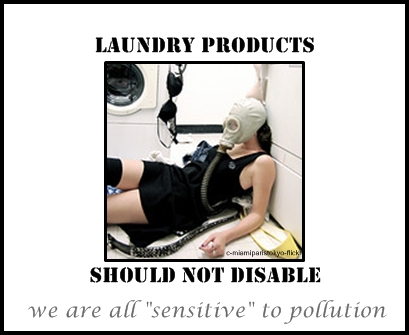
Note that even the “natural” and fragrance-free products can contain toxic chemicals, because the industry is not regulated and they can say and do pretty much what they want.
Links updated October 24, 2015.
Tobacco smoke contains so many harmful chemicals causing health problems, that smoking has been banned from most public indoor environments. Work remains to be done in shared housing, where neighbours are forced to breathe in 2nd and 3rd hand smoke.
Since fragrances also have many harmful chemicals, including too many of the same chemicals found in tobacco smoke, they should also be banned from indoor environments. Well, (unless certified organic), they should just be banned period since they also pollute the outdoor air when expelled from dryer vents, and also pollute our waterways.
Just like sitting in a smoky room for 10 minutes will make your hair and clothes smell like smoke, sitting in a fragranced room for 10 minutes will do the same. In fact, foods absorb smoke and fragrance too, including those that can’t be washed (breads, salt, etc) and if you are attending a wine tasting event, you’re asked not to smoke or wear fragrances since they interfere with people’s ability to taste and smell.
Most fragrance chemicals weren’t designed to be eaten (although IFF would probably beg to differ ) and most of us certainly don’t want to be eating plastics, do we? Makes you wonder why phthalates are found in drugs and supplements? Especially since so much evidence is mounting regarding harm.
So what to do? One might assume that shopping for food, especially organic food, at health food stores (HFSs) would be safer. One would be thinking wrong if the HFS sell fragranced products and incense, which is linked to asthma, dermatitis, and cancer, and most HFSs do sell these products.
They don’t sell cigarettes, which are even triple wrapped despite not containing any VOC’s when unlit, yet the incense and other fragranced products are often unwrapped, or sold in flimsy plastic bags which do nothing to contain the VOCs, or keep them from migrating into other foods and products in the store.
I don’t know about you, but when I pay extra for organic foods, I don’t want them tasting like incense or other fragrance chemicals. I don’t want to be eating phthalates and BPA, so I avoid plastics, I don’t want to be breathing in the chemicals in tobacco smoke, yet buying food from most stores means these toxic chemicals are getting into the foods they sell.
Buying veggies and fruit from farmer’s markets, CSA‘s or organic delivery services usually eliminates this problem, but some warehouses have so-called air”fresheners” or allow staff to use scented soaps etc, which end up leaving residues on the food, and not all kinds of foods are available from these sources.
Food should not be kept in the same air space as these toxic chemicals. Volatile toxic chemicals should be sealed in impenetrable packaging as long as they are still legal. Stores that sell both food and items that contain volatile chemicals should be required to separate the fragranced items from the foods, including using different ventilation systems. It shouldn’t be so difficult for anyone, let alone those of us with a medical need, to find safe, chemical and fragrance free foods.
Is it right that people who suffer chemical injuries and are disabled as a result are abandoned by the systems designed to help other people?
By Linda Sepp.
 In her report to the Ontario Disabilities Support Program in February 2006 when the Special Diet allowance was revised, Dr. Lynn Marshall, the previous director of the Environmental Health Clinic at Sunnybrook & Women’s College Hospital, outlined my health needs as follows:
The most effective means of managing this condition is by avoidance of known triggering chemicals, and minimization of exposure to other “everyday” synthetic environmental chemicals in food, water, air, and consumer products. As with intolerances to foods themselves, it is highly challenging and expensive to minimize such exposures.
She (Ms Sepp) requires food (water, air, and consumer products) containing the lowest possible amounts of synthetic chemicals permanently to help maintain, and hopefully improve, her health status
In a letter regarding my housing needs she wrote:
Dear _____,
If Ms. Sepp is exposed to allergens or triggers such as in scented products, laundry and cleaning products, carpeting, particle-board, pesticides, moulds, wireless technologies, etc. she suffers from inability to concentrate, poor memory, profound fatigue and muscle weakness that makes it difficult for her to walk, migraine headaches, and generalized muscle pain.
In order to avoid repeated episodes of such severe symptoms, Ms. Sepp must avoid exposure to her allergens and chemical and electromagnetic triggers.
… she is in urgent need of safe housing, a situation she has been unable to rectify since I saw her in 2005, and that her health has deteriorated considerably since then. In my opinion, from my further communication with her, if Ms. Sepp is unable to live in safe housing to meet her special needs, it is probable she will require ongoing help and assistance with activities of daily living. As it is, she requires assistance when shopping for groceries due to her deteriorating health and the increased use of strong fragrance and air freshener chemicals being used and sold in grocery stores, some of which cannot be effectively removed from areas they have been used.
Ms. Sepp is unable to use a public or shared laundromat due to the chemicals used in regular laundry products, which severely impair her ability to function. She requires her own washing machine at home to avoid these triggering substances.
She also requires whole house water filtration (like that available in the Environmental Health Clinic, Dallas) to filter all the water including for cooking and drinking, as well as for washing clothes and bedding.
…She cannot share air with other people, either by HVAC or through cracks in units or shared hallways and requires a detached two bedroom home in a chemically safe area.
In my view, it is urgent that some mechanism be found to assist Ms. Sepp to locate a suitable home to prevent even more suffering and deterioration in her already extremely compromised health.
Yours truly,
Lynn M. Marshall MD FAAEM FRSM MCFP
From a submission to ODSP, Dr Armstrong writes:
Posted in Government, Health Care, Housing
Tagged Chemicals, Food, Fragrance, Human Rights
 | linda @ Seriously "S… on MCS/ES |
| linda @ Seriously "S… on The CDC and MCS |
 | Tabatha Schnorr on MCS/ES |
| Tabatha Schnorr on The CDC and MCS |
| linda @ Seriously "S… on MCS and Housing |
| linda @ Seriously "S… on Hospital Protocols for People… |


 Seriously "Sensitive" to Pollution