Tag Archives: laundry

Fragrance: A Barrier to Access

Fragrance a Barrier to Access

Fragrance: A Barrier to Access

When you choose, use and wear products with fragrance, you create chemical barriers to access for people who are disabled when exposed to the toxic chemicals allowed in fragrances.
To be air safe and disability friendly, choose fragrance-free laundry and personal care products, and avoid dryer sheets and fabric softeners.

Not so Equal Access to Health Care in Ontario or Systemic Barriers to Access for People with MCS/ES

Fashion victim


In her blog post  Fashion victim,  Alysha writes about discovering the need for precaution when choosing her clothing, and mentions how my blog post on Greenpeace’s efforts to Detox Fashion helped open her eyes.

Thanks Alysha!

Neigbourhood Pollution

This device emits unregulated toxic chemicals to the entire neighborhood when you use conventional laundry products

Continue reading

Detox Fashion (thank you Greenpeace)

Greenpeace is running an excellent campaign to detox the fashion industry. Sadly, textiles these days are full of toxic chemicals, chemicals which are harming the health and environment everywhere in their life-cycle, where they are made, and where they are used.

This video shows a bit of the background:

You might wonder why water pollution in China is a problem for us?

from: How to get rid of chemicals in fabrics. (Hint: trick question.)

http://oecotextiles.wordpress.com/2010/11/10/how-to-get-rid-of-chemicals-in-fabrics-hint-trick-question/

“How do these chemicals get into our bodies from the textiles?  Your skin is the largest organ of your body, and it’s highly permeable.  So skin absorption is one route; another is through inhalation of the chemicals (if they are the type that evaporate – and if they do evaporate, each chemical has a different rate of evaporation, from minutes or hours to weeks or years) and a third route:  Think of microscopic particles of fabric that abrade each time we use a towel, sit on a sofa, put on our clothes.  These microscopic particles fly into the air and then we breathe them in or ingest them.  Or they  fall into the dust of our homes, where people and pets, especially crawling children and pets, continue to breathe or ingest them.”

Going after  manufacturers to detox their practices is a logical step.

And it’s working:

Levi’s shapes up to become a Detox leader
http://www.greenpeace.org/canada/en/Blog/levis-shapes-up-to-become-a-detox-leader/blog/43437/

read more here:

Toxic Threads – Product Testing Results
http://www.greenpeace.org/international/en/campaigns/toxics/water/detox/Toxic-Threads/

And if you can’t wait that long for safer clothing, you can check the list of safeR options listed in the “CHEMICAL-FREE CLOTHING (WE WISH)” tab at the top of the page here and then work on detoxing those at home using decontamination protocols found here: https://seriouslysensitivetopollution.wordpress.com/2012/09/08/laundry-decontamination-protocols/

P.S.

I forgot to mention that if you are trying to get toxic chemicals out of your clothing, using conventional, everyday laundry products isn’t going to get you non-toxic clothes… Not when the laundry products themselves are full of toxic chemicals: https://seriouslysensitivetopollution.wordpress.com/2012/04/03/toxic-chemicals-in-everyday-laundry-products/


Chemical-free clothing (we wish)

I’ve just added a new page to the top of the blog.

If you are looking for safer clothing, textiles, footwear or bedding, I’m adding links of places that offer them to hopefully make the search a little bit easier, since so many people land on this blog when searching for chemical-free clothing.

Since the level of sensitivities varies between people, there’s no way to say that something will be safe for everyone, or how many washings it might take to make something safe.

Some of the places deal with chemically sensitive clientele on a regular basis. This doesn’t mean that you can assume they know what you as an individual might need, so please be very clear if you have severe sensitivities. Discuss in advance the circumstances for returns also, as it’s unlikely anyone will accept anything that has been washed a dozen times if it still isn’t safe enough for you.

Some places will wrap things in extra cellophane or foil or even plastic, if postal fragrance and pesticide residues are of concern. Other places might not be willing to do that. Ask, and ask nicely.

This list is just a starting point for people who are searching, and will be a work in progress… Also, if I only listed places that met my standards in all areas, there wouldn’t be a list… And I’d be naked…

See the list here (or click on the tab at the top of the page):

https://seriouslysensitivetopollution.wordpress.com/chemical-free-clothing-we-wish/  

Friendship and Fragrance

There are reasons people choose and enjoy isolation, but developing disabling adverse effects from the toxic chemicals in everyday products and materials is seldom one of them.

Do you know someone who says fragrances bother or disable them? Chances are pretty good that you do, now that 34.7% of the population experience adverse effects, ranging from mild to severe and disabling, from fragrance exposures.

When your friend, family member, or colleague informs you that something you use has an adverse effect on them, how would you respond?

Do you choose the friendship? Or the product?

Continue reading

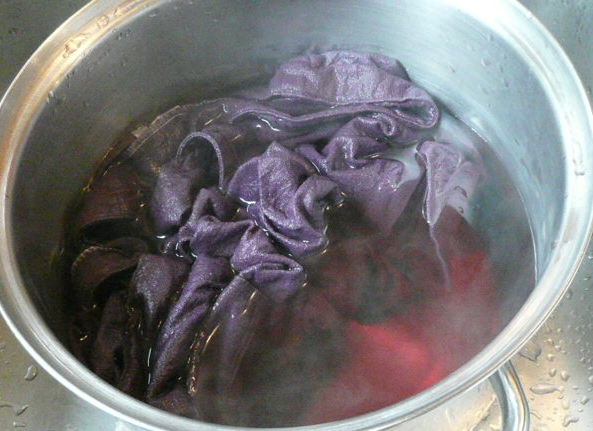
Laundry Decontamination Protocols

Safe clothing can be a huge challenge for people with MCS/ES. Most clothing is not chemical free. Even organic clothing can be treated and finished with the same toxic chemicals found in regular clothes (see link at the end of this post for more details)

Sometimes it is possible to detox regular clothing. For mildly sensitive people it might just take a few regular washes with a tolerable detergent. For more sensitive people, a more involved protocol may do the trick. For others, we often end up without much in the way of clothing and bedding, because even the trace chemicals can be too much.

Here are some methods many people have used to successfully detox their clothing. As always, individual results may vary according to personal sensitivities, water conditions, products available, and whatever might be in the clothing to begin with.
Updated Version of Ellen’s Laundry Decontamination Protocol

Originally posted at MCS-Canadian-Sources and at The Canary Report        (copied with permission)

When I joined the MCS… list in 2005, I learned what other members of the list were doing to decontaminate their new clothes. I made some changes, the main one being that I soak the new items in plastic bins, rather than soaking them in my washing machine.

I have an expensive front-loading washing machine, with a maximum soaking time of 35 minutes, which is totally inadequate for decontaminating new or really smelly fabrics. I continue to make changes as I find problems or improvements.

If you have a top-loading washing machine, soaking times can be set much longer, because the timer can be turned off after the soaking ingredient and machine water are completely mixed.
I am including the latest version of my protocol here.

Please note that I have only tested this protocol on cotton, cotton/bamboo blends, cotton/polyester blends, and a very few totally synthetic fabrics. It is not safe to use on silk.

Continue reading

Toxic chemicals in everyday laundry products!?!

During the last couple of years we’ve  seen a lot of research validating what Canaries (people with chemical sensitivities)  have been telling everyone for years: Everyday laundry products contain harmful toxic chemicals!

see: Toxic Chemicals in Fragranced Laundry Products and Health Effects

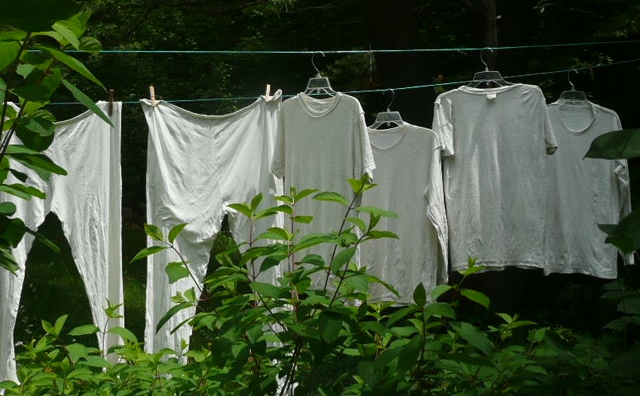
Below are links to articles and independently done (and funded) published research  that show SOME (not all) of the toxic chemicals in conventional, everyday laundry products. Chemicals  we  have 24/7 contact with, because not all of them get rinsed out of clothing and bedding… Chemicals  that get washed down our drains and  into waterways, and don’t get adequately filtered out of our drinking water… Chemicals that  if your municipality sells sewage sludge, then also get spread onto farmers fields as fertilizer (for food you buy and eat from  the supermarket)… Chemicals that get blown off laundry lines or pumped out of dryer vents (that were only designed to emit moisture) off your property and into the surrounding neighbourhood air for everyone else to breathe…

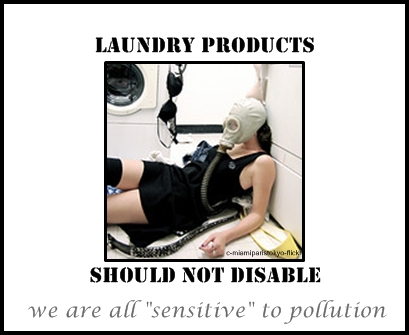
laundry products should not disable

Note that even the “natural” and fragrance-free products can contain toxic chemicals, because the industry is not regulated and they can say and do pretty much what they want.

Links updated October 24, 2015.

Continue reading

Water filtration for washing machines?

I’m hoping some day to get a washing machine, but the whole house water filtration that was installed here does not filter the water sufficiently to safely wash my clothes with. I would also have problems with the rubber residues from most hoses.

In Toronto we rigged up a Y hose with a shower filter to one of the intakes on the old machine, and controlled the water temperature manually from the taps instead of via machine, but the water pressure was nearly non-existent in that house.

I’ve been told that regular shower filters would crack from the water pressure in a place with normal water pressure if used on a washing machine.

Does anyone know if there are any water filters that are designed to be safely attached to washing machines?

My clothing issues

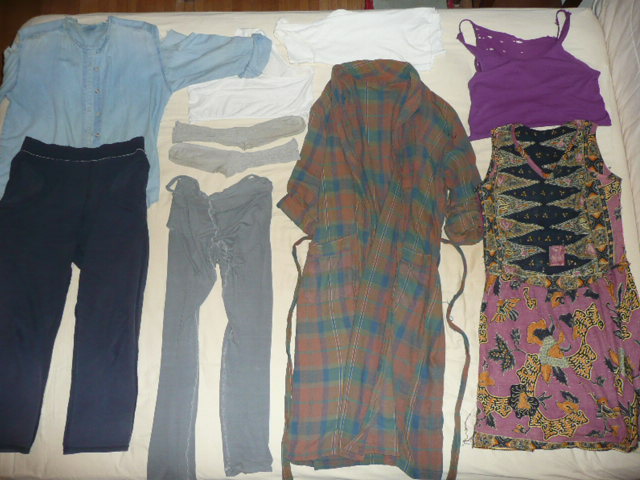
This is my entire collection of safe clothing: about a dozen pieces. I have nothing else I can wear.

By Linda Sepp.

Many of you have over-stuffed walk-in closets full of clothing. Every day you choose from a wide assortment of seasonally appropriate clothes to wear to work or out to play.

I can put everything I can wear into a regular sized (plastic) grocery bag. Look above to see a photo of what I’m wearing these days.

I live in Toronto, Canada, and depend upon Ontario Disability Support Program for all my income (ODSP is provincial welfare for the disabled) because I have severe Multiple Chemical Sensitivities/Environmental Sensitivities (MCS/ES).

In addition to these fine clothes, I have another pair of underwear, a tank top, and a t-shirt which was being washed when I took this photo.

This is my entire collection of safe clothing. I have nothing else I can wear.

Some of these pieces are so shredded they will not withstand another wash (the purple tank top, the blue shirt, but the grey leggings might have one more wash in them, the socks are developing holes which get larger when washed, not sure how long they will last–it’s is my one safe pair).

I wear all these items at the same time to be warm enough, taking off the robe, black summer capri pants with worn out elastic waist, and blue shirt only when I go to bed.

The other clothes (and the t-shirt not pictured) I wear 24/7 (except for the 12 or so hours I must wait for them to dry after a rare washing).

Continue reading