Category Archives: Environment

Air Quality and Accessibility in Health Care; Why Aren’t All Health Care Providers Fragrance-Free?

Can you smoke in a hospital or doctor’s office? No. Why not? Because smoke adversely impacts air quality and our health (despite what the tobacco industry has tried to claim).


So why then are fragrance chemicals still allowed in these environments?

One would think that with so much information about how harmful most fragranced items are, and how easy it is to find fragrance free substitutes, that the health care profession would be the first to embrace fragrance-free, low to no VOC indoor environments for both themselves and all the sick and vulnerable people they serve. This includes children, people with asthma, autism, heart and respiratory diseases, migraines, chemical and environmental “sensitivities”, and others who are prone to having symptoms greatly exacerbated by fragrance chemicals and poor indoor air quality.

We know some fragrance ingredients cause cancer. We know some are endocrine disruptors. Some are even neuro-toxic.  Fragrance chemicals trigger asthma, allergies, migraines, and mild to life threatening symptoms in people. Some of the chemicals have been linked to early puberty in girls, reduced sperm counts in men, reproductive defects in the developing male fetus (when the mother is exposed during pregnancy),  and hormone disruption which leads to some cancers, thyroid disease, obesity, and diabetes. There is also evidence suggesting that exposure to one of the ingredients that make fragrances last longer and stick to everything may cause liver and kidney failure in young children. What more are we waiting for?

Graphics by Roslyn Rodgers, health effects text by Linda Sepp.

Continue reading

Letter to health food store regarding incense

Greetings,

Regarding incense…

I started shopping full time at health food stores because of the unhealthy indoor air in regular stores, and food that tasted like laundry products as a result. More recently, I decided to look up what incense is made of after buying food that tasted like incense from sitting on the store shelf in a store that sold incense, and found some disturbing information.

” A typical composition of stick incense consists of 21% (by weight) of herbal and wood powder, 35% of fragrance material, 11% of adhesive powder, and 33% of bamboo stick. Incense smoke (fumes) contains particulate matter (PM), gas products and many organic compounds. On average, incense burning produces particulates greater than 45 mg/g burned as compared to 10 mg/g burned for cigarettes. The gas products from burning incense include CO, CO2, NO2, SO2, and others. Incense burning also produces volatile organic compounds, such as benzene, toluene, and xylenes, as well as aldehydes and polycyclic aromatic hydrocarbons (PAHs)….”

Additionally “In India, (and possibly elsewhere since it is such a common ingredient in fragrance chemistry) diethylphthalate is used extensively in the incense stick industry as a binder of perfumes. It can be emitted into the air during incense burning.”

Diethylphthalate (DEP), used as a plasticizer and a detergent base (and in many other fragranced consumer products), is a suspect carcinogen.

Like second hand smoke, pollutants emitted from incense burning in a close environment are harmful to human health. As mentioned above, particulate matters, and some of volatile organic compounds, musk ketones, musk xylenes, and musk ambrette, aldehydes, polycyclic aromatic hydrocarbons, diethylphthalate (DEP) are toxic to the lung and allergenic to the skin and eyes.

Read the full study at: http://www.clinicalmolecularallergy.com/content/6/1/3

I’m not sure what other kinds of fragranced products you carry, but hope that if you do, they’d be enclosed in glass cabinets, as they are also known to emit all kinds of health hazardous VOC’s.

see: INDOOR AIR QUALITY: Scented Products Emit a Bouquet of VOCs including some that are classified as toxic or hazardous by federal laws.
http://www.ncbi.nlm.nih.gov/pmc/articles/PMC3018511 /

Incense and other fragranced products are often unwrapped, or sold in flimsy plastic bags which do nothing to keep the VOCs  from migrating into other foods and products in the store.

I would love to be able to purchase a wide array of foods from you but I cannot, because everything that isn’t in glass or thick cellophane tastes like incense after being in the store for a while. Even those will emit incense VOCs because the labels are absorbent.

I have asked for and received some accommodation, like ordering cases of certain things, and trying to have them picked up as soon as possible to avoid cross-contamination, but since I don’t have a variety of people who can shop for me, this isn’t working out as a very effective solution. It would be much better if the foods you sold did not end up with  fragrance chemicals attached to them in the first place.

My main concern however isn’t just for myself, but for everyone who gets exposed, especially to burning incense, which might be more harmful that cigarette smoke, as the above research indicates.

I therefore believe that any store that wants to claim it is a “health” food store, should not be selling incense or any other fragranced products (that aren’t 100% certified organic).

I’m pretty sure that you’d agree after reading the research.

Please let me know if and when you can make your store a healthy incense and fragrance-free indoor environment, so that I and others will know the foods you sell have not been contaminated by harmful VOCs and are truly good for us to eat.

Kind regards,

(I’ll let you know what kind of responses I receive. Please let me know what kind of responses you receive if you use this letter as a template)

Scared or sacred?

When you encounter suffering, either your own or others’, do you close your heart in discomfort or fear and do whatever you can to distract yourself from feeling whatever comes up?

Or do you open your heart wide and approach whatever arises with compassion and kindness?

“Scared Sacred” is the 1st in a series of three films by Velcrow Ripper. It shows people who have been opening their hearts in the face of enormous suffering.

I am grateful to have run across this film now, available to view for free online via the National Film Board. (I hope the link embeds properly, I’ll also share the page link below in case it doesn’t)

Scared Sacred

In case the film did not embed above, you can find it here:

http://www.nfb.ca/film/scared_sacred


Some may wonder what MCS/ES has to do with the film, and although the connection isn’t direct, most of us who live with MCS/ES will relate. MCS/ES doesn’t exist in a vacuum… it’s all interconnected. All too often, we see and feel how people close their hearts and minds to us, choosing to use toxic and harmful products instead of changing to safer ones that would make our lives so much easier, and are also better for everyone’s health and the environment. I know of many people who are still struggling to access safe housing and health-care, all over the world, while being assaulted by toxic exposures from everyday products and materials, and by people who find it easier to ridicule than help, although fortunately, this is slowly changing as more and more people understand how their own health is also threatened by the harmful ingredients we are all exposed to.

Some very difficult personal memories of events from the past few years have been surfacing lately too, fragmented memories that I don’t know how to process yet, and the brain injury is making more difficult… Some are of human kindness, some of indifference, and others are of cruelty…

I’ve also learned that my dear 101 year old grand-mother whom I haven’t been able to see in years, is preparing to leave her body soon. It fills me with sadness that I can’t be with her, although I am grateful that for months I was able to talk with her more or less weekly until her birthday in March, it’s not at all the same as being there for her in person.

These are some of the things that are challenging me these days, and I often want to retreat from the pain, but there’s no-where to go. I try to open my heart, but it’s not always easy, yet I know my only real option is to find the love within, and to open my heart to the suffering of others, and to practice tonglen (as seen in the film) when I’m able. I also know that if we want more kindness in the world, we have to be kind with ourselves too, and that we are all in this together. I’m very fortunate to have a supportive online community, so I don’t have to feel alone during these difficult times, and I hope for a kinder, more caring world for all.

I’d like to say more, or to have said it better, but my brain isn’t co-operating. The HRV broke down almost 2 months ago and  there’s been a dearth of fresh, unpolluted, smoke-, pesticide-, fragrance- and laundry chemical free outdoor air here so my brain isn’t functioning very well. I have a jumble of thoughts, all connected in my life, without the ability to put them together now, but I can appreciate a good film when I see it.

I hope you find Scared Sacred and Velcrow’s other work as inspiring as I do.

Here’s the website where you can read more about the film: http://www.scaredsacred.org/

 
Velcrow Ripper’s second film “Fierce Light” is here: http://www.fiercelight.org/

 
He is currently editing his 3rd film, “Occupy Love”     http://occupylove.org/


Imagine VOC labels for all products, materials and buildings!

Imagine looking at a product or material and seeing if it was safe to bring indoors, or if a building was safe to breathe in, before buying or entering!

The French have developed a regulation for building materials, with a simple, easy to understand label.

* Information sur le niveau d’émission de substances volatiles dans l’air intérieur, présentant un risque de toxicité par inhalation, sur une échelle de classe allant de A+ (très faibles émissions) à C (fortes émissions).

Approximately translated as “Information on the level of risk from inhalation of toxic volatile substances in interior air on a scale of A+ (very low emissions) to C (high emissions)”

Of course, we wouldn’t NEED anything like this if products and materials were free of toxic chemicals, but since they aren’t, we need to know the risk we’re being subjected to.

So… I LOVE THIS!  And I want it required on every product, material, and building that has a VOC!

Here’s info from the source, we just need to take it a few steps further

French Regulations on VOC emissions from construction products / Compulsory VOC emissions labelling

http://www.product-testing.eurofins.com/information/compliance-with-law/european-national-legislation/french-regulation-on-voc-emissions.aspx


ACCESSIBILITY 1

The CDC and MCS

There have been questions about whether or not the CDC (Center for Disease Control) recognizes MCS.

Their Indoor Environmental Quality Policy from 2009 explicitly states:

Fragrance is not appropriate for a professional work environment, and the use of some products with fragrance may be detrimental to the health of workers with chemical sensitivities, allergies, asthma, and chronic headaches/migraines.” …

Potential hazards include chemicals, biological agents, fragrant products, and physical conditions that may cause irritation, illness, or exacerbate existing health conditions.

Here are a few more excerpts:

Continue reading

Toxic chemicals in everyday laundry products!?!

During the last couple of years we’ve  seen a lot of research validating what Canaries (people with chemical sensitivities)  have been telling everyone for years: Everyday laundry products contain harmful toxic chemicals!

see: Toxic Chemicals in Fragranced Laundry Products and Health Effects

Below are links to articles and independently done (and funded) published research  that show SOME (not all) of the toxic chemicals in conventional, everyday laundry products. Chemicals  we  have 24/7 contact with, because not all of them get rinsed out of clothing and bedding… Chemicals  that get washed down our drains and  into waterways, and don’t get adequately filtered out of our drinking water… Chemicals that  if your municipality sells sewage sludge, then also get spread onto farmers fields as fertilizer (for food you buy and eat from  the supermarket)… Chemicals that get blown off laundry lines or pumped out of dryer vents (that were only designed to emit moisture) off your property and into the surrounding neighbourhood air for everyone else to breathe…

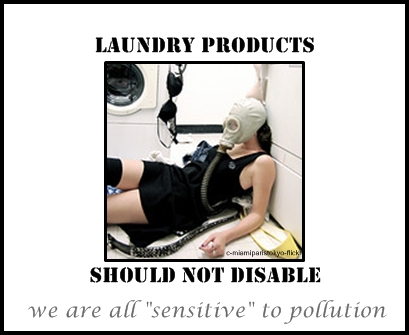
laundry products should not disable

Note that even the “natural” and fragrance-free products can contain toxic chemicals, because the industry is not regulated and they can say and do pretty much what they want.

Links updated October 24, 2015.

Continue reading

Members of EU Parliament recommend recognizing and protecting people with MCS and EHS

Written declaration on the recognition of multiple chemical sensitivity and electrohypersensitivity in the International Statistical Classification of Diseases and Related Health Problems (ICD)

The European Parliament,

– having regard to its resolution of 4 September 2008 on the mid-term review of the European Environment and Health Action Plan 2004-2010, particularly recital J thereof,

– having regard to Decision 1350/2007/EC establishing a second programme of Community action in the field of health (2008-2013), and the White Paper ‘Together for Health’ (COM(2007)0630),

– having regard to its resolution of 2April 2009 on health concerns associated with electromagnetic fields,

– having regard to Rule 123 of its Rules of Procedure,

A. whereas health inequalities between different European countries should be eradicated;

B. whereas multiple chemical sensitivity (MCS) patients are vulnerable to environmental pollution and electrohypersensitivity (EHS) patients to electromagnetic radiation, both involving serious risks in several areas over which they have no influence, such as the air they breathe and exposure to EM radiation;

1. Recommends that Member States which have not yet done so include MCS and EHS in their own ICDs and in their ILO-based Lists of Occupational Diseases; suggests that the WHO Assembly include MCS and EHS in its upcoming ICD-11;

2. Urges Member State governments to apply existing rules regarding EM radiation and exposure to harmful substances and to apply the precautionary principle strictly, with effective health and environmental measures, in order to immediately protect those affected, whose number is growing exponentially;

3. Suggests harmonising the rules on physical agents and harmful substances in the Member States, on the basis of the strictest existing criteria, and also placing controls on imported products;

4. Instructs its President to forward this declaration, together with the names of the signatories, to the Council, the Commission and the parliaments of the Member States.

PDF

The Peoples Declaration


“A group of people came together over a period of three months to discuss the laws needed to protect people and planet. This document is the outcome of those discussions. 36 people collaborated on the document for three months in early 2011 – The Peoples Declaration is the final outcome of their collaboration. The Declaration is a document which we believe all the people in the world can support and we ask you to join us in spreading this document to others to use as well.”

It’s a beautiful, powerful declaration, and starts off with:

“We the people say now is the time to act. It is the will of the people to end the pollution. It is the will of the people to create a world of peace and better standards of life for all in larger freedom.”

It  continues here: http://www.thepeoplesdeclaration.com/

Video: Creating Healthy Home Environments for Kids: Top 5 Tips

Great new video and resources from the Canadian Partnership for Children’s Health and Environment (CPCHE). While it isn’t made for people with MCS/ES, following their advice will make the world a safer place for us all.  It should also help convince friends and family that the accommodations we need and have been asking for are good for everyone, especially children.

“Controlling house dust; switching to less-toxic, fragrance-free cleaners; taking extreme care with renovation projects; avoiding certain types and uses of plastics; and choosing fish that are low in mercury are the five priority actions recommended by the Canadian Partnership for Children’s Health and Environment (CPCHE).”

“The 12-minute video – available in English and French and complemented by supporting print resources – is designed to be a “turn-key” solution for prenatal educators and other service providers looking for ways to address growing concerns about toxic substances and associated health risks for children.”

See  www.healthyenvironmentforkids.ca for all their helpful resources, including a brochure that goes with this video.

Video: Multiple Chemical Sensitivity: How Chemical Exposures May Be Affecting Your Health

An older but still relevant documentary about MCS, featuring patients, parents, doctors and more…
“Interviews with leading physicians and people whose lives have been changed by chemical sensitivity.”
Produced and directed by Alison Johnson, with cinematography and editing by Richard Startzman. Visit http://www.alisonjohnsonmcs.com for more information and to order this film or Alison Johnson’s book Casualties of Progress: Personal Histories from the Chemically Sensitive, which contains the the stories of the people appearing in this film.