Category Archives: Indoor Air Quality

UnStopped and Able Until…

I have heard that new ads are out and insinuating people will somehow feel richer  merely by inhaling mysterious blends of chemicals.  Please don’t be fooled. Seriously.

“Unstopables …  will add an indulgent level of luxurious scent to every load of your laundry. Add as much as you wish for up to 12 weeks* of scent enhancement so you can smell like the lifestyle you—and your wardrobe—deserve.”

They fail to mention that your neighbors who get migraines may think that the “scent enhancement” emanating from your dryer vent (which was designed to emit moisture, not chemicals) is not such a good thing for them, their asthmatic children, or for their aging parents who have lung disease and whose window is yards from your vent.

Apparently we also don’t deserve to know what we’d be inhaling if we use these things! P&G will only refer us to the self-regulated fragrance industry’s voluntarily disclosed list of over 3000 ingredients, most of which are petroleum derived. (Scroll down for a PDF of the list, which took quite a bit of sleuthing around their other website to find).

I’ve designed a few new ads for them, simplifying some of their marketing messages into plain English for you :
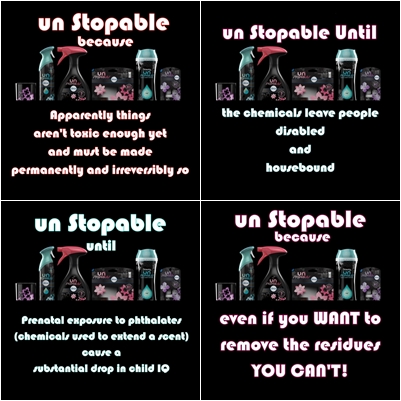
UnStopped and Able Until

There’s more, much more…

Continue reading

How To (Legally) Poison Your Baby’s Air

It should be illegal to sell products that disperse secret, unregulated, ingredients into the air people have to breathe, especially children.

Children need clean air to breathe! Clean air is air without petrochemicals in it.

fragranced baby poison 1These things emit hazardous chemicals. It is not cute or fresh to poison kids!

It’s time to stop and think about what is going into the air we expect children to breathe.

Breathing is not optional!

When children’s hospitals enact policies banning fragrance use on their premises, you know there are good reasons to be concerned:

Continue reading

It’s Not Personal, It’s The Chemicals #2

The images in the 1st It’s Not Personal, It’s The Chemicals  were so popular, I decided to make more while my brain was functioning in this mode. Here are a couple that were very well received on facebook, plus a few new ones featuring children and office workers, as they too are being impacted by what we choose to use and put in the air.

It s not you 16

It s not you children

Continue reading

Breath-taking: An architectural answer to one homeowner’s severe allergies

Safe, medically required, non-toxic, EMF/EMR safe housing CAN be built. I linked to another article and the architect’s website in the 1st comment below.
“Because Barbara Tudhope has severe allergies and acute sensitivities to dust, pollen, electromagnetic radiation (EMF) and a long list of construction materials, the couple designed their home to foster an environment that doesn’t cause her any adverse reaction.

… “Almost all construction and renovation uses building materials that off-gas volatile organic compounds [VOCs], and contractors generally pay little attention to electrical and magnetic fields in the homes they build,” says Mr. Tudhope, a business writer. “But both can have serious acute and chronic health consequences for someone like Barbara, and, in truth, for almost anyone.”

Featured Image -- 5368

More Reasons and Resources to go Fragrance Free

If fragrances and the products they are added to didn’t contain so many seriously  harmful ingredients which pollute the air we all breathe, the clothing we wear, the water we drink, and the soil we grow the foods we eat in, there wouldn’t be a need to go fragrance-free. Strangely, the fragrance industry has seen fit to include a vast array of toxic, petrochemical pollutants and highly allergenic substances in their products.

Here are some resources to use in making schools, workplaces and homes safer places to be. Some are new, some I’ve already linked to in other places on this site.

Hope you find them helpful.

access safe

from  The CDC and MCS

The CDC Indoor Environmental Quality Policy from 2009 explicitly states:

“Fragrance is not appropriate for a professional work environment, and the use of some products with fragrance may be detrimental to the health of workers with chemical sensitivities, allergies, asthma, and chronic headaches/migraines.” …

Potential hazards include chemicals, biological agents, fragrant products, and physical conditions that may cause irritation, illness, or exacerbate existing health conditions” …

Continue reading

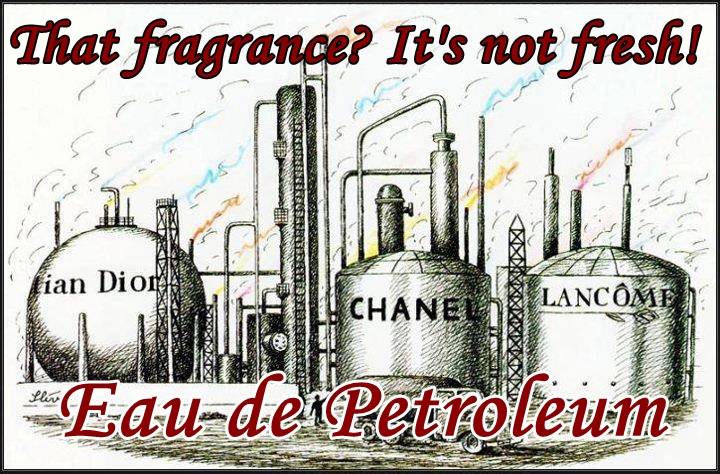
That fragrance? It’s not fresh!

eau de not fresh

That fragrance?  It’s not fresh!

Secret Scents How Hidden Fragrance Allergens Harm Public Health (WVE)

Toxic Chemicals in Fragranced Laundry Products and Health Effects

Toxic Chemicals in Air “Fresheners” and Health Effects

Fragrance Decision Undermines EPA’s DfE Program

Allergic to a World Full of Cats

(check the sidebar and tags for additional links)

Property Manager’s Guides to MCS

From the Centre for Equality Rights in Accommodation (CERA):

Environmental Sensitivities and Housing

Every year, CERA receives a significant number of calls from tenants being made ill from the poor indoor air quality in their apartment buildings. Most of these individuals suffer from environmental sensitivities and are particularly sensitive to contaminants in the air. With funding assistance from the Ontario Trillium Foundation, CERA recently launched HomeSafe, an initiative to educate tenants and multi-unit housing providers on strategies to improve indoor air quality and create healthier living environments.

The resources section has some excellent documents that are designed to “help landlords, property managers, and co-operative and condominium boards of directors reduce the health impacts associated with multi-unit housing and create living environments that are as safe and “green” as possible… and make their properties more attractive…”

For example:

Continue reading

The Trouble With Soot

Soot (and ‘by’products) from burning wood, diesel, coal or other fossil fuels are bad enough for the planet, but did you know that those particles attract harmful chemicals (secondary organic molecules) from the air so when we breathe them in, their adverse health effects can be multiplied?

smokestack earth

Here’s a must see two and a half minute video from The Allegheny Front, a radio program covering environmental issues in Pennsylvania.

Continue reading

AXE (LYNX) Axed From Another School!

Children of all ages, as well as teachers, require healthy environments to thrive in. Schools, unfortunately, have notoriously poor indoor air quality.

One thing that contributes to poor IAQ is the use of fragrance chemicals in cleaning products, as well as in personal care and laundry products.

These chemicals do nothing to enhance the air quality, and much to induce cognitive and neurological impairments, sperm damage and respiratory problems.

Boys who overused sprays such as Axe Body Spray have prompted the Brandon School Division to ban perfumes and colognes.

Boys who overused sprays such as Axe Body Spray have prompted the Brandon School Division to ban perfumes and colognes. (Canadian Press) / via CBC

Over-use of these products is not the real problem.

The real problem is that these products contain toxic chemicals and serious allergens, and these chemicals and allergens do not respect personal boundaries or property lines, but trespass into everyone’s air, brains and bodies.

Continue reading

Fragrance-Free and Healthy Schools (updated)

Are you sick from sick schools?

How Healthy is Your SchoolTeachers and students suffer when school buildings are not healthy, sometimes even developing permanently disabling conditions as a result.

MCS/ES. Asthma. Autism. Learning disabilities. Behavior problems…

Unhealthy school buildings can present real barriers to access.

It shouldn’t be like that. You shouldn’t lose your health or your job or have your child’s health and future suffer because there’s something unhealthy in the air at school.

There are enough examples of the benefits of a healthy learning environment over an unhealthy one (from toxic chemicals, molds and wi-fi for example), and tools for how to make change happen.

Here are some resources (in no particular order):

Continue reading