Category Archives: Products

The Alternative Shopping List: Becoming a Caring Consumer

Can you grow it or make it yourself?

If not, then consider the following:

1. Do I really need this? Is there anything I can use instead?

Here’s where the joys of ingenuity come in. It’s fun to find  substitutes. For instance, do you really need a nightgown  or pajamas when a big shirt will do as well?

2. How will this item affect the quality of my life?

Will it help me engage in life more fully, like sheet music or gardening supplies or a swim suit? Or will it just make me more passive – like an extra TV?

3. Is the cost of the item worth the amount of time it takes to earn the money to buy it?
This is the question suggested by Dominguez and Robin in Your Money or Your Life.  For instance,
How many hours do you have to work to buy your daily espressos?
Is it worth it?
You may say yes, but at least you’ve thought about it.

Continue reading

Chemical-free clothing (we wish)

I’ve just added a new page to the top of the blog.

If you are looking for safer clothing, textiles, footwear or bedding, I’m adding links of places that offer them to hopefully make the search a little bit easier, since so many people land on this blog when searching for chemical-free clothing.

Since the level of sensitivities varies between people, there’s no way to say that something will be safe for everyone, or how many washings it might take to make something safe.

Some of the places deal with chemically sensitive clientele on a regular basis. This doesn’t mean that you can assume they know what you as an individual might need, so please be very clear if you have severe sensitivities. Discuss in advance the circumstances for returns also, as it’s unlikely anyone will accept anything that has been washed a dozen times if it still isn’t safe enough for you.

Some places will wrap things in extra cellophane or foil or even plastic, if postal fragrance and pesticide residues are of concern. Other places might not be willing to do that. Ask, and ask nicely.

This list is just a starting point for people who are searching, and will be a work in progress… Also, if I only listed places that met my standards in all areas, there wouldn’t be a list… And I’d be naked…

See the list here (or click on the tab at the top of the page):

https://seriouslysensitivetopollution.wordpress.com/chemical-free-clothing-we-wish/  

Undisclosed chemicals in fragranced products (new video)

Independent researcher Dr. Anne Steinemann was recently interviewed by Dr. Joseph Mercola about undisclosed toxic chemicals found in laundry products, air fresheners, cleaners, lotions and other (mostly) fragranced consumer products.

She will be testing foods found in supermarkets for fragrance chemicals. Many of us have had to stop buying food from supermarkets etc because they taste like fragrance and cleaning product chemicals.

She also notes that just because a product is “fragrance free”, doesn’t mean it really is, or that it doesn’t contain other harmful chemicals.

Important, worthwhile interview, especially if you don’t know what all the “fragrance-free” fuss is about.

For more info, see Dr. Steinemann’s website

Chemical Industry Blocks Attempts to Create Healthier Buildings and Materials

Hot on the heels of several eye-popping reports about how toxic chemicals and industry bought politics are  impacting our health, including the Chicago Tribune’s expose of  how the chemical industry has succeeded in getting toxic flame retardants added to home furnishings in amounts that harm us but do nothing to prevent fires,  indeed making fires more toxic too, from Bill Walsh at the Healthy Building Network comes news of how the chemical industry is blocking efforts to create healthier buildings.

No wonder healthy housing is so hard to find!

Chemical Giants Target the USGBC: Part 1

Bill Walsh
Bill Walsh

By Bill Walsh, Executive Director
Healthy Building Network

May 22, 2012

The credibility of the US chemical industry has taken a beating in the press this month. But instead of apologizing, pledging to reform its ways, or disciplining a “few bad apples,” for being caught lying red handed, the industry has doubled down and launched an all out attack on the US Green Building Council.[1] The focus of the attack – modest amendments to the LEED Rating System, two voluntary credits that address the presence of endocrine-disrupting chemicals and other toxins in LEED-rated buildings.

continue reading at : Healthy Building Network


Letter to health food store regarding incense

Greetings,

Regarding incense…

I started shopping full time at health food stores because of the unhealthy indoor air in regular stores, and food that tasted like laundry products as a result. More recently, I decided to look up what incense is made of after buying food that tasted like incense from sitting on the store shelf in a store that sold incense, and found some disturbing information.

” A typical composition of stick incense consists of 21% (by weight) of herbal and wood powder, 35% of fragrance material, 11% of adhesive powder, and 33% of bamboo stick. Incense smoke (fumes) contains particulate matter (PM), gas products and many organic compounds. On average, incense burning produces particulates greater than 45 mg/g burned as compared to 10 mg/g burned for cigarettes. The gas products from burning incense include CO, CO2, NO2, SO2, and others. Incense burning also produces volatile organic compounds, such as benzene, toluene, and xylenes, as well as aldehydes and polycyclic aromatic hydrocarbons (PAHs)….”

Additionally “In India, (and possibly elsewhere since it is such a common ingredient in fragrance chemistry) diethylphthalate is used extensively in the incense stick industry as a binder of perfumes. It can be emitted into the air during incense burning.”

Diethylphthalate (DEP), used as a plasticizer and a detergent base (and in many other fragranced consumer products), is a suspect carcinogen.

Like second hand smoke, pollutants emitted from incense burning in a close environment are harmful to human health. As mentioned above, particulate matters, and some of volatile organic compounds, musk ketones, musk xylenes, and musk ambrette, aldehydes, polycyclic aromatic hydrocarbons, diethylphthalate (DEP) are toxic to the lung and allergenic to the skin and eyes.

Read the full study at: http://www.clinicalmolecularallergy.com/content/6/1/3

I’m not sure what other kinds of fragranced products you carry, but hope that if you do, they’d be enclosed in glass cabinets, as they are also known to emit all kinds of health hazardous VOC’s.

see: INDOOR AIR QUALITY: Scented Products Emit a Bouquet of VOCs including some that are classified as toxic or hazardous by federal laws.
http://www.ncbi.nlm.nih.gov/pmc/articles/PMC3018511 /

Incense and other fragranced products are often unwrapped, or sold in flimsy plastic bags which do nothing to keep the VOCs  from migrating into other foods and products in the store.

I would love to be able to purchase a wide array of foods from you but I cannot, because everything that isn’t in glass or thick cellophane tastes like incense after being in the store for a while. Even those will emit incense VOCs because the labels are absorbent.

I have asked for and received some accommodation, like ordering cases of certain things, and trying to have them picked up as soon as possible to avoid cross-contamination, but since I don’t have a variety of people who can shop for me, this isn’t working out as a very effective solution. It would be much better if the foods you sold did not end up with  fragrance chemicals attached to them in the first place.

My main concern however isn’t just for myself, but for everyone who gets exposed, especially to burning incense, which might be more harmful that cigarette smoke, as the above research indicates.

I therefore believe that any store that wants to claim it is a “health” food store, should not be selling incense or any other fragranced products (that aren’t 100% certified organic).

I’m pretty sure that you’d agree after reading the research.

Please let me know if and when you can make your store a healthy incense and fragrance-free indoor environment, so that I and others will know the foods you sell have not been contaminated by harmful VOCs and are truly good for us to eat.

Kind regards,

(I’ll let you know what kind of responses I receive. Please let me know what kind of responses you receive if you use this letter as a template)

Imagine VOC labels for all products, materials and buildings!

Imagine looking at a product or material and seeing if it was safe to bring indoors, or if a building was safe to breathe in, before buying or entering!

The French have developed a regulation for building materials, with a simple, easy to understand label.

* Information sur le niveau d’émission de substances volatiles dans l’air intérieur, présentant un risque de toxicité par inhalation, sur une échelle de classe allant de A+ (très faibles émissions) à C (fortes émissions).

Approximately translated as “Information on the level of risk from inhalation of toxic volatile substances in interior air on a scale of A+ (very low emissions) to C (high emissions)”

Of course, we wouldn’t NEED anything like this if products and materials were free of toxic chemicals, but since they aren’t, we need to know the risk we’re being subjected to.

So… I LOVE THIS!  And I want it required on every product, material, and building that has a VOC!

Here’s info from the source, we just need to take it a few steps further

French Regulations on VOC emissions from construction products / Compulsory VOC emissions labelling

http://www.product-testing.eurofins.com/information/compliance-with-law/european-national-legislation/french-regulation-on-voc-emissions.aspx


ACCESSIBILITY 1

Toxic chemicals in everyday laundry products!?!

During the last couple of years we’ve  seen a lot of research validating what Canaries (people with chemical sensitivities)  have been telling everyone for years: Everyday laundry products contain harmful toxic chemicals!

see: Toxic Chemicals in Fragranced Laundry Products and Health Effects

Below are links to articles and independently done (and funded) published research  that show SOME (not all) of the toxic chemicals in conventional, everyday laundry products. Chemicals  we  have 24/7 contact with, because not all of them get rinsed out of clothing and bedding… Chemicals  that get washed down our drains and  into waterways, and don’t get adequately filtered out of our drinking water… Chemicals that  if your municipality sells sewage sludge, then also get spread onto farmers fields as fertilizer (for food you buy and eat from  the supermarket)… Chemicals that get blown off laundry lines or pumped out of dryer vents (that were only designed to emit moisture) off your property and into the surrounding neighbourhood air for everyone else to breathe…

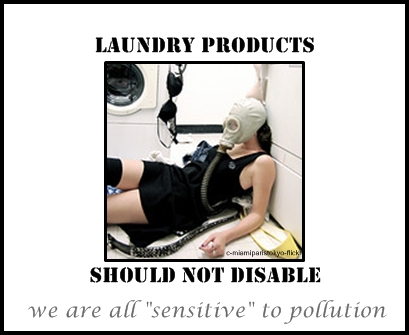
laundry products should not disable

Note that even the “natural” and fragrance-free products can contain toxic chemicals, because the industry is not regulated and they can say and do pretty much what they want.

Links updated October 24, 2015.

Continue reading

Water filtration for washing machines?

I’m hoping some day to get a washing machine, but the whole house water filtration that was installed here does not filter the water sufficiently to safely wash my clothes with. I would also have problems with the rubber residues from most hoses.

In Toronto we rigged up a Y hose with a shower filter to one of the intakes on the old machine, and controlled the water temperature manually from the taps instead of via machine, but the water pressure was nearly non-existent in that house.

I’ve been told that regular shower filters would crack from the water pressure in a place with normal water pressure if used on a washing machine.

Does anyone know if there are any water filters that are designed to be safely attached to washing machines?

HRVs are great! Unless…


I love having a heat recovery ventilation system (HRV).  It’s a system that expels stale (or toxic air) and brings in some kind of filtered fresh air from outside.

It’s great, unless it’s not working or is sucking in toxic chemicals from the outdoor air.

Someone recently asked me how I was able to keep so many of my things, including some that might still be off-gassing toxic chemicals, and the HRV is the answer. Without the HRV I would have to give up even more of my possessions than I already did.

The one here has broken down a number of times since I arrived, leaving me without fresher indoor air  for days, or even weeks at a time, which is a problem because my brain becomes sluggish when I don’t have decent air to breathe…

The unit here is 17+ years old, and the company doesn’t offer activated carbon filled filters for the model that was installed. Activated carbon filters would be helpful, even necessary for people with MCS to have, since the carbon in those filters helps remove things like the toxic VOCs from laundry products, woodsmoke, BBQ fuels, etc (name your outdoor poisons). Instead, I have had to turn the unit off whenever those fumes are being sucked inside, and turn it back on when it’s safe to do so again, when the air outside is no longer saturated, usually when the wind has changed directions, or late at night after people stop doing laundry and shut down their  fireplaces.  That might be why this unit has been breaking down, in addition to its age, it might not have been designed to be shut off and on so frequently.

I did find a place (NEEDS) that sells custom made filters for furnaces and they could make some for the HRV, but they would cost around $50 each + shipping, and would need to be replaced every 3 months. The current filters, which are provided, cost about $10 each. They won’t provide the carbon ones, and I can’t afford them on my own.

If I could find a fragrance free medical professional who would make a house-call, they could fill out forms and ODSP might fund them, since I heard they do fund furnace filters, but I haven’t been able to find any healthcare professional willing to do so despite the Accessibility Standards… but that’s a blog post for another day…

In the meantime, I’ll leave you with some links below, in case you want to explore HRV’s and filters

How to Get the Ventilation That You Need in Your House

http://www.cmhc-schl.gc.ca/en/co/maho/yohoyohe/inaiqu/inaiqu_009.cfm

Heat Recovery Ventilator
Natural Resources Canada’s Office of Energy Efficiency

http://oee.nrcan.gc.ca/publications/residential/hrv/7884

Types of filters available by one brand (there are others, this was just the 1st that came up in my search for carbon filters)

http://www.venmar.ca/en/filtrationpage.aspx

Custom made filters with activated carbon

http://www.needs.com/prod_detail_list/eea_Furnace_Filters/a

What do tobacco smoke, fragrance chemicals, food, drugs, supplements, health food stores and incense have in common?

Tobacco smoke contains so many harmful chemicals causing health problems, that smoking has been banned from most public indoor environments. Work remains to be done in shared housing, where neighbours are forced to breathe in 2nd and 3rd hand smoke.

Since fragrances  also have  many harmful chemicals,  including too many  of the same chemicals found in tobacco smoke, they should also be banned from indoor environments. Well, (unless  certified organic), they should just be banned period  since they also pollute the outdoor air when expelled from dryer vents, and also pollute our  waterways.

Just like sitting in a smoky room for 10 minutes will make your hair and clothes smell like smoke, sitting in a fragranced room for 10 minutes will do the same. In fact, foods absorb smoke   and fragrance too, including those that can’t be washed (breads, salt, etc) and if you are attending a wine tasting event, you’re asked not to smoke or wear fragrances since they interfere with people’s ability to taste and smell.

Most fragrance chemicals weren’t designed to be eaten (although IFF would probably beg to differ ) and most of us certainly don’t want to be eating plastics, do we? Makes you wonder why phthalates  are found in drugs and supplements?    Especially since so much evidence is mounting regarding harm.

So what to do? One might assume that shopping for food, especially organic food, at health food stores (HFSs) would be safer. One would be thinking wrong if the HFS sell  fragranced products and  incense, which is linked to asthma, dermatitis,   and cancer,    and most HFSs do sell these products.

They don’t sell cigarettes, which are even triple wrapped despite not containing any VOC’s when unlit, yet the incense and other fragranced products are often unwrapped, or sold in flimsy plastic bags which do nothing to contain the VOCs, or keep them from migrating into other foods and products in the store.

I don’t know about you, but when I pay extra for organic foods, I don’t want them tasting like incense or other fragrance chemicals. I don’t want to be eating phthalates and BPA, so I avoid plastics, I don’t want to be breathing in the chemicals in tobacco smoke, yet buying food from most stores means these toxic chemicals are getting into the foods they sell.

Buying veggies and fruit from farmer’s markets,    CSA‘s    or organic delivery services usually eliminates this problem, but some warehouses have so-called air”fresheners”     or allow staff to use scented soaps   etc, which end up leaving residues on the food, and not all kinds of foods are available from these sources.

Food should not be kept in the same air space as these toxic chemicals. Volatile toxic chemicals should be sealed in impenetrable packaging as long as they are still legal. Stores that sell both food and items that contain volatile chemicals  should be required to separate the fragranced items from the foods, including using different ventilation systems.  It shouldn’t be so difficult for anyone, let alone those of us with a medical need,  to find safe, chemical and fragrance free foods.