Public Health Warning
Fragrance chemicals are linked to so many health problems now that they should be banned from indoor environments just like smoking.


Fragrance chemicals are linked to so many health problems now that they should be banned from indoor environments just like smoking.
Posted in Accessibility, Fragrance, Health, Images, Indoor Air Quality, Pollution, Public Health
Tagged asthma, environment, environmental sensitivities, Fragrance, fragrance chemicals, fragrance-free policy, hazardous air pollutants, Housing, images, indoor air quality, multiple chemical sensitivities, phthalates, smoke-free, toxic chemicals
Dr. L. Christine Oliver is an Associate Professor of Clinical Medicine at Harvard Medical School and Co-Director of Occupational and Environmental Medicine at Massachusetts General Hospital.
This is an excellent half hour presentation.
Dr Oliver packs so much about the issues faced by people with MCS into the first 16 minutes of this video. If you can’t watch the whole video, at least watch this much. Alison Johnson finishes off by reading from her important book Amputated Lives.
Alison Johnson is the author/producer/director of books and documentaries on Multiple Chemical Sensitivity. Visit http://www.alisonjohnsonmcs.com to download a transcript or to purchase her books or DVDs.

Posted in Accessibility, Disability, Environmental Health, Health Care, Multiple Chemical Sensitivities, Public Health
Tagged chemical exposures, environmental sensitivities, Fragrance, fragrance-free policy, health, health care access for people with MCS/ES, Housing, indoor air quality, MCS and CDC, MCS video, MCS/ES, sensitive to pollution, smoke-free, suicide, video
Safe, non-toxic housing is the primary medical need of people with MCS/ES and EHS. The number of lives affected and needing this kind of medically required housing is growing, and far too little is being done by the various governments or medical associations to address the needs of all the people who are being injured and disabled by common everyday chemical and EMF/EMR exposures.
For us, safe housing is like the cast after we break a bone. It protects us and allows us to heal while preventing re-injury, especially if the housing is in an area where the outdoor air is also safe for us to breathe. Especially for those of us who have been repeatedly and seriously injured. That means no dryer vents that emit hazardous laundry chemicals, no pesticide use, or industrial emissions or busy roads nearby.
The good people at the Environmental Health Association of Québec (ASEQ-EHAQ) see and understand the need and are working to do something about it, by developing an ECOASIS in the Laurentian Mountains of Quebec, but they need your help to make it happen.

♥
If you need to know more about why this is so important, then please keep reading…
Derek Shanks is a 38 year old Toronto based black & white street and documentary photographer.
He recently photographed Olga, a woman who has commented here on my blog at times. The photos and some of her story can be seen on his blog:
Olga also let me know about an event she is organizing for the morning of Tuesday April 16th, 11am, if any of you are in Toronto and can attend to lend support.
Event details are on facebook:
MCS/EI/EHS, Housing & Human Rights: Press Conference
Here’s an update about Gillian’s Den
See my post Gillian’s Den for some history. 
Many thanks and much gratitude to Tony Wrench and crew for doing this!
I recently came across this website which shows what else Tony does with his time: http://thatroundhouse.info/mission.htm Many wonderful photos and videos to explore.
We need more safe and natural housing that respects the environment and our health!
ABSTRACT
Indoor air quality is an important determinant of health and wellbeing. However, the control of indoor air quality is often inadequate, one reason being the poor articulation, appreciation and understanding of basic principles underlying policies and action related to indoor air quality. As a result, the general public is familiar neither with those principles nor with their associated rights. A WHO Working Group was convened to agree on a set of statements on “The right to healthy indoor air”, derived from fundamental principles in the fields of human rights, biomedical ethics and ecological sustainability. This document presents the conclusions of the Working Group, informs individuals and groups responsible for healthy indoor air about their rights and obligations, and individuals by bringing those rights to their attention.
The Environmental Health Association of Québec (EHAQ) is ready to build an ecological, affordable housing community for people with Environmental Sensitivities and related conditions. This type of housing will provide a roof for those in dire need of a healthy home, free of the triggers that make them ill.

A home that will restore dignity and health…how amazing is that?
Please watch the video
JOIN EHAQ TO BUILD A HEALTHY COMMUNITY, ONE BRICK AT A TIME
BUY A BRICK @ $10 A BRICK!
To donate and learn more:
http://www.aseq-ehaq.ca/donation/donateonline.php

Some of you may remember Gillian McCarthy from a few years ago. Her housing situation was atrocious. I lost touch due to my own housing crisis, and only recently started remembering her and wondered what had happened.
To my delight, some people have finally taken it into their own hands to keep her from freezing this winter. Somehow, they are making a small, safe, warm natural den for her, but they need our help. This is so long overdue, it brings tears to my eyes.
Building a Low Impact Den for Multiple Chemical Sensitivity
“Gillian McCarthy is a sufferer from Multiple Chemical Sensitivity caused by organophosphate poisoning early in her career. Without a warm roof over her head she will not survive this winter.
Tony Wrench and a group of natural builders are building her an emergency den. …”
http://www.permaculture.co.uk/news/2711122573/building-low-impact-den-multiple-chemical-sensitivity
The above link has the most recent updates
This information can now be found in the Property Manager’s Guides to MCS
1844 Bloor Street West
(1991-2010)
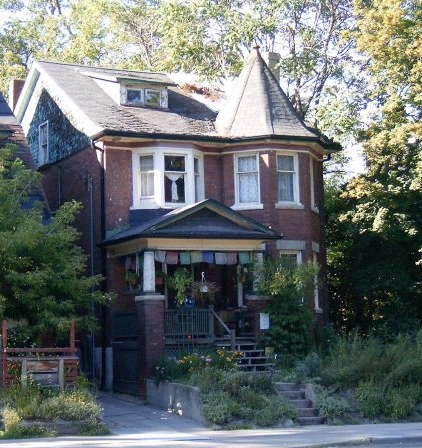
From fixing up the run down house in 1991, to raising my two wonderful children, planting and tending a garden, living and celebrating life with friends and family, to getting sick, to almost dying…
Memories of life at 1844 Bloor St W 1991-2010.

My father, daughter and son on the porch… 91 or 92.
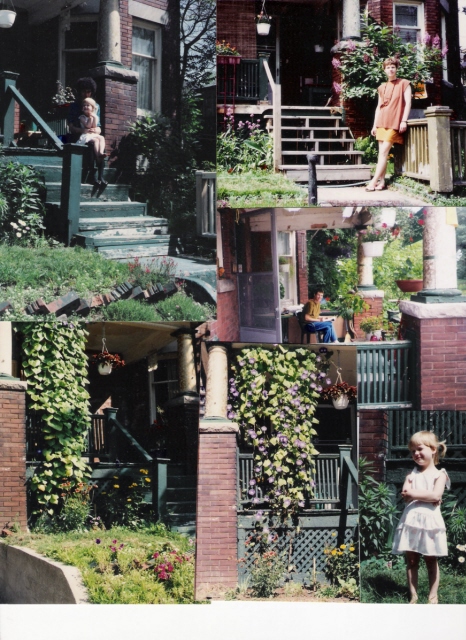
After cleaning and painting inside, I think it took almost 20 bags to remove the weeds and garbage and unearth the garden. Only the hollyhock, a red rose, and some alyssum in the rock garden were there when I moved in.
It took a few years to get the perennial garden going. My father’s old porch railing was re-purposed as a fence for a few years. People used to smile when they went by. More people who lived on Bloor St W started planting flowers in front. People often asked me if it was my garden when I was out shoveling snow, and told me how much they enjoyed seeing the seasonal changes.

When I got too sick to care for it because of the vehicle exhaust and laundry fumes from the apartment buildings, I watched from the windows as people stole plants, rocks and other items I’d placed there.
~
Many birthdays were celebrated in 1844…
Posted in Air Quality, Government, Health, Health Care, Housing, Human Rights, Multiple Chemical Sensitivities, Support
Tagged 1844 Bloor, 1844 Bloor St W, 1844 Bloor St. West, 1844 Bloor Street W, 1844 Bloor Street West, asphalt, Canary Report, Housing, Linda Sepp, MCS housing, MCS/ES, medically required housing, Real Estate for people with MCS and allergies, Toronto Star
 | linda @ Seriously "S… on MCS/ES |
| linda @ Seriously "S… on The CDC and MCS |
 | Tabatha Schnorr on MCS/ES |
| Tabatha Schnorr on The CDC and MCS |
| linda @ Seriously "S… on MCS and Housing |
| linda @ Seriously "S… on Hospital Protocols for People… |


 Seriously "Sensitive" to Pollution