Category Archives: Environmental Sensitivities

You Can Help Provide Medically Required Safe Housing!

Safe, non-toxic housing is the primary medical need of people with MCS/ES and EHS. The number of lives affected and needing this kind of medically required housing is growing, and far too little is being done by the various governments or medical associations to address the needs of all the people who are being injured and disabled by common everyday chemical and EMF/EMR exposures.

For us, safe housing is like the cast after we break a bone. It protects us and allows us to heal while preventing re-injury, especially if the housing is in an area where the outdoor air is also safe for us to breathe. Especially for those of us who have been repeatedly and seriously injured. That means no dryer vents that emit hazardous laundry chemicals, no pesticide use, or industrial emissions or busy roads nearby.

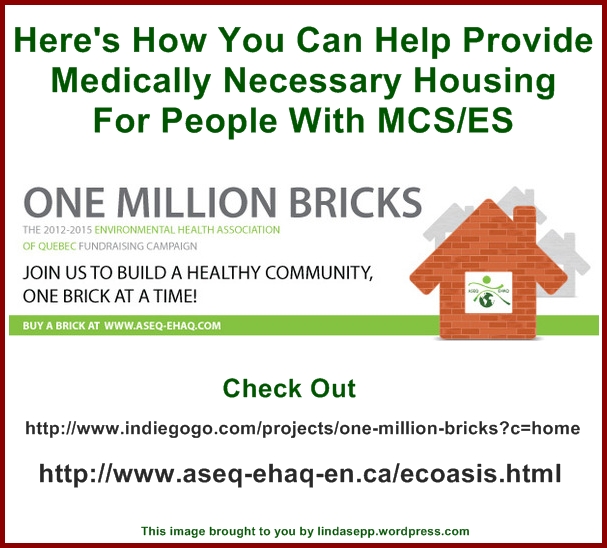
The good people at  the Environmental Health Association of Québec (ASEQ-EHAQ) see and understand the need and are working to do something about it, by developing an ECOASIS in the Laurentian Mountains of Quebec, but they need your help to make it happen.

Help Provide An ECOASIS

If you are already convinced this is a great cause to support and just want the link to where you can donate, then please click here.

If you need to know more about why this is so important, then please keep reading…

Continue reading

Allergy or Sensitivity?

place setting

Foods, chemicals, and other substances can cause disturbing, disabling, or even        life threatening symptoms.

Something to consider when trying to determine if you have allergies or sensitivities to foods is whether or not they are organic, conventional, or GMOs. Also, as a couple of recent studies revealed, many foods are chemically contaminated with BPA and phthalates (and probably other chemicals that weren’t tested for), so if a person also has chemical “sensitivities”, getting to the bottom of what is causing any number of symptoms can be challenging, especially with the delayed symptoms that are becoming so common these days.

Continue reading

There’s WHAT in my Baking Soda?

Fragrance chemicals….

Yes, I said it… There are fragrance chemicals in much of the baking soda sold now… Even in the baking soda you bake with. Unless you are extremely lucky… and there’s no rhyme or reason as to when it might be fragrance free, because no-one who might know will tell as to why there are any problems with it in the first place.

For months now, I haven’t been able to get any baking soda that isn’t fragrance (or otherwise) pre-contaminated… and I use it instead of soap products, which I don’t tolerate, to clean me, my teeth, my clothes and everything else that needs cleaning… Because my body doesn’t tolerate soap, even organic olive oil soap, probably because there’s something about modern lye that doesn’t agree with me…

If I lived in a cave, it might not matter, but I’m stuck here in the suburbs, and despite being housebound, there are people who make assumptions on my rare appearances outdoors, like when I have to go to the recycling and garbage bins… And I am just well enough to notice, and to care… And it just doesn’t feel good physically, or emotionally…

P1400358

My local Bulk Barn store owner picking up 50 lbs of fragrance contaminated baking soda during a February snowstorm

The most recent Arm and Hammer bulk sample, was even worse than the previous one, although the type of contamination is different…
The owner/manager says he took the sample from a brand new bag he just cut open and used the jar I had given him when he picked up the 50 lbs of fragrance contaminated baking soda I’d purchased in December. He was even so kind as to deliver the jar full.

Arm and Hammer is saying there is no way their stuff is contaminated before it goes in the bag, Bulk Barn won’t tell me who the middle man is, and the bags are really unlikely to pick up contamination during the time between anyway – but I’ve had fragrance contamination on the INSIDE of the bag, when the outside had no fragrance residue.

Continue reading

Tax Time: Medical and Disability-Related Expenses

Tax time is approaching yet again, and there are some disability related tax credits available in Canada, even for people with MCS/ES (some of which I will post below).

There are also tax credits offered to people who need to retrofit their homes for medical reasons:

Renovation or construction expenses – the amounts paid to make changes to give a person access to (or greater mobility or functioning within) their dwelling, when that person has a severe and prolonged mobility impairment or lacks normal physical development.

Continue reading

Affordable, Healthy Housing Project in the Laurentians Deadline Extended

This is good news for people who are willing to give up their proximity to friends and family in order to live in a medically required healthy housing community. I’ve filled out my application. I can’t wait to live somewhere I can safely go outside again without being assaulted by chemicals from other people’s dryer vents or chimneys. The Laurentians are a beautiful place to be.

The Laurentians

From Association pour la santé environnementale du Québec – Environmental Health Association of Quebec | 6 Trianon, Dollard-des-Ormeaux, Québec H9A 2H8

Affordable, healthy housing project in the Laurentians deadline extended to March 1st, 2013

Have you registered? Did you fill the NEW form and return it to us?

If you haven’t done this yet and you are interested in living in affordable, healthy housing for people suffering from environmental sensitivities (multiple chemical sensitivity and electro sensitivity), please call us immediately at (514) 683-5701.

You can find the form on our website (by clicking on the brown button ‘Affordable Housing’, which is on our Home page), fill it out, print it, sign it and mail it back to us.

If you need help filling out the form or if you don’t have a printer and/or cannot leave your home to post it, please contact us. We will help you fill the form! It is important that your form reaches us on March 1st 2013 by 5 p.m.

Did you buy your bricks?

banner_english_fundraising-4

Hospital Protocols for People With MCS/ES

hospital

Some hospitals around the world are developing fragrance-free policies and other less toxic practices, but most health-care environments can still be dangerous places to be for people with MCS/ES, presenting enormous challenges if health care services are needed, as I quoted from the ES-MCS Sensitivities Status Report in the post Canadian Statistics on MCS/ES.

“For ES-MCS sufferers the ideal of ‘patient-centred care’ is currently in stark contrast to realities within the health care system. Knowledgeable healthcare professionals and support workers are so few as to be virtually inaccessible most of the time. For moderately or severely chemically sensitive persons, physicians’ offices, clinics and hospitals commonly are unsafe places to wait, consult, or undergo procedures because patients can be exposed to many symptom triggers emitted from furnishings, cleaning and laundry products, disinfectants, and personal care products on staff or other patients, making their conditions worse. Fragrance/scent-free hospital, home care and rehabilitation services are very rarely available, and there are no chemically safe emergency shelters. Consequently, patients with severe chemical sensitivities may avoid seeking care, risking further deterioration and chronicity, thereby being “caught between a rock and a hard place.”

It can be a difficult decision for many of us when we experience symptoms, whether or not to have them checked out. Sometimes we wait too long, other times we just can’t go because the going is too dangerous for our health. Toni Bernhard touches upon it in Psychology Today, although MCS/ES adds another layer of complications to the decisions:  “5 Tough Choices You Face When Chronically Ill or in Pain

If a trip to the hospital is required, it’s best to be as prepared as possible. If it’s not an emergency, then your choice of the following documents can be forwarded and discussed in advance. Otherwise, carrying paper copies or discs with us at all times could be warranted, in case of emergency.

The following is a list of the best protocols and websites I’ve found, with important resources and documents for people willing and able to take the risks to advocate for themselves or to provide to others so they can do it on our behalf if we are not able.

Hopefully you have the time to go through them and choose what is most suitable for you before the need arises. With any luck, you won’t need them, but it’s good to be  prepared “just in case”. It will take a long time to prepare your local health care providers with protocols to reduce harm (we’re nowhere near the eliminate harm stage)  in advance.

A lot more needs to be done, because until the systemic issues are resolved, for too many of us, it’s far too dangerous to try to access health care.  The necessary negotiations are not feasible when severely disabled, ill, and in need of immediate care that does not exist.  These resources require the ability to work to implement. And there’s no guarantees that if you make progress once, the progress can be built on the next time, as far too often, it’s a start all over again from the beginning process.

Continue reading

Canadian Statistics on MCS/ES

According to Statistics Canada, between 2005 and 2010 the rates of people diagnosed with Multiple Chemical Sensitivities, Fibromyalgia and Chronic Fatigue Syndrome in Canada increased significantly.

The number of people diagnosed with MCS increased by 31%

The number of people diagnosed with FM increased by 15%

The number of people diagnosed with CFS increased by 24%

As far as I know, they are no longer collecting information about these conditions, so updated prevalence statistics may not be forthcoming, despite these alarming increases and every indication that the amount of people being affected will continue to rise.

Continue reading

Guest Post: Personal Protection Against Electromagnetic Waves

Another danger from wireless technology,  discussed a bit here in the BioInitiative Report is that of electromagnetic hypersensitivity (EHS) /aka electromagnetic sensitivity, or one of the many potentially disabling “sensitivities” falling under the broader term Environmental Sensitivities (ES).

As the use of wireless technology increases, more and more people around the world are becoming disabled by, or “sensitive” to electromagnetic waves, and must find ways to survive and cope in the world, since safe sanctuaries are not yet available and life of some sort must go on. Some people are discovering special materials that can be used to make protective clothing, hoods, capes etc. Note that care must be taken to keep the waves from bouncing around inside the material.

Ryozo posted this account of what he must wear to his fb page and he agreed to share it here.

He lives in Japan and has MCS and EHS. He was a teacher by profession and now works to raise awareness about these conditions whenever he is able. He is a member of the Japanese organization CACP – Citizens Against Chemicals Pollution.

My way to protect from electromagnetic waves

by Ryozo Tamakoshi

Points to keep in mind

The causes and the conditions of chemical sensitivity or electromagnetic hypersensitivity are very various. My method is not always effective for all people. Ultimately, it may be important to find your own way. Please note that metal allergy could affect ability to use these protective clothes. Summer is so hot, this way is impossible. (This is only the protection from electromagnetic waves.)

Continue reading

MCS Car Repair Safety Precautions

This note can be modified to suit individual needs.

car repair

Car Repair Safety Precautions (when taking the car in for any work)

Would you please ensure that the enclosed notice is taped visibly to the driver’s side car window, and that anyone who works on the car is made aware of the precautions necessary to prevent an accidental use of products which would render the car unusable to me.

Thank you.

I have severe environmental and chemical sensitivities and allergies, etc. to a wide assortment of chemicals contained in cleaning and other petrochemical products.

In order to make sure the car remains safe for me to drive, can you please take the following precautions:

No-one with gas, oil, cologne, aftershave, scented soap or lotion residues on their hands should touch the car interior.

No smoking in the car, or anyone who has just been smoking.

Use clean disposeable gloves or paper towel to touch doorknobs, handles, steering wheel, etc.

Make sure the seat and steering wheel are fully covered before touching or sitting.

(I may provide a mylar emergency blanket to cover the seat with)

Do not use WD-40 or other products on door hinges or anywhere inside. If any interior lubrication is necessary, please advise and we will research a safe alternative product.

Do not, under any circumstances, use any cleaning or air “freshening” products in or near the car.

Please do call  if there are any questions

Thank you for your co-operation.

Safe Housing – One Brick at a Time

The Environmental Health Association of Québec (EHAQ) is ready to build an ecological, affordable housing community for people with Environmental Sensitivities and related conditions. This type of housing will provide a roof for those in dire need of a healthy home, free of the triggers that make them ill.

safe and healthy home

A home that will restore dignity and health…how amazing is that?

Please watch the video

JOIN EHAQ TO BUILD A HEALTHY COMMUNITY, ONE BRICK AT A TIME
BUY A BRICK @ $10 A BRICK!

To donate and learn more:

http://www.aseq-ehaq.ca/donation/donateonline.php

banner_english_fundraising-4