Tag Archives: IAQ

Your Very Own Neighbourhood Chemical Distribution Device

Did you know?

If you use conventional laundry products, you might not knowingly be feeling the effects now, but you more than likely have some neighbours who do!

Dryer vents are undisclosed, unregulated chemical distribution devices.

When you choose your laundry products,
you choose what your neighbours have to breathe!
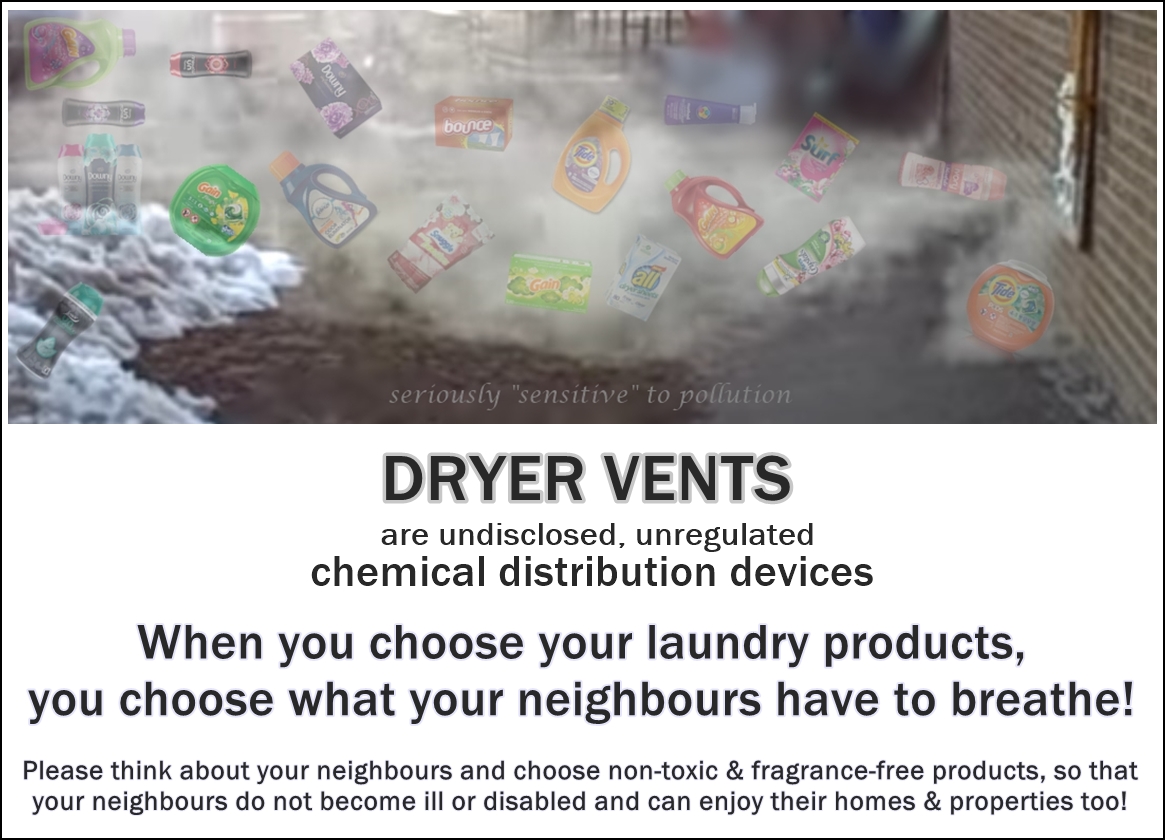
Please think about your neighbours and choose non-toxic & fragrance-free products, so that your neighbours do not become ill or disabled
and can enjoy their homes and properties too!

A growing number of people (millions, not handfuls) cannot enjoy walking about their neighbourhoods, sitting or working in their own outdoor spaces, or even open the windows of their homes due to the harmful pollutants released from dryer vents that were designed to emit moisture, not drifting toxic chemicals.

Laundry products should not be disabling people or cause short term adverse health effects like asthma, headaches, migraines, confusion, vomiting, dizziness, etc., or longer term effects like reproductive and neurodevelopmental problems!

EWG has a website where you can check the ratings for the products you use. It’s a great place to start learning which products to avoid, and which are safer options.

Continue reading

When Someone Says They’re Fragrance-Free, But

When someone says they’re fragrance-free, but

they smell like

essential oils, febreze, scented candles, plug-in air effers, &/or air effing sprays…

When someone says they’re fragrance-free, but

Continue reading

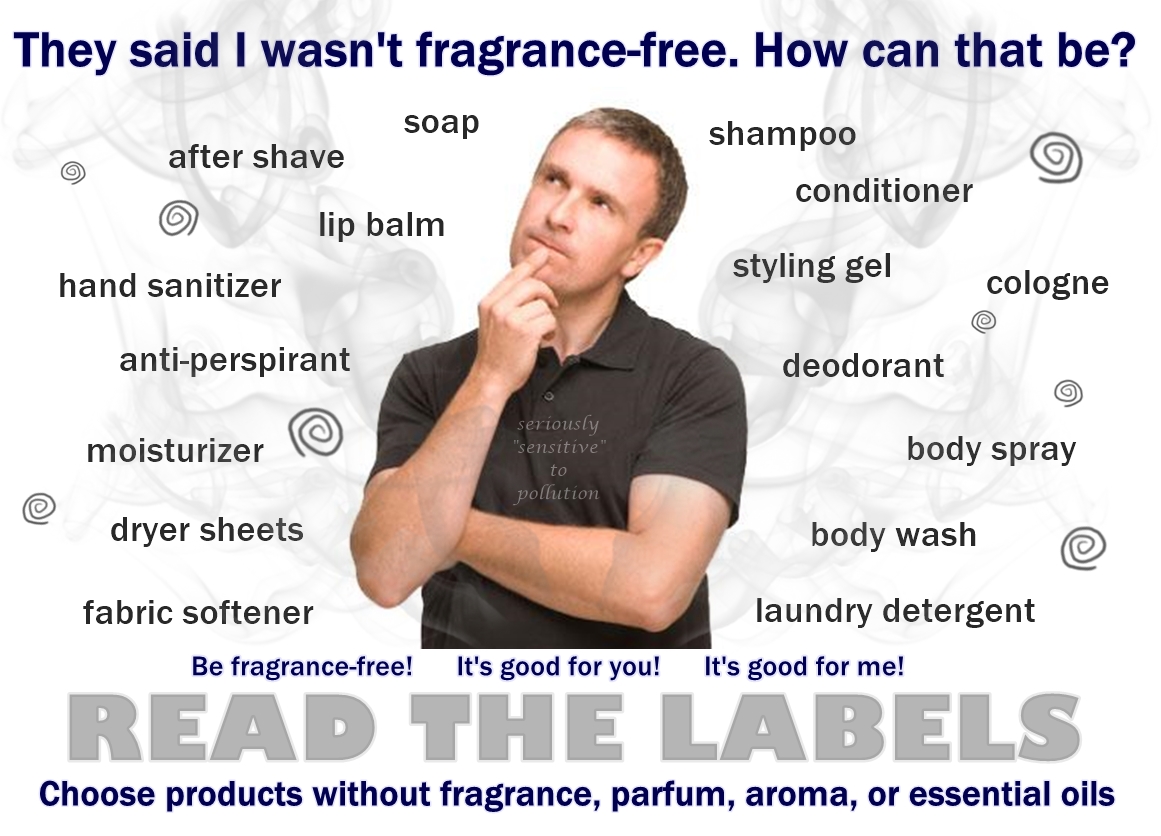
They Said I Wasn’t Fragrance-Free. How Can That Be?

Has anyone ever asked you to be fragrance-free or told you that your fragrance is affecting their ability to function in some way, and you didn’t know what they were talking about?

You may or may not have heard that fragrance-free policies are becoming much more common now since so many people are being adversely affected by fragranced products.

Unfortunately, many people still don’t know why fragrance-free products are healthier for themselves and others, or unaware how common fragrances are!

It’s not just perfumes and colognes!

I’ve had people tell me they didn’t use any fragrance when they couldn’t name a single product they used for laundry or personal care and cleaning.

I’ve had people tell me they didn’t have any fragrance on when all of their products had fragrance listed in the ingredients.

People have also said “but I don’t smell anything”, or “I only used a little this morning” (or yesterday, or the day before yesterday).

They Said I Wasn’t Fragrance-Free. How Can That Be?

Think about that! Read the labels on all of your products, if you haven’t already.

There are all kinds of undisclosed and toxic ingredients in everyday fragranced products that are  linked to cancer, birth defects, and other chronic illnesses.

And it’s not only the fragrances from the products you washed with or applied to your body, or the residues of laundry products in your clothing that are problematic!

Did you ever walk into a room where people were smoking, or have have smoked in the past?

Continue reading

UK’s Clean Air Strategy 2019 Addresses Product VOCs

The UK has released their Clean Air Strategy 2019 document and it contains some groundbreaking measures that, if implemented, will have very positive impacts on the environment and our health.

It encompasses many areas of air pollution, including indoor air pollutants for the 1st time in any meaningful way, which as NOAA recently pointed out, have as large an impact on outdoor air pollution as vehicle exhaust!

The few news reports I saw did mention air “fresheners” and perfumes, with some building materials, but didn’t get into details. I had to dig through the document and what follows is most of what pertains to our interests here, being seriously sensitive to indoor pollutants.

I’m sure that other sources will focus on the regular types of outdoor pollutants quite well, while mostly ignoring the indoor products and materials, so I will not touch upon them, except for a few illustration screenshots  from the report.

I’ve added  very little of my own commentary. It’s almost entirely copied and pasted (and reformatted) from their document, so you can see for yourself what their plans are regarding NMVOCs (non-methane volatile organic compounds) from consumer products and materials that leave so many of us disabled and housebound, and unfortunately, far too rarely in a home that protects us from exposures and contributes to our well-being.


Among other types of pollutants, the executive summary of the report includes:

Chapter 6: Action to reduce emissions at home

Many people are unaware that emissions in the home increase personal exposure to pollutants and contribute significantly to our overall national emissions.

Burning wood and coal in open fires and stoves makes up 38% of the UK’s primary emissions of fine particulate matter1 (PM2.5). Harmful sulphur dioxide (SO2) is emitted by coal burned in open fires.

Non-methane volatile organic compounds (NMVOCs) from a wide variety of chemicals that are found in carpets, upholstery, paint, cleaning, fragrance, and personal care products are another significant source of pollution.

We will:

Continue reading

So You Think We’re Being Difficult When We ask You to Change Products?

Seriously though:

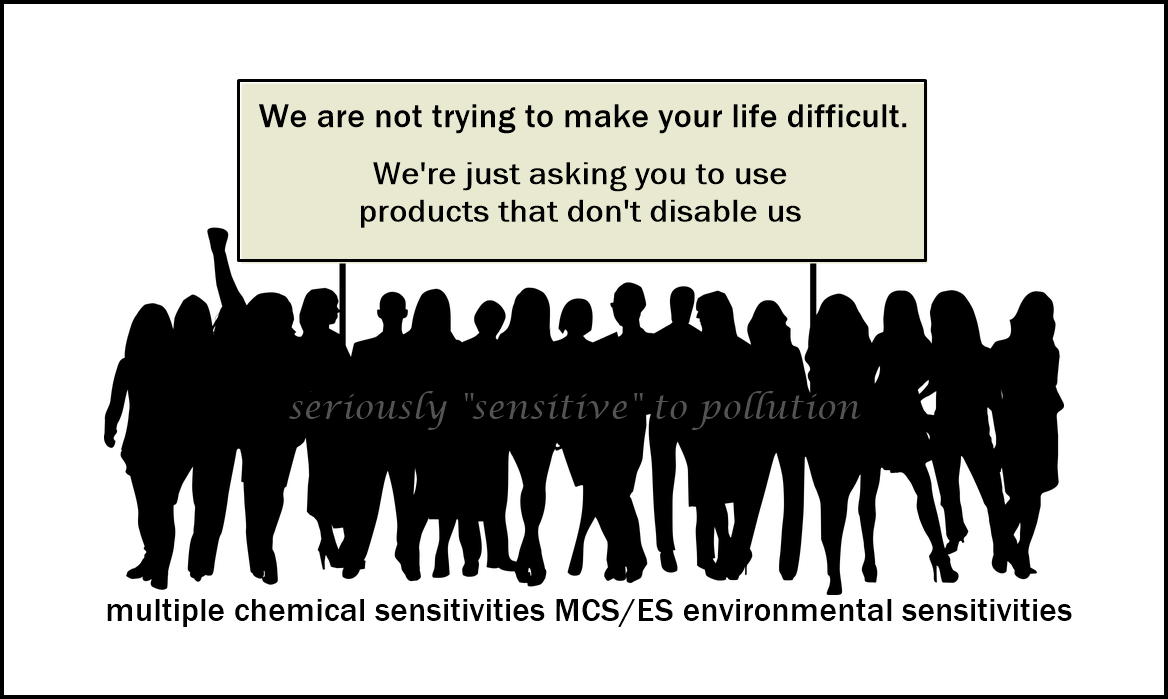
We are not trying to make your life difficult.

We’re just asking you to choose products that don’t disable us.

“Really? Products we can buy in every store disable you?”

Continue reading

What’s it Like to Have MCS/ES? Part 3: Toast Chaos

MCS/ES (multiple chemical sensitivities / environmental sensitivities)  is a disability recognized by the Canadian and Ontario Human Rights Codes. There are over a million people with doctor diagnosed MCS in Canada, and so many more all around the world.

In the US, the latest prevalence study found that “among the population, 12.8% report medically diagnosed MCS and 25.9% report chemical sensitivity.”

The term ‘sensitivities’ seems to trivialize the condition in many people’s minds.

You may wonder what’s it really like then, if it’s not trivial?

Here’s how Laura J Mac describes it:

Having MCS means never knowing when you can manage something as simple as making toast.

• Can’t stand up due to pain.

• Can’t figure out all the steps involved to make toast. #execfun

Continue reading

What Are Your Wishes for 2019?

Dream big! What would you wish for? Continue reading

Return to Vendor

Get something stinky
as a gift?
Don’t toss it
on the street
or in the trash.
Don’t regift it
to a friend
or enemy.
Don’t donate it
to a charity.
Do send a message
loud and clear!

Now’s the time Continue reading

CBC News Hi-lights Accessibility Barriers to Housing for People With MCS/ES

Severe sensitivity to household chemicals leaves GTA man
homeless for the holidays

Environmental sensitivities have forced Oliver Zhang to move 70 times in 3 years


I hope that someone can offer or help create a safe place for Oliver Zhang to live.

I also hope that something is done soon to ensure safe, affordable, accessible,  non-toxic, mold-free, housing is available for all  the other people who have  MCS/ES (a condition, not disorder) who need safe and accessible housing.

Since finding a safe place to rest one’s head and body is so challenging, even in the best of current circumstances, Oliver Zhang should not be forced to leave the shelter where he is currently residing if it is physically safe enough for him to be there.  He is in crisis.

Forcing people onto the streets creates preventable trauma and mental health problems in addition to the serious challenges that already exist when trying to survive with MCS/ES in a society full of systemic accessibility barriers.

I know of many people who have had to move numerous (even countless) times  in their quest to find housing that doesn’t hurt and disable them. I hear from too many who are in crisis,  seeking accessible housing. I know people who no longer have the energy to keep looking for a needle in a haystack, because each toxic haystack leaves them more and more incapacitated. I know people with MCS/ES who are sleeping in cars and tents, and I have also known more than a few people who weren’t able to find safe housing and are no longer with us.

This is a preventable crisis.

Oliver Zhang and all the other people who are homeless due to the lack of accessible housing for people with MCS/ES, have been put into this position due to systemic neglect (if not deliberate discrimination) and bad policies, not through any fault of their own.

The City of Toronto has known about the critical need for accessible housing for people with MCS/ES since at least 2007, and most likely long before.

In 2008:

“The City of Toronto has launched a consultation process on the development of the City’s ten-year affordable housing plan, known as Housing Opportunities Toronto (“HOT”); and

Continue reading

When There’s No Accessible Potty


This washroom isn’t accessible:


neither is this one:


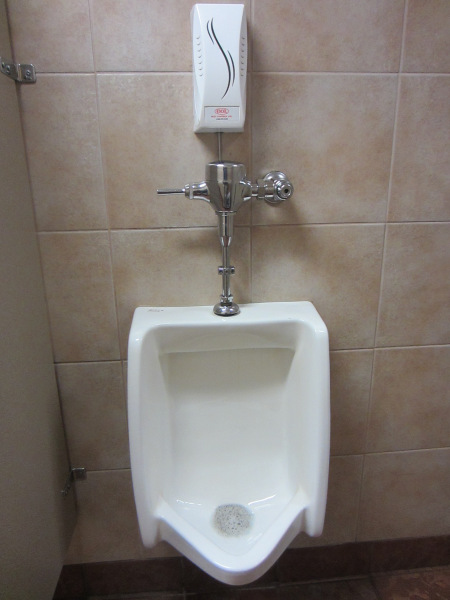
nor are the Ontario highway and other washrooms that have these installed:

Pesticides and fragrance! What could go wrong?


Many of us cannot go into a washroom that has an air effer or scented soap.

“In addition to the possibly life threatening immediate and delayed adverse health effects, “our clothes are contaminated and need to be aired out for days before we can even wash them or they contaminate more of our clothes.”
(from a  fb comment on the last post
)

So what to do?

Continue reading