Tag Archives: invisible disabilities

How to Survive the Holidays with EI and (Possibly) Not End Up Alone or Wanting to Give Your Family the Boot (Part Three)

Part Three of Four

(Part One and Part Two)

Guest post by Che Ray


Here are some things I would recommend: even when it’s a stuck in bed day…

I: Don’t try to do too much physically. Definitely let your body rest, but also do something active to restore your mind like listen to a meditation talk or guided meditation. Tarabrach.com or jonathanfoust.com are great!  I recommend them highly.  This will help you get restorative rest, which is a much deeper, more relaxing experience.

II: I only recently discovered an online language tutorial called Mango. It’s free if you have a public library card. It is an awesome interactive language learning app. It has everything from Spanish to Swahili, to Pirate (really, it’s super fun and funny!) to Yiddish; dozens of languages.

I have a brain injury from the toxic exposures but have not been able to get the kind of occupational therapy I need which has been depressing. One day I thought, what can I do to keep my mind stimulated?  And I came across this. Even if you don’t want to dedicate yourself to learning a new language, 10 minutes of mimicking Pirate language is going to make you laugh and feel better. And it’s good for your brain.


III.  You are a superhero.

Recruit other people in your life to join your fight.

Continue reading

How to Survive the Holidays with EI and (Possibly) Not End Up Alone or Wanting to Give Your Family the Boot (Part Two)

Part Two of Four

(link to Part One)

Guest post by Che Ray


Overarching rule of thumb:

Talk about MCS/EI/TE/TILT like you are talking about cigarette smoking or HIV exposure.  What I mean by this is:

A: It is a given fact that second hand cigarette smoking causes disease.

We didn’t know this for a long time because the tobacco industry didn’t want us to know. So people had to put up with cigarette smoke in their face. Now it is not only not tolerated, it’s illegal to smoke in many places.

Explain to people that the elements in cigarettes that really kill people are often the exact same chemicals used in fragranced products.

I also say this condition is like smoking and HIV in that these diseases, more than others, DEPEND on other people caring about the health of people (like us) as much as they care about themselves.


B:  We have NOTHING to apologize for, so DON’T DO IT.

Continue reading

How to Survive the Holidays with EI and (Possibly) Not End Up Alone or Wanting to Give Your Family the Boot

Part One of Four

Guest post by Che Ray


For those of us with EI (environmental illnesses), the holidays are especially brutal.  What were once happy times surrounded by family and friends become increasingly isolating experiences.  Depending on how bad off we are with things like fragrance sensitivity (which, next to fruit cake is the worst part about inviting Aunt Betty) or severe fatigue (where you just want to curl up into a ball under the dinner table), more and more we are faced with having to choose between trying to brave a family gathering only to end up sick in bed for weeks or convincing ourselves we will just stay home and write that novel.

In response to a heart-felt plea for help from one newly aware Canary who was torn between wanting to accommodate her family and fear of going overboard and getting sick, I wanted to reach out to her and give her some advice I wish someone had told me.  This is more or less what I said:

Continue reading

Help for How to Be Fragrance-Free

All it takes is a decision to go fragrance-free!

It should be easier than quitting smoking since there aren’t supposed to be addictive chemicals in fragrances, right?

Due to the fact that so many people are now experiencing adverse effects from fragranced products (34.7% in 2016), we are well on the way to having fragrance-free policies everywhere for the sake of protecting public health just as was done with smoking bans. It’s not just those of us who suffer immediate and disabling adverse effects from the products (1st, 2nd, and 3rd hand), but for everyone.

Here are some great resources (in no particular order) to help you go fragrance-free:

Continue reading

Corporate Gaslighting and Conflicts of Interest at the Women’s College Hospital

I saw something that shocked me, and I don’t know how anyone involved with this could have thought it was a good idea.

This is what I saw

If you are a Canadian, you will probably understand.

.

It’s pretty much the same thing as this (slightly revised) image:

(pretend it’s done all the way)

What would you think if you saw that?

Shoppers Drug Mart is the antithesis of scent or fragrance free!


Continue reading

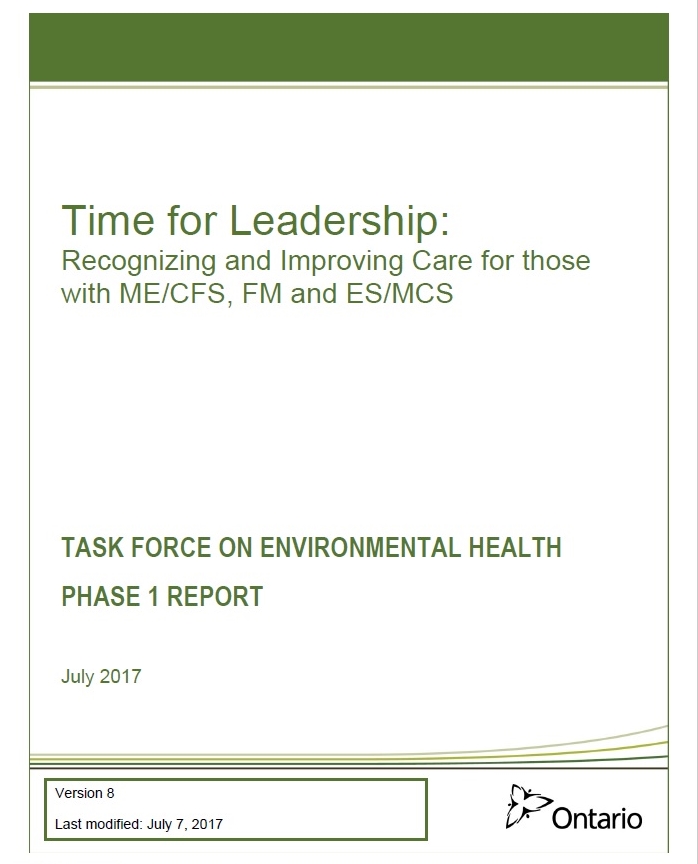
Province of Ontario Interim Report on ME/CFS, FM, and MCS/ES

The Province of Ontario’s Ministry of Health and Long Term Care’s long awaited Environmental Health Task Force Interim Report has finally been released!

“We found that, throughout the health care system and in society at large, there is:

•a lack of recognition of the seriousness and severity of these conditions
•a profound shortage of knowledgeable care providers
•a dearth of clinical tools to support and guide care
•a discouraging shortage of services and supports for people living with these conditions
•an absence of support for family caregivers.

The lack of knowledge and appropriate accessible care has devastating effects on Ontarians struggling with ME/CFS, FM and ES/MCS.

For those living with ME/CFS, FM and ES/MCS, the lack of recognition of these serious and debilitating conditions is as harmful as the lack of treatments. …

We urge the Minister to act now to raise awareness of these conditions and address the barriers that keep people with ME/CFS, FM and ES/MCS from getting the care and services they need.”

From the press release:

Continue reading

Published: “Invisible Barriers, Invisible Disabilities, Invisible People”

My article “Invisible Barriers, Invisible Disabilities, Invisible People”   is now available to read in the

Special Issue on Ecopsychology and Environmental Sensitivities:
Chemical, Electrical, and Beyond

All the articles in the entire special issue will be available for free until Sept. 5  2017, which is unprecedented access!

Please check them out and share as widely as possible!


Table of Contents:

Continue reading

Bubbled People


I ran across some striking photos by Alex Kisilevich (you can see them in the banner above if you squint) and I shared the link with  the intro “Food for thought… what’s outside the bubble preventing access?”  Someone responded with  “tell me about it”, so I wrote a short story before seeing what the photographer’s intent was, if it was indeed as a writer wrote, to say:

Continue reading

MCS/ES 2017 Continued: The Canaries Are Still Waiting!

The canaries are still waiting!

“We issued a report (in 1985) that identified existing, publicly funded means of diagnosis, and accepted various methods of patient management, including avoidance of offending agents.

We did not feel that more research was needed before these and other measures were introduced to protect patients from being caused harm through inappropriate labelling or the denial of reasonable accommodation.”

Excerpted from this letter by Judge George M. Thomson, B.A., LL.B., LL.M., who chaired the extensive report by the Ad Hoc Committee on Environmental Hypersensitivity Disorders for the Province of Ontario in 1985:

Continue reading

Endangered Human Art Project: Bringing Awareness to Chemical Sensitivity

WHO Says We Need Fresh Air?!

Guest Post from Marie LeBlanc

Bringing awareness to chemical sensitivity
Marie LeBlanc at the Centennial Concert Hall in Winnipeg. May 12th 2017.

I am an artist  in Winnipeg who lives with multiple chemical sensitivity (MCS) and environmental illness caused by mold exposure. My art has been in relation to multiple chemical sensitivity (MCS)/Environmental Illness (EI) and toxic environments.

“WHO says we need fresh air?!” is a series of quotes from sufferers of Multiple Chemical Sensitivity, Environmental Illness, Mold Exposure, Electrohypersensitivity Syndrome, Lyme Disease and other conditions related to Chronic/Complex Immunological Neurological Diseases.

The art installation was on display during the evening of Fri. May 12, on Multiple Chemical Sensitivity (MCS)/Environmental Sensitivities Awareness Day,  outside the Centennial Concert Hall (with a few quotes displayed on the indoor screens), and is dedicated to my friend Eliana from Mexico.

Continue reading