Category Archives: Air Quality

The Canadian Human Rights Commission’s “Environmental sensitivity and scent-free policies”

The Canadian Human Rights Commission’s
Policy on Environmental Sensitivities
has been updated to add more on scent-free policies.

Image description: “Environmental sensitivity and scent-free policies” text on a blue background to the left, with a photo of a dark haired woman resting her chin on her hand, while looking wistfully (towards the title  text) out a window with rain drops on it, on the right side.

The new policy includes this:

“A scent-free policy is similar to other workplace policies such as
anti-harassment policies. It applies to all employees and is intended to guide
their conduct. If an employee does not comply with the policy, disciplinary
action can be taken.”

and this:

“If an employee with environmental sensitivities needs to leave because of a trigger, this person should not suffer negative impacts because of their disability
or their need for accommodation.”


Visit the CHRC website to download the PDF:
https://www.chrc-ccdp.gc.ca/eng/content/policy-environmental-sensitivities


Full text of the policy
(as copied from their PDF for people who have difficulties with PDFs):

Continue reading

Diffusing Health Harm on Unsuspecting Shoppers and Outrageously False Product Claims

Here’s yet another example of a systemic issue regarding health harming accessibility barriers, happening in a province (and country) where we have Human Rights laws that recognize people with environmental ‘sensitivities’ as having a disability, and where everyone is encouraged to remove accessibility barriers instead of creating new ones.

Unsuspecting Oshawa Costco Canada shoppers are being subjected to this fragrance assault and/or accessibility barrier between November 26, 2019 and December 8, 2019.

Info which was found buried on Costco Canada’s website in the Special Events page, there may be other locations as well.
How many members see these announcements?

In December, it appears that those who shop at  Costco’s Ste Foy location will also be sprayed, without alternative accommodations made for member shoppers whose lives are harmed by this kind of thing (unless there’s a public outcry before it happens).

Not only is the store air thoroughly polluted by this kind of diffusion (as experienced by someone who reported it to their mother who has environmental sensitivities and is severely allergic to fragranced products) for the 2 week duration of this “special event”, but everything in their store(s), *including food*, will also have absorbed substantial residues of undisclosed (and not food-safe) fragrance substances, that may be difficult if not impossible to remove.

This ‘special event’ can cause significant harm to people with asthma, autism, chemical and environmental sensitivities, fragrance allergies, migraines, and mast cell activation syndrome (to name a few). Even 2nd and 3rd hand residues of this type can cause serious (and life-threatening) health problems and long lasting disabling effects, so a suggestion of having someone else do the shopping is not a reasonable or feasible accommodation.

See below for the product details and the store manager’s and assistant manager’s responses when called.

Continue reading

Persil: Just STOP!

When you need a product that says it’s fragrance-free

and the product’s web page states:

“It’s 100% dye-free, perfume-free and dermatologist-tested. Take laundry day to the next level. … With Persil® Sensitive Skin you can achieve a deep clean without scents and perfumes that can aggravate skin sensitivities.”

Guess what? You still need to read the ingredient list, because some manufacturers think it’s ok to do this:

Continue reading

Hyperthyroidism in Cats Exposed to Air “Fresheners”, Upholstered Furniture, and New Buildings

Cats are adversely affected by toxic chemicals too


… “Higher TDCIPP exposures were associated with air freshener use, houses built since 2005 and cats that prefer to nap on upholstered furniture.” …

The same things cause disabling adverse effects in people with MCS/ES.

Learn more:

Continue reading

How to Basics: Accessible Washrooms for People With MCS/ES

So many accessibility guidelines completely skip the fact that these necessary and super easy to implement accessibility measures make it possible for perhaps  1/3 of the population to use (or use without harm) a public (or other) washroom, and especially help provide access for those who have disabling chemical and or environmental “sensitivities” (a term that trivializes the condition and effects).

Fragranced products not only create accessibility barriers for people with chemical and environmental “sensitivities”, fragrance sensitivity, autism, sensory sensitivities, migraines, asthma, MCAS/MCAD, and others, but fragrance ingredients have been linked to a number of other short and serious long term health effects in the general population.

It has come to our attention that too many places that hang up a scent or fragrance-free sign in the front office, have air effers and scented soaps in the washrooms. That’s not how this is done.

How to Basics:
Accessible washrooms for people with environmental sensitivities

Image is of a public washroom with sinks on the left side, a cleaning cart in the middle, and garbage cans holding open the stall doors on the right. There are purple bars across the image with the following lines of accessibility tips text:

Continue reading

Accessibility STOP Signs

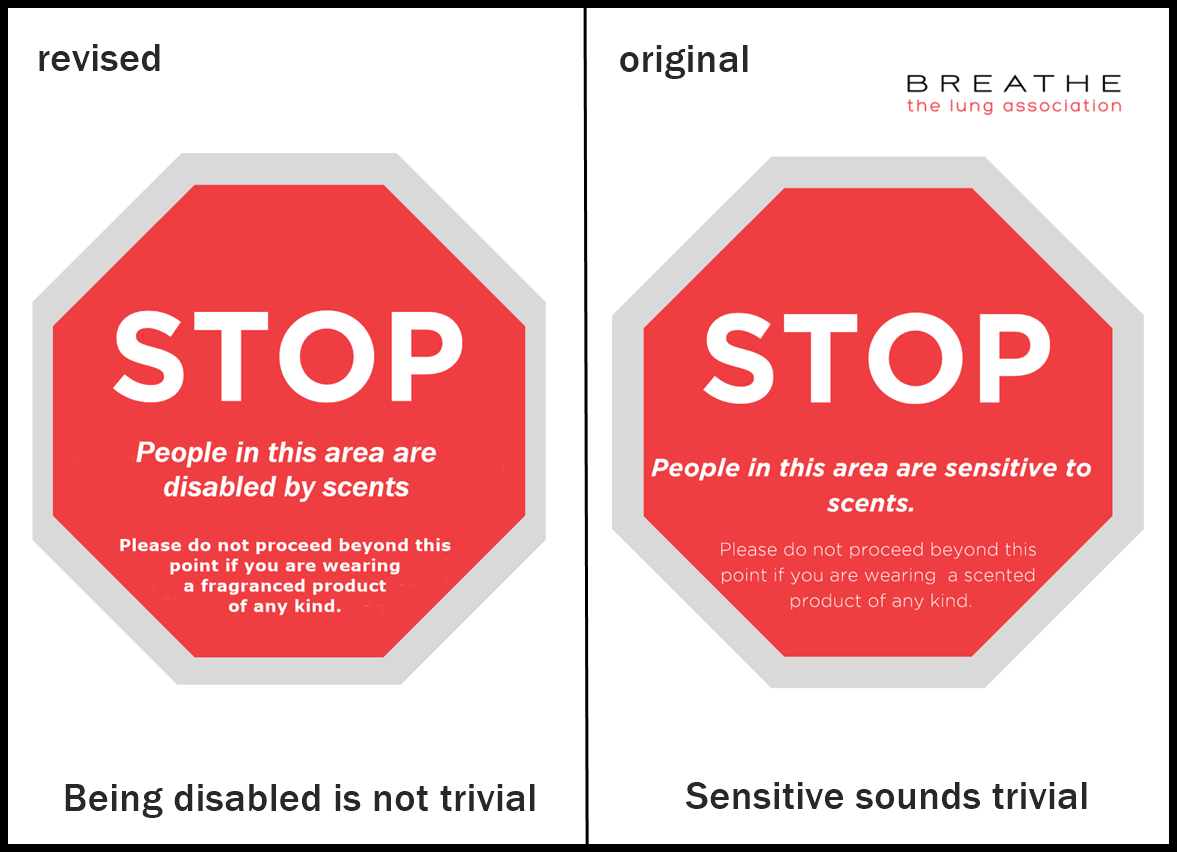
I ran across a sign that the lung association had created, and while I am glad they are doing something , I found the message and visual required some tweaking.

Of course, the lung association didn’t come up with the term “sensitive”, it’s what is used in human rights laws, but it seems to have created an impression in the public’s mind that chemical and environmental sensitivities are trivial, and not disabling or even life threatening like they can be.

It also needs to be said that signs without enforcement are endangering lives and perpetuating harm, systemic accessibility barriers, discrimination, and forced isolated segregation for those who are disabled by any or repeated exposures.

To download printable posters, see below.

Continue reading

Mask Challenge Revisited

Back in 2017, there was an effort by Memes for Inconvenient Disabilities to get people to wear a mask to see what it was like to be a human canary.

Only one person we know of took the challenge, but she did not give permission to share her incredible insights from her experience.

I’ve discovered that Fast Company did their own version of the Mask Challenge and here’s their video: Continue reading

Can’t Ban Fragrances? Consider a Fragrance Free Zone

This article appears in The Job Accommodation Network’s
ENews: Volume 17, Issue 2, Second Quarter, 2019

JAN provides free, confidential technical assistance about job accommodations and the Americans with Disabilities Act (ADA).

Can’t Ban Fragrances?
Consider a Fragrance Free Zone

Dig into developing a fragrance free zone

From the desk of Linda Carter Batiste, J.D., Principal Consultant/Legislative Specialist

Employees with fragrance sensitivity often need a fragrance free work environment to avoid triggering symptoms. However, it can be difficult to completely eliminate fragrances in some workplaces. Fragrance sensitivity can be triggered by not only perfumes and colognes, but also in some cases by personal products such as deodorant, shampoo, laundry detergent, and lotion. In workplaces with a lot of employees or in which the public has access, trying to control what products people use and enforcing a total fragrance ban can be virtually impossible. So what else can be done? Continue reading

Gain – Sinking Your Disabled Boat

Have you seen the new  “the more the better” Gain detergent ad?

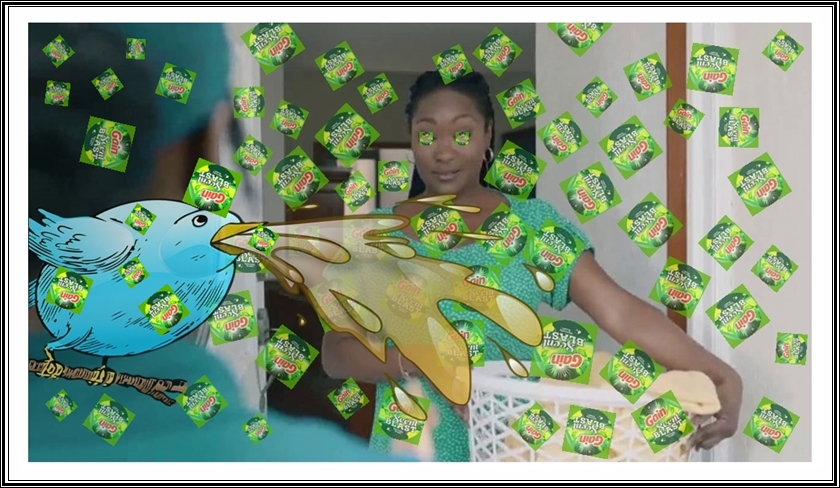
When the delivery woman tries her best not to puke from the Gain fumes,
the Gain user shrugs and the voice-over says:

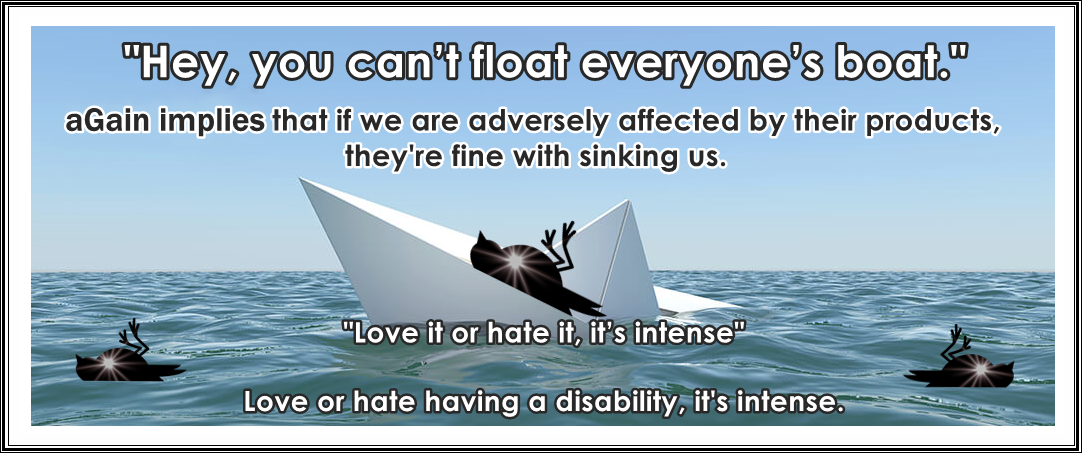
“Hey, you can’t float everyone’s boat. Love it or hate it, it’s intense.”

!!!

In other words, Gain implies they’re fine with sinking us

(More on what we all think about that later)

The ad starts off with a scene that already promotes an IAQ nightmare:

Continue reading

Appropriating Disability Language to Sell Products That Harm People With Disabilities

Hey Vagisil!

Aside from making women feel like they need products that are
totally unnecessary and can be all around harmful in general, it’s
TOTALLY NOT COOL
to appropriate disability language
to sell products
that harm people with said disability!

If you are  ‘scentsitive’, it means you need to be scent-free!

Continue reading