Category Archives: Environment

Endangered Human Art Project: Bringing Awareness to Chemical Sensitivity

WHO Says We Need Fresh Air?!

Guest Post from Marie LeBlanc

Bringing awareness to chemical sensitivity
Marie LeBlanc at the Centennial Concert Hall in Winnipeg. May 12th 2017.

I am an artist  in Winnipeg who lives with multiple chemical sensitivity (MCS) and environmental illness caused by mold exposure. My art has been in relation to multiple chemical sensitivity (MCS)/Environmental Illness (EI) and toxic environments.

“WHO says we need fresh air?!” is a series of quotes from sufferers of Multiple Chemical Sensitivity, Environmental Illness, Mold Exposure, Electrohypersensitivity Syndrome, Lyme Disease and other conditions related to Chronic/Complex Immunological Neurological Diseases.

The art installation was on display during the evening of Fri. May 12, on Multiple Chemical Sensitivity (MCS)/Environmental Sensitivities Awareness Day,  outside the Centennial Concert Hall (with a few quotes displayed on the indoor screens), and is dedicated to my friend Eliana from Mexico.

Continue reading

For Me, MCS Means …

mcs es invisible disability framed“For me, MCS means having to wear a mask when I go out”

MCS Awareness Month Guest Post from Laura J Mac

Multiple Chemical Sensitivity or MCS (also known as Environmental Sensitivities) is a chronic and disabling condition characterized by symptoms from low-level exposures to common chemicals. To put it simply, really common chemical exposures are disabling to some people, even in very small amounts.

ES has been recognized as a disability in Ontario since 2000, and federally (in Canada) since 2007, yet most people, and in fact many medical professionals, have never heard of it.

May is MCS Awareness Month, though I promise you, we are aware of it all year!

Instead of asking others to imagine something so unimaginable, we asked 1500 people with MCS to share what life is like with MCS. These memes are some of the responses.*

Continue reading

Lynn Lawson Received NCEHS EI Pioneer Award Weeks Before Her Death

1-2 Lawson - Lynn Lawson Holding NCEHS Award December 14, 2015 Lynn Lawson with award, December 14, 2015

Ninety year old Lynn Lawson of Evanston, IL passed away on January 30, 2016

In September, 2015, Mary Lamielle, Executive Director  of the National Center for Environmental Health Strategies,  named Lynn Lawson the first recipient of the NCEHS EI Pioneer Award:

Continue reading

‘Conceptual Breakthrough’ Regarding the Chemicals We’re Stewing In

This is BIG news in the everyday chemicals and human health research front!

This explains what many of us who have MCS/ES experience – we can feel these processes as they occur, we don’t have to wait for the cancer that will kill us if we don’t get away from the exposures and find tools to heal the already occurring damage.

chemical effects

‘Conceptual breakthrough’

“This is the first time scientists have figured out how widespread this is, and how many different layers of machinery within the cells themselves are being impacted by these chemicals.”

.

“We found definite evidence that chemicals that are unavoidable in the environment can produce a wide range of low-dose effects that are directly related to carcinogenesis. So the way we’ve been testing chemical safety is really quite out-of-date.”

“Every day we are exposed to an environmental ‘chemical soup’ and we need testing to evaluate the effects of our ongoing exposure to the mixtures in this soup.”

~ William Goodson III, a senior scientist at the California Pacific Medical Center in San Francisco.


“This research backs up the idea that chemicals not considered harmful by themselves are combining and accumulating in our bodies to trigger cancer and might lie behind the global cancer epidemic we are witnessing.

~ Cancer Biologist Dr Hemad Yasaei from Brunel University London

.

This would be all kinds of everyday chemicals, such as those that trigger MCS – they included chemicals found in items such as mobile phones, detergents and cooking pans, and pesticides used on fruits and vegetables!

Read the research or check out some of the media reports:

Continue reading

Industrial Engineering Students Learn That EHS is a Functional Impairment… and More About Wireless

This presentation by Professor Olle Johansson about the biological and health effects of  electromagnetic pollution was given to a group of Industrial Engineering students in Barcelona, Spain and was recorded in October 2015. We are fortunate to be able to have access to easy to understand scientific presentations of this caliber.

Pr Olle Johansson presentation

Professor  Johansson, from the Neuroscience department at Karolinska Institutet in Sweden, starts by saying the first problem is that they have no women in the class and then discussed how EHS is recognized as a functional impairment in Sweden, and how the environment must be modified to accommodate and include people with a functional impairment. (His recently published paper on the subject is also available below). He went on to describe other issues with wireless radiation and encouraged the class to come up with solutions.

I think it’s worth taking the time to watch, but I like learning about the things that are affecting our lives, and what we can and have to do now and to protect future generations, so that they have a chance at more than mere survival.

Adverse health effects of modern electromagnetic fields from wireless telecommunication, such as mobile phones and WiFi

Continue reading

When 90% of Us Share 12.3% of the Pie

I can’t get this out of my mind, as it really brings into focus why so many people have become chronically ill, and are dying younger from devastating new health problems and increasingly early  deaths (including suicides), because our true health and well-being is not profitable, and therefore what is needed is not available.

When access to safe, non-toxic, healthy air to breathe, water to drink, homes to live in, clothing to wear, health care, and other necessities of life are denied to so many people because everything that is manufactured now is made with so many toxic chemicals, including our food, because our current system allows corporations to pollute us for profit, without paying any of the costs (some of which are priceless), when the environment we depend on for life is destroyed and treated like a garbage dump, (as are our minds and bodies) then we are not going to survive as a species for much longer.

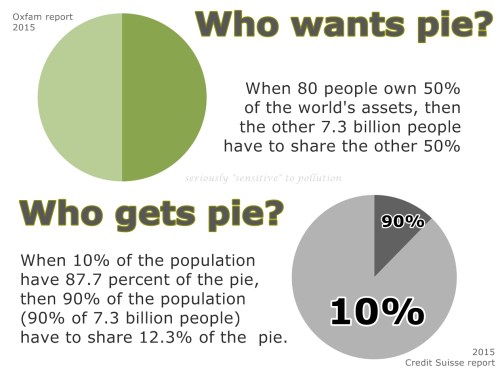
When 10% of the population is hoarding 87.7% of the global asset pie, and when 90% of us have just 12.3% of the pie, how many have no access to pie at all?

This has to change if we are to have future human generations on this planet, the only place which is uniquely suitable to provide what we need to live healthy, loving lives, if only we would respect and care for it and each other!

Think about this, over and over again, until it sinks in…

When 80 people own 50% of the world’s assets, then everyone else (the other 7.3 billion people who live on this planet) have to share the other 50%. (Oxfam, 2015)

That is, 7.3 BILLION people share 1/2 of the pie, while just 80 people share the other half… but it gets worse:

“Since the release of the Oxfam report in January, Credit Suisse released a new report validating the concern for the acceleration of global income disparity as the richest ten percent of people now hold 87.7 percent of all wealth.”
 

pie

Meaning some portion of  90% of the population have 12.3% of the global pie…

This is a very graphic view of what is wrong in the world today, why so many people are seriously sick and dying at astonishingly younger ages (as several new reports this year show), and why so many of us don’t have access to even very basic needs.

I believe that we can work together to bring things back into harmony with each other and the planet that supports our lives and existence.

We have to act now to change this, and it starts with reconnecting with our hearts!

Continue reading

Can You Imagine A World Where…

imagine a world

Can you imagine a world where it’s unacceptable to profit from polluting people and the environment we all depend on for life?

Someone imagined it was ok to pollute for profit, it wasn’t always happening or acceptable.

What if it’s possible to live good lives while looking after the planet and each other?

For things to change, we have to imagine something different first.

Then, if we can imagine it, we can work together to make it happen!

which world do we want 2

About Those Fragrance-Free Laundry Products

Some of us have gone to great lengths to encourage others to use fragrance-free products, especially for laundry, as many of the chemicals in fragrances cause such  disabling effects for us.

Not only that, but fragranced laundry products pollute entire neighbourhoods with hazardous chemicals when pumped out of dryer vents (which were designed to emit moisture, not toxic chemicals), meaning that we (and others with asthma, migraines, COPD, etc) can’t sit or work outside in our gardens, open our windows for fresh air, or go for walks safely when other people are doing laundry with regular commercial  products (and when are they not?), because we could be felled at any time from the emissions.

Much to our chagrin, many of us have discovered that some fragrance-free products can also make us dizzy, cause breathing difficulties like asthma, create cognitive confusion and memory problems, give us headaches, chemical hangovers, and more.

This has caused all kinds of difficulties, not just for us, but for the people who switched products only to discover that their efforts were not “good enough” for us.

“Can’t they EVER be happy?  Why are they still complaining?”

Anne Steinemann’s recently published research regarding VOCs emitted from regular personal care, cleaning, and laundry products, (the popular ones used by most people in the “developed” world) sheds some much needed light on the problems.

So what did she find?

Continue reading

Being a Caring “Consumer”, Giver, and Receiver of Gifts

‘Tis the season when we are encouraged or expected to participate in mad shopping frenzies, buying products that are mostly toxic and usually generate vast quantities of waste to boot. On some level, I believe most people know that this isn’t working out so well for anyone, but it’s hard to know why it’s so hard for people to show love in ways that don’t involve disposable packaging and toxic materials that are advertised as being cool or trendy. Or maybe it’s the advertising that has something to do with it?

Thankfully, we do have available a plethora of alternative ways to show our love to friends and families, and the trendiness factor is growing. There are ways that are kinder, gentler, more personal, and usually much more appreciated

more love

I’d like to share some ideas and resources that I have found helpful. Some are newer while others have been around for years but are still very relevant now, if not more so.

I hope you find something that not only inspires you, but also makes your life easier and allows you to become more attuned to your own gifts and needs, as well as those of others.

Continue reading

There’s Petrochemicals in What?

We now breathe, drink, eat and wear petrochemicals every where, every moment, every day! There’s no getting away from them!

Where are they coming from?

“The petroleum industry includes the global processes of exploration, extraction, refining, transporting (often by oil tankers and pipelines), and marketing petroleum products… Petroleum (oil) is also the raw material for many chemical products, including pharmaceuticals, solvents, fertilizers, pesticides, and plastics.”

(https://en.wikipedia.org/wiki/Petroleum_industry)

So many of the things we use (and consume) are being made from petrochemicals.

eau de petrochemical pollutants

Check out these two charts:

Continue reading