Category Archives: Fragrance

Harm Reduction Policy for People With Autism

Recent research that Anne Steinemann conducted in  three countries (United States, Australia, and the UK), found that 83.7% autistic adults reported adverse health effects from exposures to  fragranced products, effects such as:

migraine headaches (42.9%),
neurological problems (34.3%),
respiratory problems (44.7%), and
asthma attacks (35.9%)

In particular,
62.9% of autistic adults report health problems from air fresheners or deodorizers,
57.5% from the scent of laundry products coming from a dryer vent,
65.9% from being in a room cleaned with scented products, and
60.5% from being near someone wearing a fragranced product.

Health problems can be severe, with 74.1% of these effects considered potentially disabling under legislation in each country. Further, 59.4% of autistic adults have lost workdays or lost a job, in the past year, due to fragranced product exposure in the workplace.

Results show that vulnerable individuals, such as those with autism or autism spectrum disorders, can be profoundly, adversely, and disproportionately affected by exposure to fragranced consumer products.

Continue reading

The Fragrance-free Checklist


It seems like the best way to clear up some confusion about being fragrance-free, is to provide a checklist of products and places where fragrances that can make you not be fragrance-free are found, so that you don’t inadvertently bring fragrances with you when going  somewhere with a strict fragrance-free policy.

The checklist addresses some common misconceptions about what being fragrance-free really means.

Being fragrance-free is about more than not using perfume or cologne.
It’s also not about skipping deodorant, as some people seem to think.

Continue reading

When Someone Says They’re Fragrance-Free, But

When someone says they’re fragrance-free, but

they smell like

essential oils, febreze, scented candles, plug-in air effers, &/or air effing sprays…

When someone says they’re fragrance-free, but

Continue reading

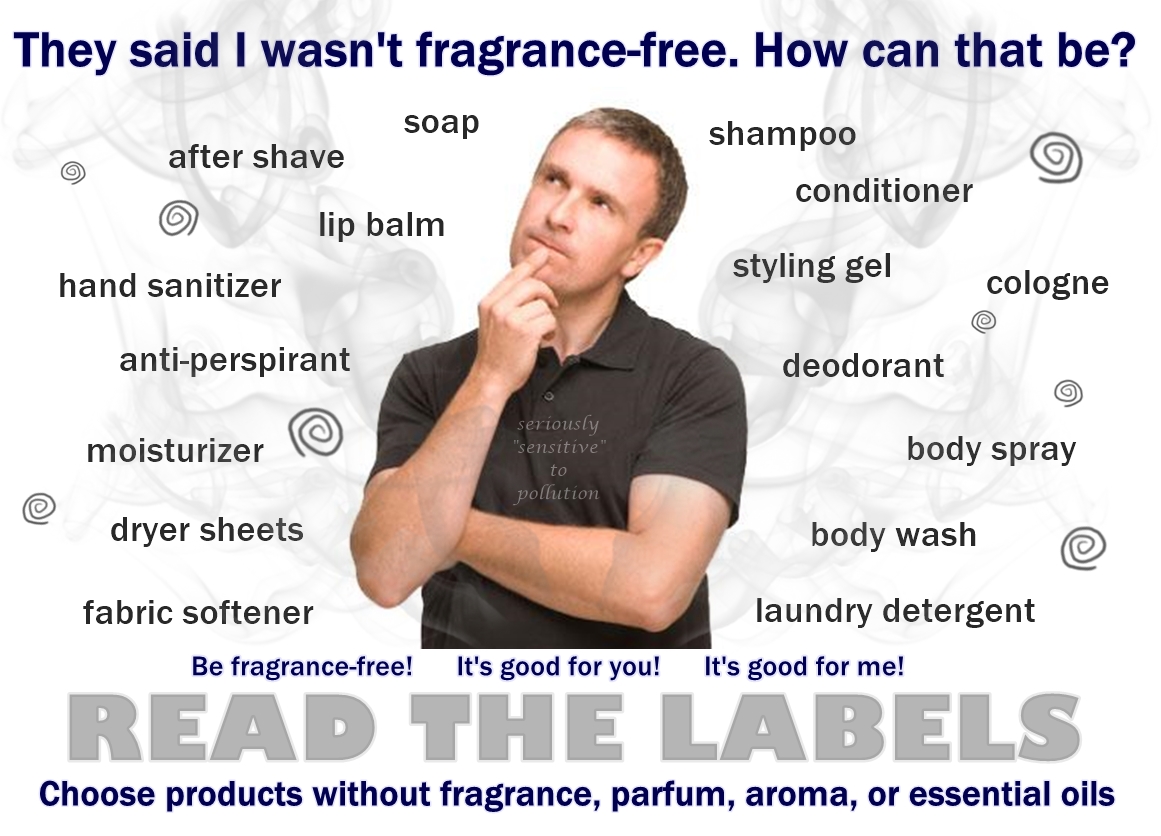
They Said I Wasn’t Fragrance-Free. How Can That Be?

Has anyone ever asked you to be fragrance-free or told you that your fragrance is affecting their ability to function in some way, and you didn’t know what they were talking about?

You may or may not have heard that fragrance-free policies are becoming much more common now since so many people are being adversely affected by fragranced products.

Unfortunately, many people still don’t know why fragrance-free products are healthier for themselves and others, or unaware how common fragrances are!

It’s not just perfumes and colognes!

I’ve had people tell me they didn’t use any fragrance when they couldn’t name a single product they used for laundry or personal care and cleaning.

I’ve had people tell me they didn’t have any fragrance on when all of their products had fragrance listed in the ingredients.

People have also said “but I don’t smell anything”, or “I only used a little this morning” (or yesterday, or the day before yesterday).

They Said I Wasn’t Fragrance-Free. How Can That Be?

Think about that! Read the labels on all of your products, if you haven’t already.

There are all kinds of undisclosed and toxic ingredients in everyday fragranced products that are  linked to cancer, birth defects, and other chronic illnesses.

And it’s not only the fragrances from the products you washed with or applied to your body, or the residues of laundry products in your clothing that are problematic!

Did you ever walk into a room where people were smoking, or have have smoked in the past?

Continue reading

Health Canada and Chemicals in Fragranced Products

This report from the Auditor General of Canada came out in 2016. Nothing has changed as far as I have seen, and I keep my eyes open for these kinds of things.

“The Office of the Auditor General of Canada (OAG) conducts independent audits and studies that provide objective information, advice, and assurance to Parliament, territorial legislatures, boards of crown corporations, government, and Canadians.”

Here’s a short video, followed by the transcript,  more from the report, and some relevant bits from a follow up by Health Canada:

Chemicals in Consumer Products and Cosmetics


Video Transcript

Continue reading

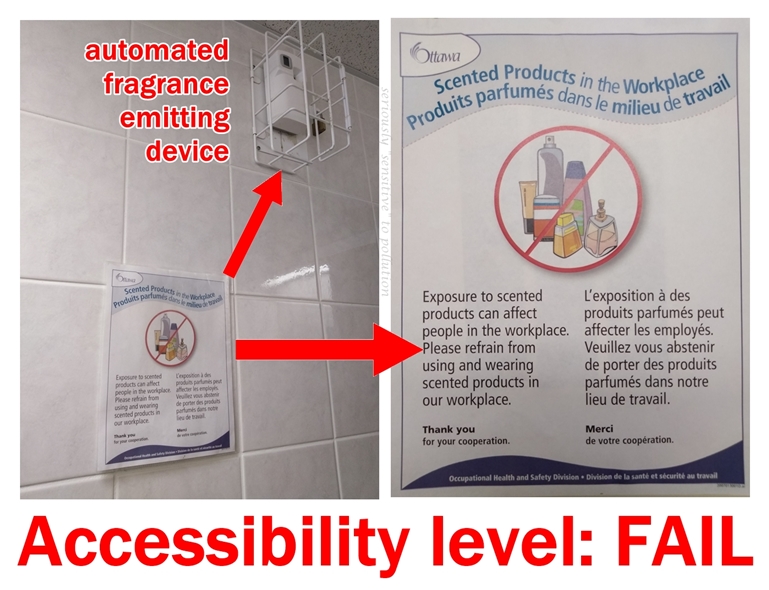
How NOT to Do a Scent (or fragrance) Policy

This is why so many people with MCS/ES, MCAD/MCAS, asthma, migraines,  and fragrance allergies and sensitivities lose their jobs and end up  housebound.

When policies are mere wallpaper, they become dangerous.
Real people’s lives and well-being are threatened.

Please, do not put up a sign if you are not going to respect or enforce it.

Continue reading

Sharing My Truth

Jacqueline originally shared her public speaking experience at a noncompetitive StorySlam with the theme ‘Misunderstood’ in a fb group, and very graciously accepted my invitation to share her story here with you.


Guest Post by Jacqueline Rice

Photo of me sharing my truth @ Ex Fabula (from stories), the MKE storytelling organization.   Photo from Ex Fabula


Here’s the excerpt from the blog entry from their website:

Invisible Stories

“Not all stories have a resolve, but instead bring a call to action. Like Teller Jacqueline, who shared her invisible disability with the crowd. Due to carbon monoxide poisoning Jacqueline was forced to alter her lifestyle in dramatic ways. Her exposure to carbon monoxide caused her to be intolerant to chemicals such as perfumes and sprays. Because of this, Jacqueline can’t be in many public spaces. Thank you, Jacqueline, for using your voice and story to advocate for many others with invisible disabilities.”

How it felt for me at the mic in front of 200+ people: Continue reading

Quote

Judge Brett Kavanaugh’s Father Made a Fortune Representing the Fragrance Industry

This really stinks.
These guys don’t care how much anyone suffers if they can keep profiting.

via Judge Brett Kavanaugh’s Father Made a Fortune Representing the Fragrance Industry

“According to an article published by the New York Times on July 14, 2018, Judge Brett Kavanaugh’s father, Edward Kavanaugh, “was paid $13 million, including his retirement package, in 2005, his last year at the Cosmetics, Toiletry and Fragrance Association,” an organization of which he became president in 1972.  His yearly salary at the point of his retirement was $5 million. ” …

no more

Continue reading

11 Reasons To Stop Using Fragrances and Implement Fragrance-free Policies

Here are 11 excellent  reasons to stop using and allowing fragrances in your home, at work,  in healthcare, in housing, at school, in transportation, in retail, and in other public places:

Continue reading

Acts of Festive Kindness

Christmas, Birthdays, and Other Holidays with MCS/ES

For most people, these special occasions are times of joy and celebration in the company of friends and loved ones, but for people with invisible disabilities and chronic illnesses like MCS/ES, they can be sad reminders of the lives that we no longer have  access to.

We are still seldom  included in the festivities and are usually left alone to fend for ourselves. Unfortunately, since human beings are social beings, not everyone is well equipped to self occupy, and  some people become seriously depressed and even suicidal because of this.

To realize it’s because some friends, family, neighbours, and co-workers prefer to keep using certain products instead of using other products so we can safely be around them and enjoy their company,  makes it even harder for us, knowing they care more about the products they buy than they care about us. It’s a heart breaking thing to have to live with.


  Thankfully, not everyone chooses products over people 


Before I became too chemically injured to socialize in crowds, I had a wonderful friend who happily made the effort to make her place and parties safe for me!

In 2005  her invites were all sent out with these words:

Continue reading