Category Archives: Policy

They Said I Wasn’t Fragrance-Free. How Can That Be?

Has anyone ever asked you to be fragrance-free or told you that your fragrance is affecting their ability to function in some way, and you didn’t know what they were talking about?

You may or may not have heard that fragrance-free policies are becoming much more common now since so many people are being adversely affected by fragranced products.

Unfortunately, many people still don’t know why fragrance-free products are healthier for themselves and others, or unaware how common fragrances are!

It’s not just perfumes and colognes!

I’ve had people tell me they didn’t use any fragrance when they couldn’t name a single product they used for laundry or personal care and cleaning.

I’ve had people tell me they didn’t have any fragrance on when all of their products had fragrance listed in the ingredients.

People have also said “but I don’t smell anything”, or “I only used a little this morning” (or yesterday, or the day before yesterday).

They Said I Wasn’t Fragrance-Free. How Can That Be?
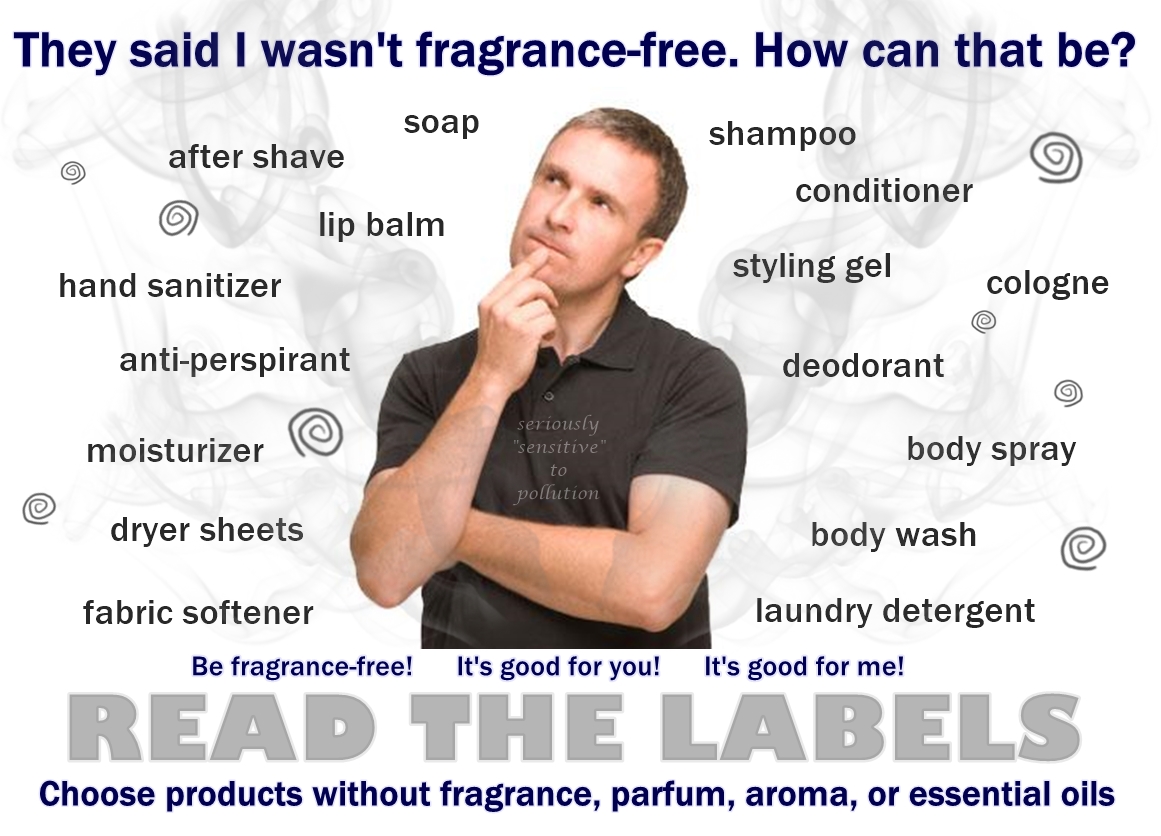
Think about that! Read the labels on all of your products, if you haven’t already.

There are all kinds of undisclosed and toxic ingredients in everyday fragranced products that are  linked to cancer, birth defects, and other chronic illnesses.

And it’s not only the fragrances from the products you washed with or applied to your body, or the residues of laundry products in your clothing that are problematic!

Did you ever walk into a room where people were smoking, or have have smoked in the past?

Continue reading

UK’s Clean Air Strategy 2019 Addresses Product VOCs

The UK has released their Clean Air Strategy 2019 document and it contains some groundbreaking measures that, if implemented, will have very positive impacts on the environment and our health.

It encompasses many areas of air pollution, including indoor air pollutants for the 1st time in any meaningful way, which as NOAA recently pointed out, have as large an impact on outdoor air pollution as vehicle exhaust!

The few news reports I saw did mention air “fresheners” and perfumes, with some building materials, but didn’t get into details. I had to dig through the document and what follows is most of what pertains to our interests here, being seriously sensitive to indoor pollutants.

I’m sure that other sources will focus on the regular types of outdoor pollutants quite well, while mostly ignoring the indoor products and materials, so I will not touch upon them, except for a few illustration screenshots  from the report.

I’ve added  very little of my own commentary. It’s almost entirely copied and pasted (and reformatted) from their document, so you can see for yourself what their plans are regarding NMVOCs (non-methane volatile organic compounds) from consumer products and materials that leave so many of us disabled and housebound, and unfortunately, far too rarely in a home that protects us from exposures and contributes to our well-being.


Among other types of pollutants, the executive summary of the report includes:

Chapter 6: Action to reduce emissions at home

Many people are unaware that emissions in the home increase personal exposure to pollutants and contribute significantly to our overall national emissions.

Burning wood and coal in open fires and stoves makes up 38% of the UK’s primary emissions of fine particulate matter1 (PM2.5). Harmful sulphur dioxide (SO2) is emitted by coal burned in open fires.

Non-methane volatile organic compounds (NMVOCs) from a wide variety of chemicals that are found in carpets, upholstery, paint, cleaning, fragrance, and personal care products are another significant source of pollution.

We will:

Continue reading

Health Canada and Chemicals in Fragranced Products

This report from the Auditor General of Canada came out in 2016. Nothing has changed as far as I have seen, and I keep my eyes open for these kinds of things.

“The Office of the Auditor General of Canada (OAG) conducts independent audits and studies that provide objective information, advice, and assurance to Parliament, territorial legislatures, boards of crown corporations, government, and Canadians.”

Here’s a short video, followed by the transcript,  more from the report, and some relevant bits from a follow up by Health Canada:

Chemicals in Consumer Products and Cosmetics


Video Transcript

Continue reading

When There’s No Accessible Potty


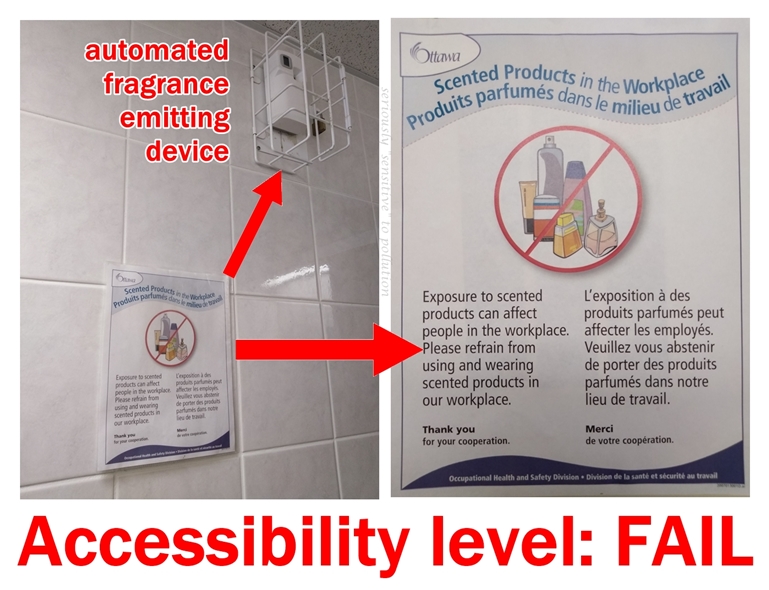
This washroom isn’t accessible:


neither is this one:


nor are the Ontario highway and other washrooms that have these installed:

Pesticides and fragrance! What could go wrong?


Many of us cannot go into a washroom that has an air effer or scented soap.

“In addition to the possibly life threatening immediate and delayed adverse health effects, “our clothes are contaminated and need to be aired out for days before we can even wash them or they contaminate more of our clothes.”
(from a  fb comment on the last post
)

So what to do?

Continue reading

How NOT to Do a Scent (or fragrance) Policy

This is why so many people with MCS/ES, MCAD/MCAS, asthma, migraines,  and fragrance allergies and sensitivities lose their jobs and end up  housebound.

When policies are mere wallpaper, they become dangerous.
Real people’s lives and well-being are threatened.

Please, do not put up a sign if you are not going to respect or enforce it.

Continue reading

Quote

Judge Brett Kavanaugh’s Father Made a Fortune Representing the Fragrance Industry

This really stinks.
These guys don’t care how much anyone suffers if they can keep profiting.

via Judge Brett Kavanaugh’s Father Made a Fortune Representing the Fragrance Industry

“According to an article published by the New York Times on July 14, 2018, Judge Brett Kavanaugh’s father, Edward Kavanaugh, “was paid $13 million, including his retirement package, in 2005, his last year at the Cosmetics, Toiletry and Fragrance Association,” an organization of which he became president in 1972.  His yearly salary at the point of his retirement was $5 million. ” …

no more

Continue reading

Fragrance-Free Initiative From UC Boulder’s OIT


The Fragrance-Free Initiative from the University of Colorado Boulder’s Office of Information Technology (OIT) has created a video I really like,  and they have also put together some other resources that can be useful to learn from when creating fragrance-free policies.

Continue reading

Open Letter to the Ontario Minister of Health and the MOHLTC

Dear Minister of Health, we’re ready for action!

According to official statistics:

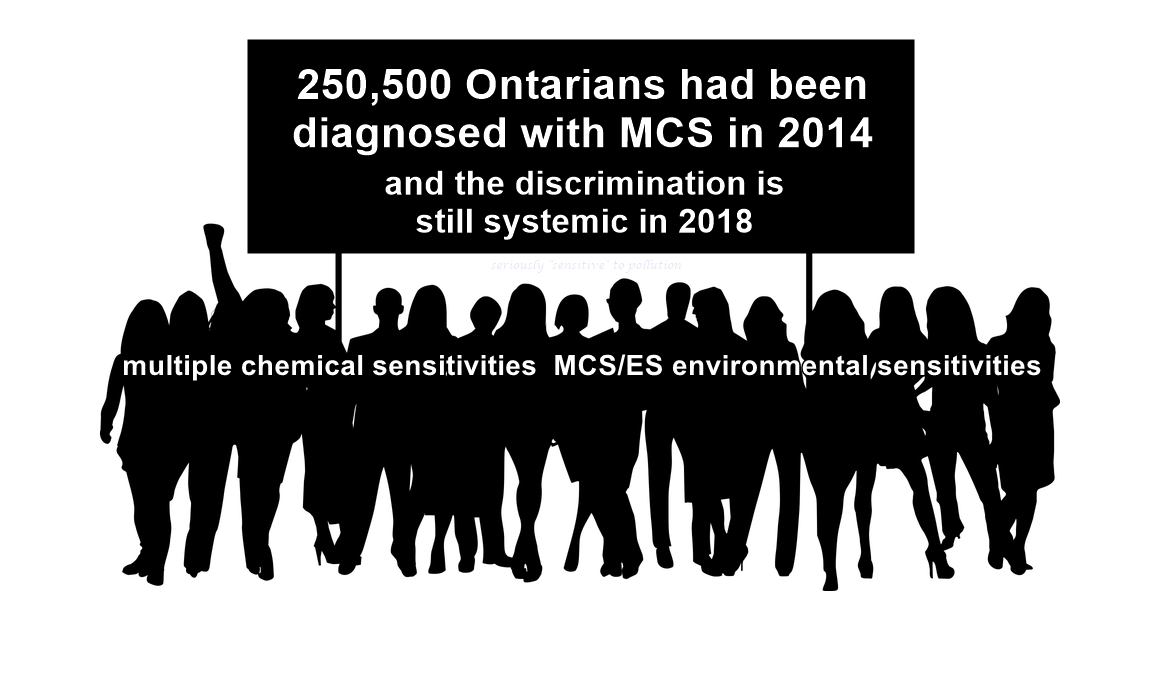
250,000 Ontarians had been diagnosed with MCS in 2014
and the discrimination is still systemic in 2018

SUBJECT: Accommodation for People with Disabilities

Honourable Helena Jaczek, Minister of Health (at hjaczek.mpp@liberal.ola.org )


On September 29, 2017,
Ontario  quietly released the report “Time for Leadership: Recognizing and Improving Care”  for those with myalgic encephalomyelitis /chronic fatigue syndrome, fibromyalgia, and environmental sensitivities /multiple chemical sensitivity  (ME/CFS, FM and ES/MCS). This report  was produced by the Task Force on Environmental Health for the Ministry of Health and Long Term Care.

The report found that throughout the Ontario health care system and in society at large, there is:

• a lack of recognition of the seriousness and severity of these conditions
• a profound shortage of knowledgeable care providers
• a dearth of clinical tools to support and guide care
• a discouraging shortage of services and supports for people living with these conditions
• an absence of support for family caregivers

The lack of knowledge and appropriate accessible care has devastating effects on Ontarians struggling with ME/CFS, FM and ES/MCS.

Continue reading

Ontario’s Task Force Releases its Phase 1 Recommendations to help people suffering from chemical sensitivity but health ministry abdicates again. Here’s a new take on that report.

An important update on the situation in Ontario, from Varda Burstyn, one of the original members of the Task Force on Environmental Health.

Please read and share, and find a way to put pressure on the elected reps, and if possible, get much needed media attention on this travesty of justice!

Note too that it’s not just for us, it’s a public health issue when over 50% of children have chronic health problems (including preschool kids with disabling anxiety), and something like 2/3 of the population on at least one pharmaceutical drug. We know that removing the cause of the problem results in better health than ineffectively trying to manage some symptoms!

When the canaries are ignored, public health suffers!

Varda Burstyn's avatarDispatches from The Chemical Edge

Hundreds of thousands are sick – and after 33 years, Ontario government again declines to implement basic measures of care

 Extracted pages from task_force_on_environmental_health_report

“These three environmental health conditions typically have a devastating impact on the individuals affected. Unfortunately, our health care system too often has not helped them to the extent they need. The report of the Task Force sets out a course that will begin to remedy this. I look forward to seeing the Minister’s response to our report, and urge him to respond quickly and decisively. There is a need for strong leadership.“ Neil Stuart, Vice-Chair of the Task Force.

Few people have any idea of the number of people in Ontario afflicted with the debilitating, painful, often co-occurring and even life-threatening conditions of Environmental Sensitivity/Multiple Chemical Sensitivities (about 310,000), Myalgic Encephalomyelitis/Chronic Fatigue Syndrome (about 215,000) and Fibromyalgia (about 196,800). But it turns out that, in total, there are a…

View original post 2,692 more words

Statement From ARCH and CELA re MCS, ES, and the Ontario Task Force on Environmental Health

The ARCH Disability Law Centre and the Canadian Environmental Law Association (CELA) announced in September of 2016 that they were working on a report about the challenges faced by people with multiple chemical and/or environmental sensitivities.

ARCH Alert September 2016

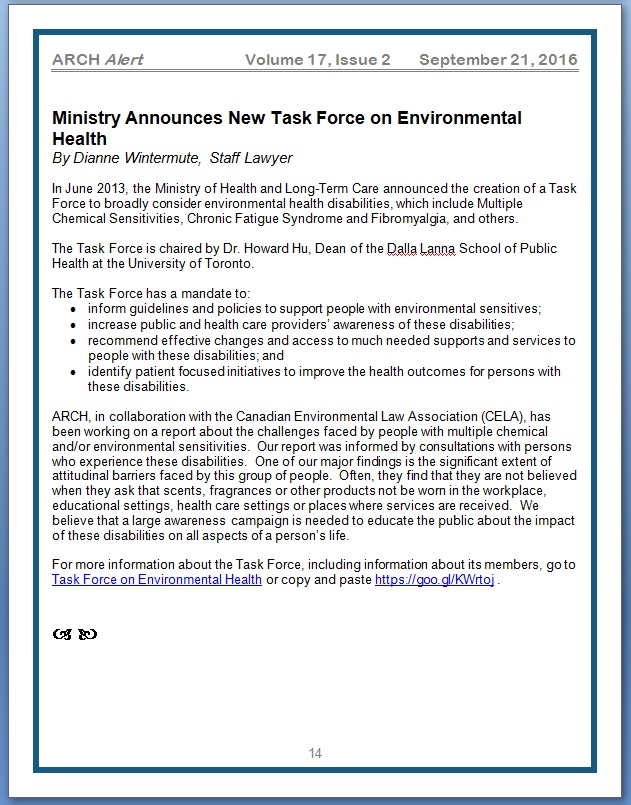
“ARCH, in collaboration with the Canadian Environmental Law Association (CELA), has been working on a report about the challenges faced by people with multiple chemical and/or environmental sensitivities.  Our report was informed by consultations with persons who experience these disabilities. 

One of our major findings is the significant extent of attitudinal barriers faced by this group of people.  Often, they find that they are not believed when they ask that scents, fragrances or other products not be worn in the workplace, educational settings, health care settings or places where services are received.  We believe that a large awareness campaign is needed to educate the public about the impact of these disabilities on all aspects of a person’s life.”


The release of their report has been delayed because they want to respond to the Ontario Task Force on Environmental Health’s Interim Report, which came out just when their own report was intended for release.

In the November 2017 issue of Arch Alert, both ARCH and CELA  urge the Task Force to do more consultations with those of us who are living the experience:

Continue reading