Tag Archives: Fragrance

Unilever to Disclose Some (but not all) AXE and Other Fragrance Ingredients

Unilever, the company responsible for making disabling products like AXE (aka LYNX) has announced they will be expanding their product ingredient lists  to include fragrance ingredients above 0.01 percent (100 parts per million) in a product’s formulation (via the SmartLabel app, but not on the actual labels *)

Here’s what we need to know:

* 20 parts per million (ppm) is the FDA’s standard for ‘gluten-free’ *

Which means that people who are allergic or “sensitive” can suffer serious and life threatening effects from substances at well below 100 ppm, and we still won’t know what is causing the symptoms, or what we need to avoid to stay alive.

unilever-banner

This plan may help people who aren’t knowingly or immediately affected by fragrance exposures to choose their products more wisely, but it doesn’t go nearly far enough to help those of us who are disabled by or have life threatening reactions to their products.

Edited to add:

Unilever’s fragrance transparency is a major green-wash at 100 ppm, when gluten-free has to be below 20 ppm, and people with isothiazolinone (aka MI) allergy react to as little as 3 ppm, perhaps less.

Also,  long-term health limit for fumes from dry-cleaning solvents has dropped from 20 parts per billion to an infinitesimal 2 parts per billion because long-term exposure to even very low concentrations can result in cancer, as well as fetal development problems for pregnant women.

Other interesting tidbits about Unilever:

Continue reading

Why?

Why do people who lose their health from being polluted and poisoned for profit end up being forced into isolation and invisibility in order to try to remain alive?

mcs prison visit crying-game 2

Why?

Continue reading

Are the Wrong People in Solitary Confinement?

Who should be isolated?

The poisoned or the poisoners?

When we develop MCS/ES, we are told to avoid the triggers that disable us. Yet, far too often, fragrance chemicals are the biggest triggers of disabling effects, yet they are in everything, and everywhere now.

To follow doctors orders, and to have some quality of life (like the ability to look after ourselves), when others at work or elsewhere won’t stop using toxic products,  we have to stay isolated in our homes (if we’ve found a safe one).  It’s just like being in prison… but for crimes we did not commit.

WE who are immediately disabled by these harmful pollutants are being forced into prisons of isolation for crimes the chemical and fragrance industry are committing, like when they hide  oil and gas industry toxic waste chemicals into everyday products and materials, without listing them on labels, they are causing a public health crisis, a crisis that  most people are unaware of.

WE who become disabled are being imprisoned for their crimes of saturating people (and our air and water) with toxic chemicals, and so, if we are to be able to see our friends and loved ones, we need to be protected from them, in environments kind of like this:


Continue reading

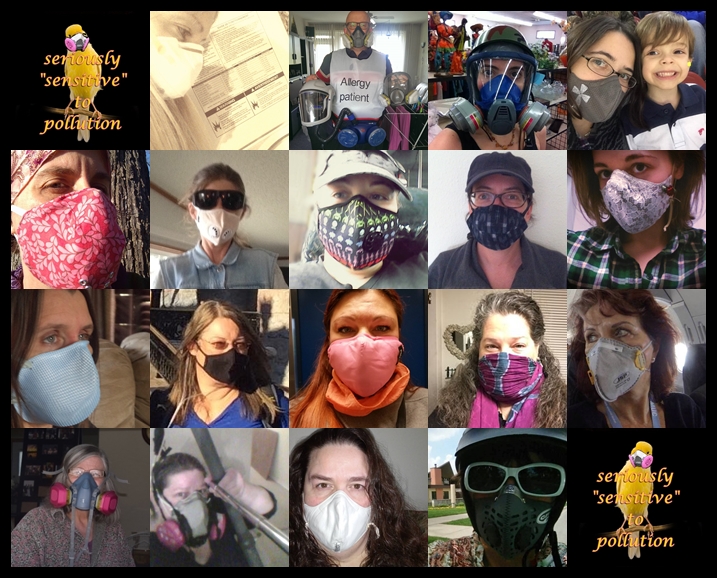
The Courageous Canaries of MCS/ES (and mask) Awareness Month 2016

2016 MCS-ES Awareness Month Compilation

Many thanks to the Courageous Canaries of MCS/ES (and mask)
Awareness Month 2016!

Your courage, kindness, and willingness to share your photos and stories in the “What I Wear in Bad Air” series generated a lot of discussion in various support groups, and will benefit so many others who can see some of the options that are available, as worn by their peers, and that it’s more than ok to be visible. Continue reading

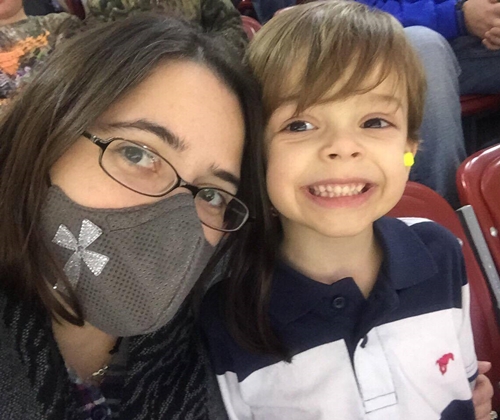
What I Wear in Bad Air :: Melanie

2016 Melanie and Jaiden 1Melanie and Jaiden

When I wear my mask I noticed people couldn’t see me smile at them and would avert their eyes and not smile at me.

I will usually speak and say hello. Most people will nod or say hello back even if they don’t smile or look at my eyes. Some will shrink away like I have Ebola. I’ve felt like a leper when that happens. I just hate that my kids are learning that lesson about humanity so young. I hope it will help instill a more compassionate nature in them as they see how not to be.

I started using fabric stickers on my mask sometimes and noticed that people would smile at them. I felt less invisible even if it was my stickers they smiled at more than me. I have several different ones including penguins, crosses, and holiday relevant ones I wear around Christmas time.

Continue reading

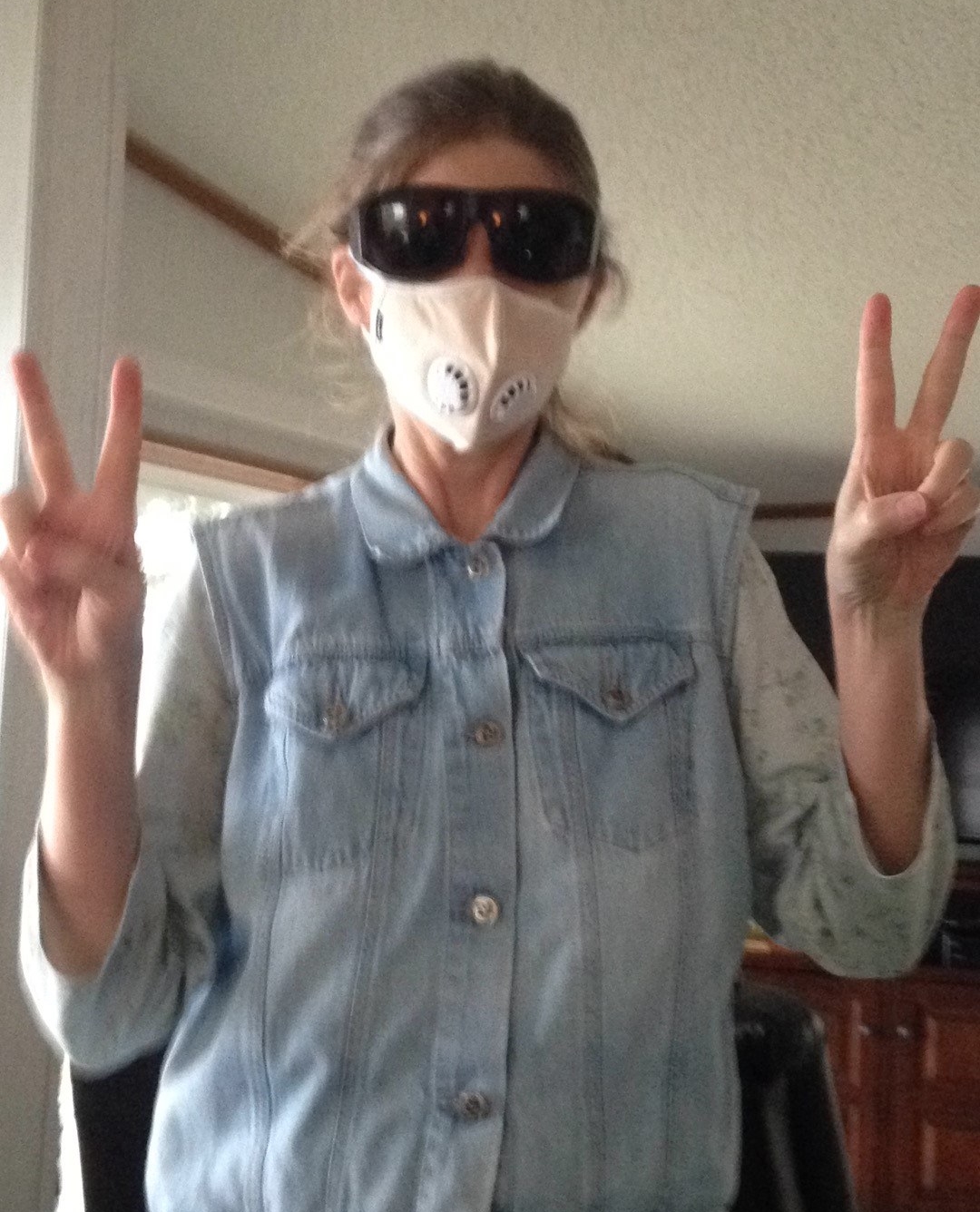
What I Wear in Bad Air :: Lisa T

2016 Lisa Mary T

This photo was taken of me at my parent’s home, to demonstrate how I attempted to protect myself to be able to visit them, 2000 miles away.

When I can’t avoid exposures, I wear a mask to try to keep as functional as possible. Exposures affect my brain, my breathing, and I get more exhausted, etc. Even without the mask, I have challenges with my brain, breathing, energy, etc. Wearing the mask weakens me but not as much as a direct exposure would.

I am sensitive to chemicals in perfume, cologne, aftershave, hair care products, hand sanitizer, sunblock, air “freshener”, chlorine, white board and markers, building materials, cleaning products, laundry soap, dryer sheets, paints, pesticides, gasoline fumes, gas appliances, some plants, new asphalt, etc.

Continue reading

What I Wear In Bad Air :: E.P.


2016 E.P.

“I wear this whenever I leave the house, like when taking my child to the park, or walking by people and homes. I had to wear it indoors as well when I lived in an apartment building, because I get sick from exposure to wafting perfume, and dryer vent laundry scents in the air. Even outside it is impossible to avoid these scents blowing in the air and from people walking by.”

~ E.P.

For more info on masks see:

Continue reading

People All Around the World Are Seriously “Sensitive” to Pollution

Here’s a screenshot of where you all are from!2016 readers are global

Most readers are from the US of A, followed by Canada, the UK, and Australia (which makes sense from a language perspective) and thousands more visitors are from 119 other countries!

The blog’s facebook page followers are said to be from 45 countries all around the world, and apparently communicate in 24 different languages!

Being “sensitive” to pollution is truly a global issue!

There is no away!

I wish there was no need for what I do here, that pollution wasn’t profitable, and that we could all access everything we need for health and well-being.

Living beings were not designed to withstand 24/7 exposures to toxic pollutants, toxic foods, and wireless radiation (like from wi-fi and smart meters).

Hopefully what I share with you all encourages you to eliminate toxic and harmful products and materials from your lives, and to speak up and out, so that we aren’t invisible to the world, because we are all over the world, we are all “sensitive” to pollution, and we are all in this together!

cropped-blog-banner-heart-and-flags.jpg


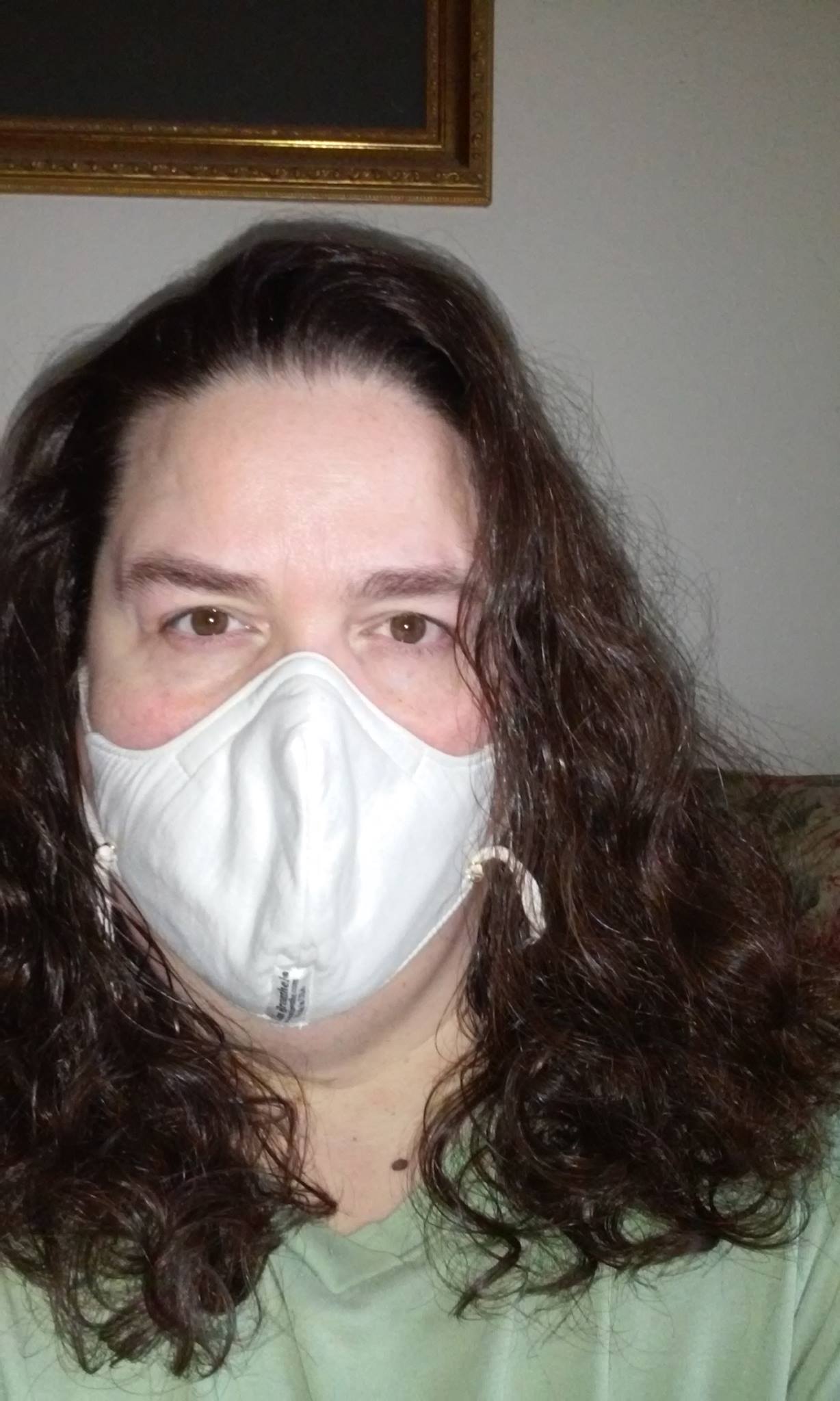
What I Wear In Bad Air :: Debbie


2016 Debbie Clark Seely

“This is me in my mask. I keep it right next to me in case I have to put it on quickly. I used to only use it when I went to the grocery store, but I haven’t been inside a store since July 2015.  I still end up needing it for when people come in my home or my neighbor’s laundry scent comes in.”

~ Debbie Clark Seely


For more info on masks, please see Continue reading

For Me, MCS Means …

mcs es invisible disability framed“For me, MCS means having to wear a mask when I go out”

MCS Awareness Month Guest Post from Laura J Mac

Multiple Chemical Sensitivity or MCS (also known as Environmental Sensitivities) is a chronic and disabling condition characterized by symptoms from low-level exposures to common chemicals. To put it simply, really common chemical exposures are disabling to some people, even in very small amounts.

ES has been recognized as a disability in Ontario since 2000, and federally (in Canada) since 2007, yet most people, and in fact many medical professionals, have never heard of it.

May is MCS Awareness Month, though I promise you, we are aware of it all year!

Instead of asking others to imagine something so unimaginable, we asked 1500 people with MCS to share what life is like with MCS. These memes are some of the responses.*

Continue reading