Tag Archives: hazardous air pollutants

Fragrances, Hormones, Women, and Children

While these resources are primarily directed at women of childbearing age and children, they are really applicable to all of us. If a mother stops using perfume, but the father still piles on the scented deodorant, aftershave, and cologne, then his sperm, the mother, and children (born or unborn) are still being exposed to harmful chemicals.

If other family members, friends, and places like daycares are using scented laundry,  personal care, and cleaning products, they too are putting moms-to-be and kids at risk.

The adverse effects from these chemicals can be life-long, even longer. Our exposures can affect our grandchildren. Eliminating them from our lives now will ensure better health all around, including downstream, where fish and wildlife are also being affected.

WECF Pregnancy and EDCs

The short video below, produced by Women in Europe for a Common Future  (WECF), provides simple, important information on how you can protect yourself and your child from Endocrine Disrupting Chemicals (EDCs). They are found in so many places now.

WECF have also developed a new website, NESTING, which is another good resource for all of us. They have assembled a lot of good advice there.

Here’s an example from their Cleaning & personal care page:

Continue reading

Do It Yourself Air Filtering Mask

When air is polluted both indoors and out, when people use fragrances and other products with toxic chemicals, when we are made ill and disabled by the pollutants, then we can’t wait for better regulations to take effect, we need to do something to protect our health now.

Sometimes we can buy masks that work for us, especially if we tolerate synthetic materials, but sometimes making our own is the only way. When we make our own, we can use safe-for-us fabrics and even coordinate them to our outfits (if we’re lucky enough to have safe-to-wear outfits).

Some people use scarves as masks. You can sew a pouch on the inside to hold filtering Continue reading

3o Things

30 Things

The following is a list of products many of us use or have contact with every day. Each and every one of these usually contains unregulated synthetic chemical ingredients, many of which pose known health hazards.

How many of these things did you touch or breathe in today?
What is protecting you?

Continue reading

Are Essential Oils Too Popular For Our Own Good?

Did you know that essential oils are not harmless?

Essential Oils have been, in limited circumstances,  a good thing. Some have useful healing properties when used medicinally in very specific and temporary ways, but too much of anything is not a good thing. Essential oils  are now used and diffused everywhere, and have become more of a serious health hazard than something beneficial. Indeed,  for an ever growing percent of the population they have become life-threatening accessibility barriers.

They can be sensitizers and allergens, and can cause other serious health problems too.
They can emit and create hazardous air pollutants. Some are made with synthetic ingredients, or from pesticided plants, and are processed using toxic solvents.

They are WAY over-used and over-promoted, and any beneficial uses the organic oils may have, risk being lost due to this careless over-use.

They should not be used as a popular way to make money the way they are now.

They should be kept for medicinal use under the guidance of qualified, trained professionals, and  not the MLM (multi-level-marketing) folks who are inventing new ways to use them so that they can sell more product.

Some people have severe adverse reactions to them, and their proliferation is causing new barriers to access, meaning people can’t access food from health food stores,  other essentials, or even alternative health care, because the oils are so prevalent and contaminating everything (1st, 2nd, and 3rd hand) in what should be healthy places with clean, fragrance-free air.

Fore more information, here are a few links to check out: Continue reading

About Those Fragrance-Free Laundry Products

Some of us have gone to great lengths to encourage others to use fragrance-free products, especially for laundry, as many of the chemicals in fragrances cause such  disabling effects for us.

Not only that, but fragranced laundry products pollute entire neighbourhoods with hazardous chemicals when pumped out of dryer vents (which were designed to emit moisture, not toxic chemicals), meaning that we (and others with asthma, migraines, COPD, etc) can’t sit or work outside in our gardens, open our windows for fresh air, or go for walks safely when other people are doing laundry with regular commercial  products (and when are they not?), because we could be felled at any time from the emissions.

Much to our chagrin, many of us have discovered that some fragrance-free products can also make us dizzy, cause breathing difficulties like asthma, create cognitive confusion and memory problems, give us headaches, chemical hangovers, and more.

This has caused all kinds of difficulties, not just for us, but for the people who switched products only to discover that their efforts were not “good enough” for us.

“Can’t they EVER be happy?  Why are they still complaining?”

Anne Steinemann’s recently published research regarding VOCs emitted from regular personal care, cleaning, and laundry products, (the popular ones used by most people in the “developed” world) sheds some much needed light on the problems.

So what did she find?

Continue reading

Wendy is NOT a Widget and She Shouldn’t be Treated Like One

Wendy is NOT a widget. Widgets can go anywhere. Wendy can’t.

“Widget” is used in texts and speech, especially in the context of accounting, to indicate a hypothetical “any-product”. Companies in such texts will frequently be given names such as “ABC Widgets” or “Acme Widget Corp.” to indicate that the particular business of the hypothetical company is not relevant to the topic of discussion.
(Widget economics – wikipedia)

“Economists often use the term widget to refer to an abstract unit of production.”

Wendy is NOT a widget as her local housing authority seems to believe. They have a capacity problem, but instead of addressing the need for improved (and accessible) capacity, they want to re-arrange people’s lives as if they were widgets, with little to no regard or understanding of the consequences.

INVESTOPEDIA EXPLAINS ‘Capacity’

“The widget manufacturer may be able to produce 150,000 widgets in a month. However, due to downtime because of equipment maintenance and worker illness, only about 130,000 widgets can actually be produced per month. Over the long run, a business can increase its capacity and output by acquiring more factors of productions. For example, if market demand for widgets spikes, the widget manufacturer can buy more equipment and hire more workers, and thus increase its capacity to 175,000 widgets per month.”

Wendy is not a widget. She is a living, breathing, human being, a human being with a complex, chronic environmentally linked condition and disability related needs, needs that widgets don’t have.

Wendy Kearly photo by ADAM MACINNIS – THE NEWS

Wendy Kearly photo by ADAM MACINNIS – THE NEWS

The housing authority from which Wendy rents her safe home has deemed her over-housed, and are in the process of evicting her, despite the fact that Wendy has no other option for medically required, safe housing available, and no safe access to any of the other places most people take for granted (see below).

In the following audio interview with Wendy, among other things, she talks about the process her grown children take to detox themselves enough to be able to safely visit with her, so that she is able to safely hug them when they come to town.

Continue reading

Your Favorite Personal Care and Cleaning Products Went to the Lab, and They Came Back With This

Take a deep breath (or maybe not)

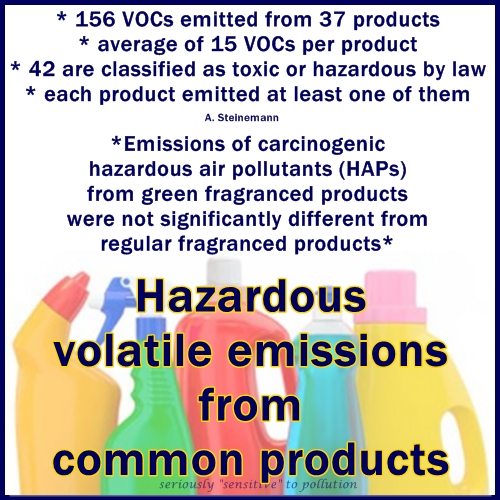
“This study found 156 different VOCs emitted from the 37 products, with an average of 15 VOCs per product. Of these 156 VOCs, 42 VOCs are classified as toxic or hazardous under US federal laws, and each product emitted at least one of these chemicals. Emissions of carcinogenic hazardous air pollutants (HAPs) from green fragranced products were not significantly different from regular fragranced products.”

Most homes are full of these products!!!

Indeed, most indoor environments (and everything in them) are now polluted with these VOCs due to the pervasive nature of these products and chemical compounds.

156 VOCs

From the research article:

Continue reading

What If an Industry was Allowed to Disable Us and Keep Us Housebound?

Something Is Really Wrong With This Picture

Imagine this 1

There’s a global proliferation of artificial fragrance and methods of dispersing it. Fragrance concoctions are added to almost everything imaginable (with more ridiculous ideas emerging all the time). They are sold and used everywhere at the same time as more people are developing adverse health effects from them, effects like serious allergies, disabling “sensitivities”, migraines, asthma, neurological disorders, lowered IQ, birth defects, etc. (the list keeps growing).

These health problems are due to unregulated and secret ingredients, ingredients which pollute our bodies, our air, and the waterways they get washed into from our sinks, tubs, and showers, ingredients that are impossible to avoid now, even when we don’t want them in our lives.

If you or your child had celiac disease or a severe peanut allergy, it would be the same as the peanut and gluten industries adding peanuts and gluten or peanut and gluten mist along with doses of mood altering drugs to every product imaginable, including building materials. That would be in addition to having peanut and gluten essences worn by everyone (in their hair, armpits, clothing …), pumped out of air ducts, automated devices in public washrooms, transportation, stores, apartments, offices, hotels, even medical offices, and your neighbours burning peanuts and gluten in their fireplaces, washing with laundry with them, and then pumping the residues out of their dryer vents 24/7.

You could imagine cat allergies too, but they are usually more inconvenient than life threatening and disabling.

The fragrance industry is very aware of the adverse effects its products have on people and the environment, yet they continue to look for more ways to pollute us and every product and environment conceivably possible. They knowingly create concoctions that harm and act like drugs! Yet they consider these risks reasonable and acceptable, and choose to dismiss or ridicule those who have problems, using similar tactics the tobacco industry used to deny there are problems and to continue to profit from them.

Continue reading

A Fine Fragrance for a Special Valentine

This is special, so special that you might be inspired in ways that surprise you!

MYSTERY 2MYSTERY… Should we trust the fragrance industry with our loved ones health?

We could buy products that are made by a self regulated industry that believes it’s ok to include many harmful chemicals (derived from petroleum and other fossil fuels) in their products (according to their member’s voluntary disclosure of over 3000 ingredients, which is as close to disclosure as they come) or we can show our love for each other by doing things that nurture long term health and well-being for each other and the planet we all depend on for life.

The choice is ours once we know it exists.

Here are a few more nourishing ideas for gifts of love:

Continue reading

Revolutionary Way to Freshen the Air

Freshening the air is big business these days. Polluting the air is also very profitable. Sadly, it’s usually similar chemicals  polluting the air as are in the substances sold to “freshen” it.

What does fresh air smell like?

fragrance emitting products smell like chemicals

Continue reading