When 90% of Us Share 12.3% of the Pie

I can’t get this out of my mind, as it really brings into focus why so many people have become chronically ill, and are dying younger from devastating new health problems and increasingly early  deaths (including suicides), because our true health and well-being is not profitable, and therefore what is needed is not available.

When access to safe, non-toxic, healthy air to breathe, water to drink, homes to live in, clothing to wear, health care, and other necessities of life are denied to so many people because everything that is manufactured now is made with so many toxic chemicals, including our food, because our current system allows corporations to pollute us for profit, without paying any of the costs (some of which are priceless), when the environment we depend on for life is destroyed and treated like a garbage dump, (as are our minds and bodies) then we are not going to survive as a species for much longer.

When 10% of the population is hoarding 87.7% of the global asset pie, and when 90% of us have just 12.3% of the pie, how many have no access to pie at all?

This has to change if we are to have future human generations on this planet, the only place which is uniquely suitable to provide what we need to live healthy, loving lives, if only we would respect and care for it and each other!

Think about this, over and over again, until it sinks in…

When 80 people own 50% of the world’s assets, then everyone else (the other 7.3 billion people who live on this planet) have to share the other 50%. (Oxfam, 2015)

That is, 7.3 BILLION people share 1/2 of the pie, while just 80 people share the other half… but it gets worse:

“Since the release of the Oxfam report in January, Credit Suisse released a new report validating the concern for the acceleration of global income disparity as the richest ten percent of people now hold 87.7 percent of all wealth.”


pie

Meaning some portion of  90% of the population have 12.3% of the global pie…

This is a very graphic view of what is wrong in the world today, why so many people are seriously sick and dying at astonishingly younger ages (as several new reports this year show), and why so many of us don’t have access to even very basic needs.

I believe that we can work together to bring things back into harmony with each other and the planet that supports our lives and existence.

We have to act now to change this, and it starts with reconnecting with our hearts!
Continue reading

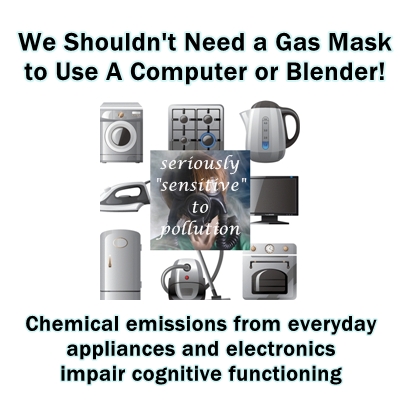
We Shouldn’t Need a Gas Mask to Use A Computer or Blender!

Ever notice how when you buy a new appliance or electronic device, and take it out of the box, or plug it in, the smell makes you nauseous, dizzy, and gives you a headache? Or worse?

That smell is made up of some really toxic chemical fumes. Benzene, styrene, and toluene, among others… in everyday technology!

.

New research from the Exposure, Epidemiology & Risk Program, Department of Environmental Health, Harvard T.H. Chan School of Public Health, on how the pollutants in indoor environments affect people’s cognitive functioning (people who are still able to work in polluted offices, not the people who are already too disabled to work in polluted offices) discovered that

Green office environments linked with higher cognitive function scores

…”People who work in well-ventilated offices with below-average levels of indoor pollutants and carbon dioxide (CO2) have significantly higher cognitive functioning scores–in crucial areas such as responding to a crisis or developing strategy–than those who work in offices with typical levels, according to a new study from the Harvard T.H. Chan School of Public Health’s Center for Health and the Global Environment, SUNY Upstate Medical University, and Syracuse University.

“We have been ignoring the 90%. We spend 90% of our time indoors and 90% of the cost of a building are the occupants, yet indoor environmental quality and its impact on health and productivity are often an afterthought,” said Joseph Allen, assistant professor of exposure assessment science, director of the Healthy Buildings Program at the Harvard Center for Health and the Global Environment, and lead author of the study.

“These results suggest that even modest improvements to indoor environmental quality may have a profound impact on the decision-making performance of workers.”

Researchers wanted to look at the impact of ventilation, chemicals, and carbon dioxide on workers’ cognitive function because, as buildings have become more energy efficient, they have also become more airtight, increasing the potential for poor indoor environmental quality.

Building-related illnesses and “sick building syndrome” were first reported in the 1980s as ventilation rates decreased. In response, there has been an emphasis on sustainable design–“green” buildings that are energy efficient and are also designed to enhance indoor environmental quality. The researchers designed this study to identify the specific attributes of green building design that influence cognitive function, an objective measure of productivity.

“The major significance of this finding lies in the fact that these are the critical decision making parameters that are linked to optimal and productive functioning. Losing components of these skills impacts how people handle their day to day lives.”

In other words, pollution prevents people from being smart!

appliance gas mask

Here are just some of the harmful emissions from computers:

Continue reading

When Programmers Send Old Computers Into ICU and Palliative Care

My computer and old Operating System have seen better days. Things are crashing almost hourly now. I am so grateful that the original donor was twice able to get this computer back up again (with telephone advice) after a partial freeze and fully appearing meld-down, but it is still malfunctioning online, so I have to shut it down frequently, as the sites I use seem to have updated using technology that is no longer inclusive of XP and my  minimal RAM (adding more would be cost-prohibitive).

I  therefore find myself in critical need of a new computer, even with all the toxicity and adverse health risks involved, and without the time to mitigate them (like running things somewhere else that is also fragrance free, for however long it takes to off-gas everything).

Eeks! image from pixabay 2

Here are some details:

Continue reading

Healthy Living Tips 101

Here are three simple Top Tips For Healthy Living (printable) PDFs, with clear information on things we must do to live healthier lives, including things to do and things to avoid, in order to prevent cancer and other health problems that are linked to all the everyday toxic exposures we are currently subjected to. Continue reading

Scent-Free Buildings Guide from CCIAQB

From The Canadian Committee on Indoor Air Quality (CCIAQB) 

“This Module provides building owners and managers with information about the sources and effects of scents and fragrances. It also suggests ways to move toward scent-free buildings. The information covers scents and fragrances brought into a workplace by people wearing personal products such as perfume as well as those scents and fragrances that originate from custodial products such as washroom hand soap.”

scent-free buildings guide banner

Continue reading

Down is Harder After Up

Alternate title: Be Grateful or Be Miserable!

I had some really good brain and body days in the early spring, enough that they left an imprint on me of how it felt to feel (relatively, and almost) normal. instead of the usual:

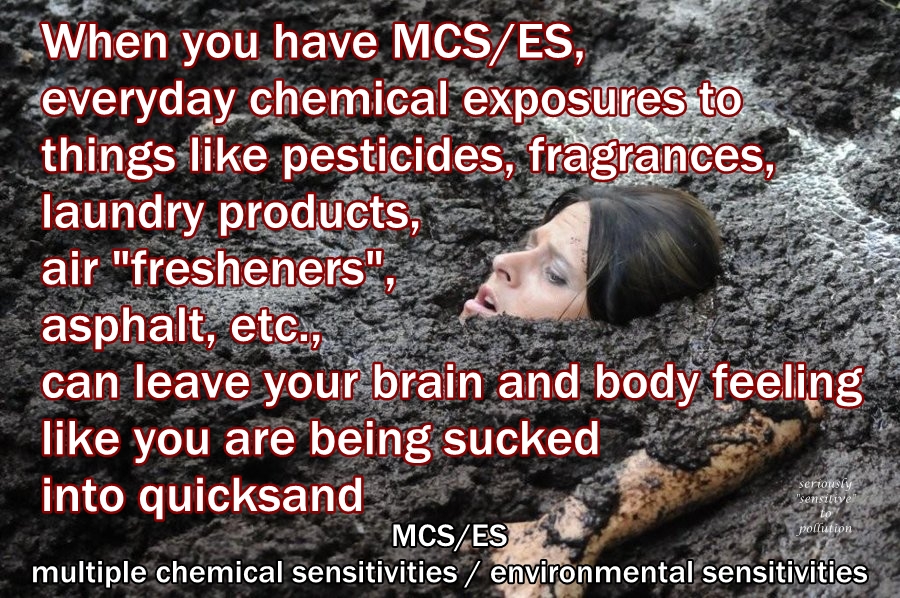
feels like quicksand-3

Then shit happened… (sorry, I don’t usually use language like that, but I’ve lost access to some parts of my vocabulary lately as a result of the toxic stuff I was exposed to).

Pesticides, dental infections and extractions, toxic products and materials (including trying to replace a SS kitchen kettle -simple, yes? Actually, NO), summer road work, more and more pesticides, heat,  VOCs, lack of ventilation and air filtration, which meant no ability to cook, and more…all of which resulted in some serious brain fog, cognitive problems,  and drastically reduced physical abilities.

Back to the drawing board…

After having some good days this year, I crashed again, and I haven’t been able to recover… much… There can be a few better mini-moments here and there if the outdoor air quality is exceptional and the breezes have been blowing the “right” way, but nothing like how well I was doing for a while in the spring.

Which makes it so much harder now, because I can actually remember what it was like to be more functional. It was so long ago before, that it didn’t really come into play or into my thoughts, as for so many years, I couldn’t remember what it was like to think clearly, or to function without effort, with relative ease.

Is it really too much to ask to be able to function with relative ease? To not have every thought, every action be like climbing a mountain or navigating an obstacle course?

Continue reading

V’s Canary Cries

Guest Post by V from the USA

This was originally posted to an online support group. V granted her permission to share it here. She has been able to put this part of her life story into words that so many of us find hard to express, and I thank her deeply for sharing her words with you too.


Canary V

It’s about 1:30 a.m. and this is about the time where I start to feel despair about everything in my life. I just can’t seem to adapt to the isolation and lack of a routine or purpose. Also, I can’t seem to find any pain meds for my chronic pain. I have been in physical pain for so long.

I know this post may seem disjointed which is apropos considering how I feel.

I AM so tired of spinning my wheels…Along with MCS I have so many other medical issues…non terminal that I know of but still…I have asthma and allergies.. I can’t be around dogs or cats, the weather determines my breathing status for the day and my physical mobility.

I can only eat about 10 things and it’s exhausting to try to rotate these foods and I spend excessive time trying to plan. Even planning a rotation I still get itching throat and sometimes a swollen throat with some of the ten things I think I can eat…it’s horrible to start eating and not know how I will feel ..

Continue reading

“Artificial scents have no place in our hospitals”

Canada’s top medical journal, the Canadian Medical Association Journal (CMAJ), says
Artificial scents have no place in our hospitals

Hospital NO Fragrance

“These patients may be involuntarily exposed to artificial scents from staff, other patients and visitors, resulting in worsening of their clinical condition. As patients,
family members and emergency physicians will attest, the attacks can be quite sudden and serious. There is little justification for continuing to tolerate artificial scents in our
hospitals.” …

Continue reading

Scientists to WHO: Recognize MCS and EHS

International Scientists Invite WHO to Recognize MCS and EHS

Paris, September 4th 2015.

“Following the fifth Paris Appeal congress, which took place on the 18th of May, 2015, the attending European, American and Canadian scientists unanimously decided to create a working group and to write a Common International Declaration to request an official recognition of these new diseases and of their sanitary consequences worldwide.

The declaration calls upon national and international bodies and institutions and particularly the WHO, for taking urgently their responsibility for recognizing electrohypersensitivity and multiple chemical sensitivity as real diseases, including them in the International Classification of Diseases.

This International Declaration also asks national and international institutions to adopt simple precautionary measures of prevention, to inform populations and requires the appointment of real independent expert groups to evaluate these sanitary risks in total scientific objectivity, which is not the case today.”

2015 WHO MCS EHSThe links to download the Declaration Statement and Press Release are below, as well as the link to see the presentations that took place during the meetings in May of 2015.

Continue reading

Why We Need “Sensitive” Human Canaries

“Sensitive” humans are not defective or here to inconvenience you.

maybe it is not me

Some canary history:

“Carbon monoxide, a potentially deadly gas devoid of color, taste or smell, can form underground during a mine fire or after a mine explosion.

Today’s coal miners must rely on carbon monoxide detectors and monitors to recognize its presence underground. However, before the availability of modern detection devices, miners turned to Mother Nature for assistance.

Canaries — and sometimes mice — were used to alert miners to the presence of the poisonous gas. Following a mine fire or explosion, mine rescuers would descend into the mine carrying a canary in a small wooden or metal cage.


Any sign of distress from the canary was a clear signal that the conditions underground were unsafe, prompting a hasty return to the surface.


Continue reading