Tag Archives: cancer

Research Shows Harmful Chemicals Can Remain In Clothing Even After Washing

“Exposure to these chemicals increases the risk of allergic dermatitis, but more severe health effect for humans as well as the environment could possibly be related to these chemicals. Some of them are suspected or proved carcinogens and some have aquatic toxicity,”

textile chemical release

Giovanna Luongo found that there are harmful chemical residues left in clothing even after 10 washes and presents the information in her Doctoral Thesis, Chemicals in textiles A potential source for human exposure and environmental pollution.

This scientifically validates what some of us have been saying for years, that some harmful chemical residues can be extremely difficult if not impossible to remove, (as the rigmarole we have to go through in an attempt to have safe to wear clothing to wear attests), and that normally undetectable trace levels can cause disabling effects.

Many chemicals present in clothing (and bedding) enter the human body via dermal absorption, and can be detected in urine hours later!

This poster shows how chemicals enter our bodies:

Continue reading

Scent Marketing or Scented Drugging?

The May June 2015 issue of Costco’s magazine had an article about scent marketing.

The Economist had an interesting article in 2007 regarding manipulative chemical use.

Women’s Voices For the Earth has several reports about fragrances and the fragrance industry.

Why should you be concerned? Read on:

Continue reading

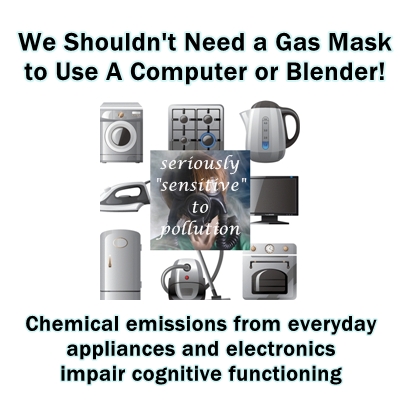
We Shouldn’t Need a Gas Mask to Use A Computer or Blender!

Ever notice how when you buy a new appliance or electronic device, and take it out of the box, or plug it in, the smell makes you nauseous, dizzy, and gives you a headache? Or worse?

That smell is made up of some really toxic chemical fumes. Benzene, styrene, and toluene, among others… in everyday technology!

.

New research from the Exposure, Epidemiology & Risk Program, Department of Environmental Health, Harvard T.H. Chan School of Public Health, on how the pollutants in indoor environments affect people’s cognitive functioning (people who are still able to work in polluted offices, not the people who are already too disabled to work in polluted offices) discovered that

Green office environments linked with higher cognitive function scores

…”People who work in well-ventilated offices with below-average levels of indoor pollutants and carbon dioxide (CO2) have significantly higher cognitive functioning scores–in crucial areas such as responding to a crisis or developing strategy–than those who work in offices with typical levels, according to a new study from the Harvard T.H. Chan School of Public Health’s Center for Health and the Global Environment, SUNY Upstate Medical University, and Syracuse University.

“We have been ignoring the 90%. We spend 90% of our time indoors and 90% of the cost of a building are the occupants, yet indoor environmental quality and its impact on health and productivity are often an afterthought,” said Joseph Allen, assistant professor of exposure assessment science, director of the Healthy Buildings Program at the Harvard Center for Health and the Global Environment, and lead author of the study.

“These results suggest that even modest improvements to indoor environmental quality may have a profound impact on the decision-making performance of workers.”

Researchers wanted to look at the impact of ventilation, chemicals, and carbon dioxide on workers’ cognitive function because, as buildings have become more energy efficient, they have also become more airtight, increasing the potential for poor indoor environmental quality.

Building-related illnesses and “sick building syndrome” were first reported in the 1980s as ventilation rates decreased. In response, there has been an emphasis on sustainable design–“green” buildings that are energy efficient and are also designed to enhance indoor environmental quality. The researchers designed this study to identify the specific attributes of green building design that influence cognitive function, an objective measure of productivity.

“The major significance of this finding lies in the fact that these are the critical decision making parameters that are linked to optimal and productive functioning. Losing components of these skills impacts how people handle their day to day lives.”

In other words, pollution prevents people from being smart!

appliance gas mask

Here are just some of the harmful emissions from computers:

Continue reading

Healthy Living Tips 101

Here are three simple Top Tips For Healthy Living (printable) PDFs, with clear information on things we must do to live healthier lives, including things to do and things to avoid, in order to prevent cancer and other health problems that are linked to all the everyday toxic exposures we are currently subjected to. Continue reading

Scent-Free Buildings Guide from CCIAQB

From The Canadian Committee on Indoor Air Quality (CCIAQB) 

“This Module provides building owners and managers with information about the sources and effects of scents and fragrances. It also suggests ways to move toward scent-free buildings. The information covers scents and fragrances brought into a workplace by people wearing personal products such as perfume as well as those scents and fragrances that originate from custodial products such as washroom hand soap.”

scent-free buildings guide banner

Continue reading

“Artificial scents have no place in our hospitals”

Canada’s top medical journal, the Canadian Medical Association Journal (CMAJ), says
Artificial scents have no place in our hospitals

Hospital NO Fragrance

“These patients may be involuntarily exposed to artificial scents from staff, other patients and visitors, resulting in worsening of their clinical condition. As patients,
family members and emergency physicians will attest, the attacks can be quite sudden and serious. There is little justification for continuing to tolerate artificial scents in our
hospitals.” …

Continue reading

Why We Need “Sensitive” Human Canaries

“Sensitive” humans are not defective or here to inconvenience you.

maybe it is not me

Some canary history:

“Carbon monoxide, a potentially deadly gas devoid of color, taste or smell, can form underground during a mine fire or after a mine explosion.

Today’s coal miners must rely on carbon monoxide detectors and monitors to recognize its presence underground. However, before the availability of modern detection devices, miners turned to Mother Nature for assistance.

Canaries — and sometimes mice — were used to alert miners to the presence of the poisonous gas. Following a mine fire or explosion, mine rescuers would descend into the mine carrying a canary in a small wooden or metal cage.


Any sign of distress from the canary was a clear signal that the conditions underground were unsafe, prompting a hasty return to the surface.


Continue reading

Your Wireless Devices Have Secrets

If you own ANY wireless devices, you really want to know about these secrets.

Right to Know 2

The following video is a must see video. It’s very easy to understand. These are secrets you need to know about, as if your life depended on it, because it actually might.

Highlights from the Massachusetts Statehouse Briefing on Wireless and Public Health:

Continue reading

Shouldn’t Cleaning Products REMOVE Pollutants Instead of ADDING Them?

Here’s yet another scientific report about how dangerous chemicals and VOCs are being released from the everyday cleaning products most people use in their homes!

Environmental Defense (Canada) recently released their report THE DIRTY TRUTH, which found that products from some of the biggest cleaning brands (Mr. Clean, Clorox, Lysol, Windex, and PineSol ) pollute the air in Canadians’ homes with harmful chemicals. (Note that these products are not significantly, if at all different in the US, but the EU does have some bans on ingredient that are still allowed here).

ED’s The Dirty Truth follows hot on the heels of Women’s Voices For the Earth’s DEEP CLEAN report, and while both of these reports name names, they had a slightly different focus.

In Deep Clean, Women’s Voices For the Earth graded four major cleaning product manufacturers based on key indicators to expose their commitment to product safety: Product Ingredient Disclosure, Responsiveness to Consumer Concerns, Toxic Chemical Screening Process and Removal of WVE’s Chemicals of Concern.

Dr. Anne Steinemann’s research from earlier this year did not name product names, but she named numerous harmful volatile organic chemicals (VOCs) that the many popular products she tested do release into the air we breathe.

One has to wonder why this is allowed to be going on?

We should not be subjected to harmful industrial pollutants in our own homes!

cleaning pollution 1.

“Our new report found that products from some of the biggest cleaning brands (Mr. Clean, Clorox, Lysol, Windex, and PineSol ) pollute the air in Canadians’ homes with harmful chemicals called Volatile Organic Compounds. These chemicals have been linked to respiratory problems such as asthma and lower IQs.”

.

 Volatile Organic Compounds and Your Health

Continue reading

Report: RF EMR and the Health of Canadians

The_Canadian_Flag
… “Numerous concerns relating to radiofrequency (RF) exposure were raised by witnesses during Committee meetings on Safety Code 6 as well as in the briefs that were submitted. …
Witnesses also spoke to possible links between RF exposure and cancer, reproductive issues and autism.These concerns tied in to other testimony that expressed unease about RF exposure in schools as a result of the use of Wi-Fi; the need for RF exposure limits and guidelines to protect vulnerable populations such as pregnant women, infants and children, and others who may be more susceptible to the effects of RF exposure; and electromagnetic hypersensitivity (EHS).
While witness testimony and briefs often emphasized the need for Health Canada to take a precautionary approach to RF exposure by reducing the limits established by Safety Code 6 (and sometimes provided examples of limits and other measures taken to protect populations from RF exposure in other jurisdictions), they also referred to steps that individuals can take to reduce their own RF exposure. Finally, some witnesses stated that industry should play a role in reducing RF exposure.” …
RADIOFREQUENCY ELECTROMAGNETIC RADIATION AND THE HEALTH OF CANADIANS
 ∴
Report of the Standing Committee on Health
This much awaited report contains 12 major recommendations by effectively echoing the expert evidence heard by eight MPs during the recent hearings this Committee.
 
 ∴
The List of Recommendations:

Continue reading