Tag Archives: environmental sensitivities

It’s Only A Little Fragrance

How many times have we heard it’s “only a little fragrance”?

Telling a person with MCS/ES that there is “only a little fragrance”

is like

telling someone with Celiac Disease that there’s “only a little gluten”

or

 telling someone with a peanut allergy that there’s “only a little peanut”

or

telling someone who uses a wheelchair that there are “only a few steps”.

It’s not ok.

telling 103It’s NOT ok.

Individual images follow: Continue reading

Fragrance Facts Brochure

I’ve been looking through some of my old files and ran across this printable brochure about fragrances. Made by Betty Bridges in 2002, it has very useful information that is still relevant.

What has changed since then is that fragrance industry members voluntarily disclosed over 3000 ingredients that they commonly use (only they know how many were not disclosed, as the fragrance industry is still not regulated), and more research has come out on how harmful many of the fragrance ingredients are.

Additionally,  many  more people have become permanently disabled with MCS/ES, often originally triggered from fragrance chemical exposures (in Canada, there was a 31% increase in people diagnosed with MCS between 2005 and 2010, with many more undiagnosed due to a lack of doctors trained in environmental health matters), and  now it has become impossible to avoid 1st, 2nd and 3rd hand fragrance chemical exposures in the “developed” world, so everyone is constantly being exposed to these chemicals.

Fragrance Brochure 1- horz screenshots

Screenshot of brochure. Download the document at link below.

 ∴

Continue reading

Fibro Flare From Underwear

 fibro flare from underwear 1 Original image from GettyYes way…sighs…

Most of us wear underwear all the time. We don’t think much about it.

I remember when I used to be able to find decent 100% cottom undies with enclosed elastic waistbands at the dollar stores! I could throw them in the wash once, and they were good to go. Those were the days!

More recently, I’ve been disabled from a serious fibro flare caused by trace (?) levels of chemical residues from wearing organic undies that cost me $20 a pair. Even after soaking and washing them at least a dozen times, and then boiling them several times after.

Disabled?
Yes, disabled!

My alternate title for this post was Disabled by Underwear… Here’s what happened:

Continue reading

Can You Imagine A World Where…

imagine a world

Can you imagine a world where it’s unacceptable to profit from polluting people and the environment we all depend on for life?

Someone imagined it was ok to pollute for profit, it wasn’t always happening or acceptable.

What if it’s possible to live good lives while looking after the planet and each other?

For things to change, we have to imagine something different first.

Then, if we can imagine it, we can work together to make it happen!

which world do we want 2

Assistive Devices For People With MCS/ES

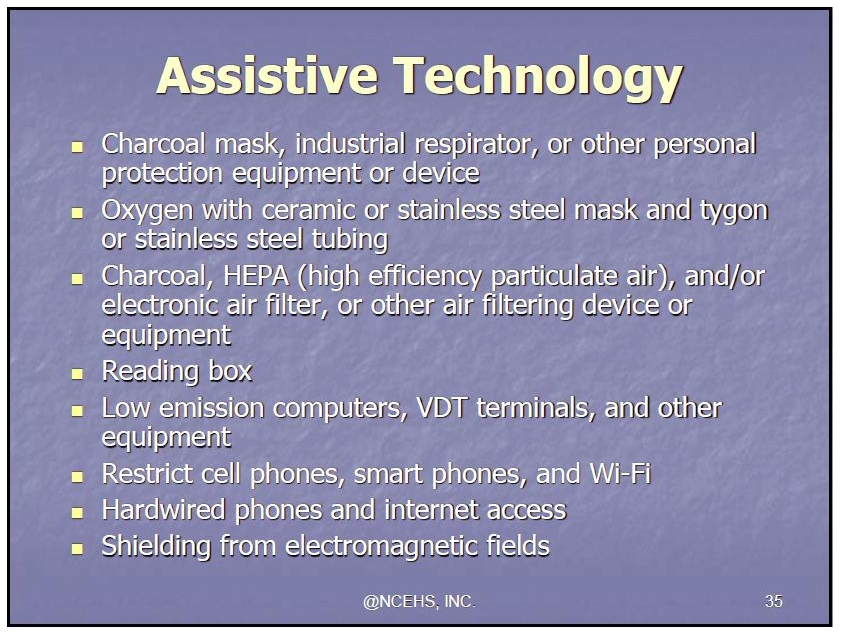
For people with MCS/ES, assistive devices can allow us to remain functional, independent, and able when we can’t control everything in our environments.

MCS ES assistive technologySlide with a few options from New MCS/ES Accommodation Resource

In addition to fragrance, chemical, and wireless free policies, these and other devices can help reduce or eliminate exposures to the pollutants that can otherwise completely disable people with MCS/ES. They can make the difference for people to remain employed when provided early enough, effectively minimizing the effects of MCS/ES.

Continue reading

Wendy is NOT a Widget and She Shouldn’t be Treated Like One

Wendy is NOT a widget. Widgets can go anywhere. Wendy can’t.

“Widget” is used in texts and speech, especially in the context of accounting, to indicate a hypothetical “any-product”. Companies in such texts will frequently be given names such as “ABC Widgets” or “Acme Widget Corp.” to indicate that the particular business of the hypothetical company is not relevant to the topic of discussion.
(Widget economics – wikipedia)

“Economists often use the term widget to refer to an abstract unit of production.”

Wendy is NOT a widget as her local housing authority seems to believe. They have a capacity problem, but instead of addressing the need for improved (and accessible) capacity, they want to re-arrange people’s lives as if they were widgets, with little to no regard or understanding of the consequences.

INVESTOPEDIA EXPLAINS ‘Capacity’

“The widget manufacturer may be able to produce 150,000 widgets in a month. However, due to downtime because of equipment maintenance and worker illness, only about 130,000 widgets can actually be produced per month. Over the long run, a business can increase its capacity and output by acquiring more factors of productions. For example, if market demand for widgets spikes, the widget manufacturer can buy more equipment and hire more workers, and thus increase its capacity to 175,000 widgets per month.”

Wendy is not a widget. She is a living, breathing, human being, a human being with a complex, chronic environmentally linked condition and disability related needs, needs that widgets don’t have.

Wendy Kearly photo by ADAM MACINNIS – THE NEWS

Wendy Kearly photo by ADAM MACINNIS – THE NEWS

The housing authority from which Wendy rents her safe home has deemed her over-housed, and are in the process of evicting her, despite the fact that Wendy has no other option for medically required, safe housing available, and no safe access to any of the other places most people take for granted (see below).

In the following audio interview with Wendy, among other things, she talks about the process her grown children take to detox themselves enough to be able to safely visit with her, so that she is able to safely hug them when they come to town.

Continue reading

Your Favorite Personal Care and Cleaning Products Went to the Lab, and They Came Back With This

Take a deep breath (or maybe not)

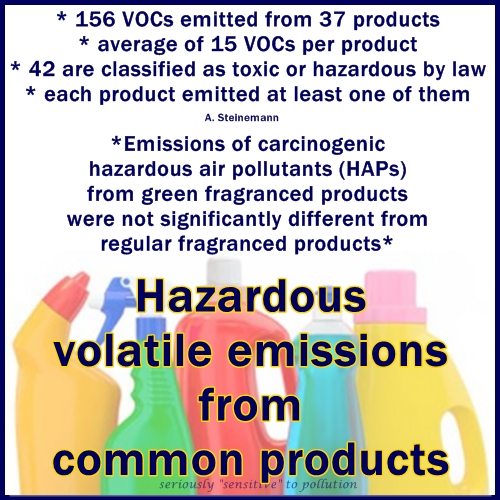
“This study found 156 different VOCs emitted from the 37 products, with an average of 15 VOCs per product. Of these 156 VOCs, 42 VOCs are classified as toxic or hazardous under US federal laws, and each product emitted at least one of these chemicals. Emissions of carcinogenic hazardous air pollutants (HAPs) from green fragranced products were not significantly different from regular fragranced products.”

Most homes are full of these products!!!

Indeed, most indoor environments (and everything in them) are now polluted with these VOCs due to the pervasive nature of these products and chemical compounds.

156 VOCs

From the research article:

Continue reading

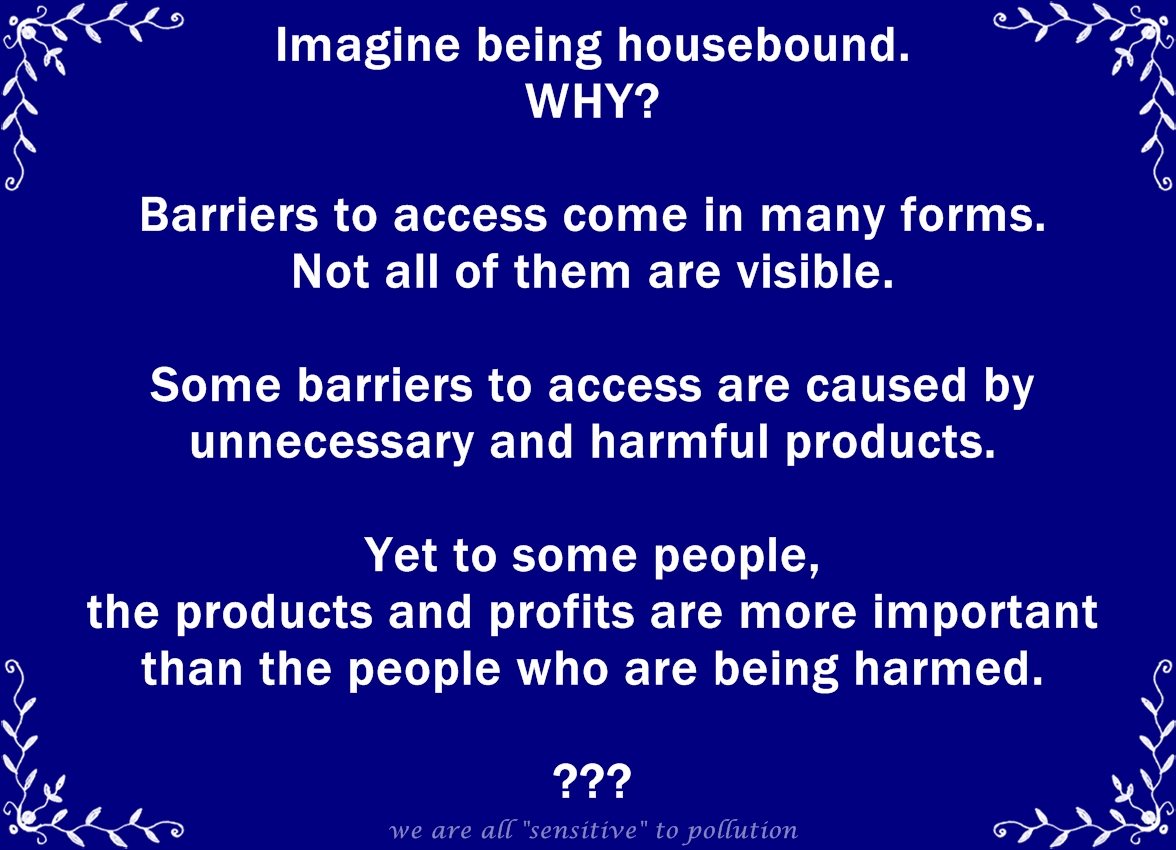
What If an Industry was Allowed to Disable Us and Keep Us Housebound?

Something Is Really Wrong With This Picture

Imagine this 1

There’s a global proliferation of artificial fragrance and methods of dispersing it. Fragrance concoctions are added to almost everything imaginable (with more ridiculous ideas emerging all the time). They are sold and used everywhere at the same time as more people are developing adverse health effects from them, effects like serious allergies, disabling “sensitivities”, migraines, asthma, neurological disorders, lowered IQ, birth defects, etc. (the list keeps growing).

These health problems are due to unregulated and secret ingredients, ingredients which pollute our bodies, our air, and the waterways they get washed into from our sinks, tubs, and showers, ingredients that are impossible to avoid now, even when we don’t want them in our lives.

If you or your child had celiac disease or a severe peanut allergy, it would be the same as the peanut and gluten industries adding peanuts and gluten or peanut and gluten mist along with doses of mood altering drugs to every product imaginable, including building materials. That would be in addition to having peanut and gluten essences worn by everyone (in their hair, armpits, clothing …), pumped out of air ducts, automated devices in public washrooms, transportation, stores, apartments, offices, hotels, even medical offices, and your neighbours burning peanuts and gluten in their fireplaces, washing with laundry with them, and then pumping the residues out of their dryer vents 24/7.

You could imagine cat allergies too, but they are usually more inconvenient than life threatening and disabling.

The fragrance industry is very aware of the adverse effects its products have on people and the environment, yet they continue to look for more ways to pollute us and every product and environment conceivably possible. They knowingly create concoctions that harm and act like drugs! Yet they consider these risks reasonable and acceptable, and choose to dismiss or ridicule those who have problems, using similar tactics the tobacco industry used to deny there are problems and to continue to profit from them.

Continue reading

Revolutionary Way to Freshen the Air

Freshening the air is big business these days. Polluting the air is also very profitable. Sadly, it’s usually similar chemicals  polluting the air as are in the substances sold to “freshen” it.

What does fresh air smell like?

fragrance emitting products smell like chemicals

Continue reading

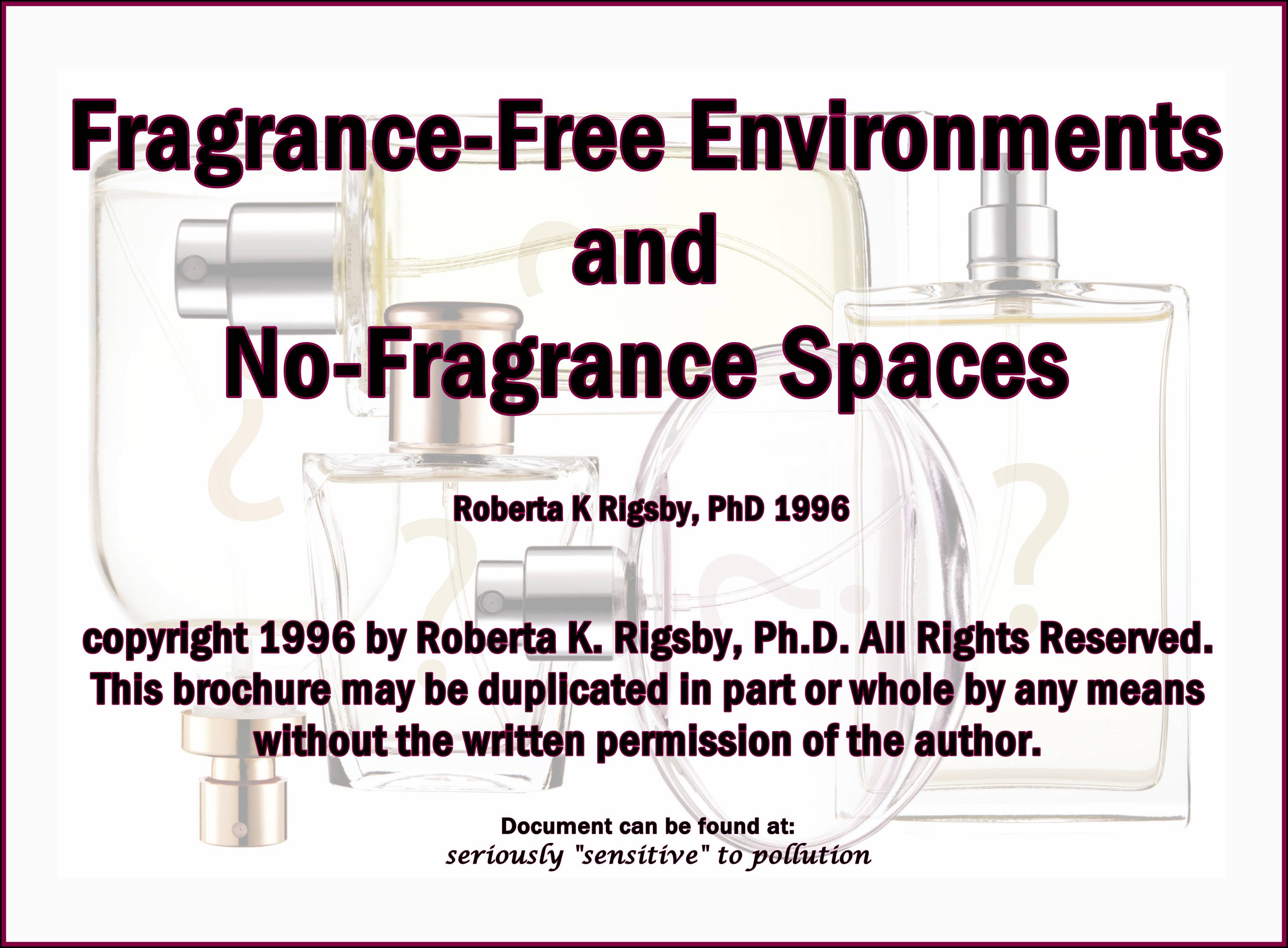
Fragrance Free Environments and No Fragrance Spaces

Someone shared a very good PDF handout with me the other day, one that I had never seen before. It gently explains to people why there is a problem with fragrance, why people may need to avoid fragrances, that it is not the smell, it’s not personal, and a few other bits of helpful information  The resource links are old and could be updated (somehow), but it’s otherwise a great tool to share with people who don’t understand.

I can’t find a link to share it from elsewhere, so I am posting it here to make it easily available.

Fragrance-Free Environments and No-Fragrance Spaces (PDF)

Fragrance Free Environments and No Fragrance Spaces

The text image is copied below.

Continue reading