When it’s hard to think in words, it’s sometimes easier to do pictures…

Take Action:

When it’s hard to think in words, it’s sometimes easier to do pictures…
Take Action:
How to Enforce a Fragrance-Free Policy
“Make it clear that the policy applies to everyone”

Fragranced consumer products: exposures and effects from emissions
“Overall, 34.7 % of the population reported one or more types of adverse health effects from exposure to one or more types of fragranced products.”
“72.6 % were not aware that even so-called natural, green, and organic fragranced products typically emit hazardous air pollutants.”
“20.2 % of the population reported that if they enter a business, and smell air fresheners or some fragranced product, they want to leave as quickly as possible.”
“Significantly, 15.1 % of the general population reported that exposure to fragranced products in their work environment has caused them to become sick, lose workdays, or lose a job.”
Health and societal effects from exposure to fragranced consumer products (AU)
…”Finally, for public officials, the problem of “secondhand scents,” or indirect exposure to fragranced products, has parallels to secondhand tobacco smoke. Prevention from fragrance product exposure will enable individuals to work in their workplaces, attend school, and function in society without suffering involuntary harm.” …
More Resources:
Children of all ages, as well as teachers, require healthy environments to thrive in. Schools, unfortunately, have notoriously poor indoor air quality.
One thing that contributes to poor IAQ is the use of fragrance chemicals in cleaning products, as well as in personal care and laundry products.
These chemicals do nothing to enhance the air quality, and much to induce cognitive and neurological impairments, sperm damage and respiratory problems.

Boys who overused sprays such as Axe Body Spray have prompted the Brandon School Division to ban perfumes and colognes. (Canadian Press) / via CBC
Over-use of these products is not the real problem.
The real problem is that these products contain toxic chemicals and serious allergens, and these chemicals and allergens do not respect personal boundaries or property lines, but trespass into everyone’s air, brains and bodies.
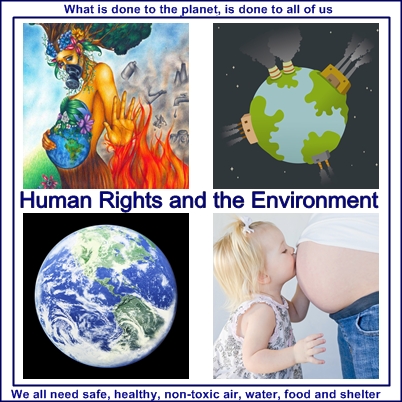
Human Rights and the Environment
No More Toxic Chemical Trespass
♦
Forgive us our (chemical) trespasses
By Carolyn Raffensperger
This is not a trespass in the property sense. It is a violation of our shared rights to a clean and healthy environment. Forgive us for destroying the Earth, our bodies, our communities, each other.
http://www.sehn.org/blog/?p=176
♦
and
and this
♥
What is done to the planet, is done to us…
Do We Not Have the Right to a Healthy Environment?
In Brazil, they now have the right to a healthy environment!
♥
Learn more about Human Rights and the Environment here:
Imagine being shut in, without air conditioning, without being able to open the windows to refresh the air, because the outdoor air is so full of VOCs as to be totally disabling…
For some of us, this is a somewhat usual occurrence anyway, due to the prevalence of toxic laundry products blowing out of dryer vents everywhere, but during summer, things can get so much worse!
The heat makes many chemicals more volatile, and where do they off-gas? Into the air we breathe…
Here are just some of the things that affect summer air quality:
Not only do they scare the living daylights out of so many dogs and other creatures, they also pollute our air, water and bodies!

Let’s find safer ways to celebrate
Are these substances life supporting?
Aluminum, Antimony sulfide, Arsenic compounds, Barium , Cadmium, carcinogens, Copper compounds, dioxin, gunpowder, heavy metals , Lead Dioxide, Polychlorinated, dioxins, Lithium compounds, Mercury, Nitric oxide, Nitrogen dioxide, Ozone, Perchlorate , radioactivity, Rubidium, Strontium, Sulfur Dioxide and others…
Perhaps we should celebrate with life supportive ways instead?
Read more:
http://www.mnn.com/earth-matters/translating-uncle-sam/stories/are-fireworks-bad-for-the-environment
http://www.clearlakemuskoka.com/fireworks.htm
http://www.backcountryattitude.com/toxic_fireworks.html
The State Fire Marshall, an office within Cal Fire, has the statutory mandate to manage seized fireworks which are hazardous waste in most cases.
http://www.dtsc.ca.gov/technologydevelopment/opptd_fly_fireworks.cfm
“The toxicological research has shown that many of the metallic particles in the smoke from fireworks are bio-reactive and can affect human health,”
http://www.sciencedaily.com/releases/2010/11/101116111715.htm
Note, some sites are including a campfire in their supposedly non-toxic alternatives suggestions, but woodsmoke is highly problematic as well.
Posted in Chemicals, Environment, Environmental Health, Health
Tagged celebrations, fireworks, hazardous air pollutants, toxic, toxic trespass
This is the most significant issue I have with MCS/ES, the ways my brain (and functioning) are affected from exposures to chemicals in everyday products.
I suspect (and I am not the only one) that some of the bigger problems we are seeing in society now, are due to widespread neuro-toxic chemicals (in addition to wireless radiation) affecting too many people’s ability to think clearly.
Philippe Grandjean:
Our intelligence depends on the integrity of the complete organ. Even subtle effects, such as memory deficits, attention problems, or motor dysfunction, can seriously impact on our health. Thus, the brain differs substantially from other important organs, such as the kidney or the liver, where we can lead successful lives without maximal function…
Our brain functions are valuable to ourselves and to society. Data on exposures to lead, mercury, and pesticides suggest that the losses to society amount to hundreds of billions of dollars every year. This calculation is based solely on losses of income and does not take into account less tangible damages associated with chemical brain drain

(chemicals known to cause brain toxicity and neurological symptoms in humans)
Someone needs to check IFRA’s list of ingredients to see how many of these are used in fragrances, I think too many…
The commercials and advertisements we see are almost all carefully crafted by teams of “scientists”so that they have the greatest impact possible, resulting in people believing that we NEED to buy and use these products for our lives to be complete.
Here’s how Febreze was marketed and we the people have been manipulated into buying and using an unnecessary and toxic product.
Some excerpts from an article well worth reading:
Febreze
By CHARLES DUHIGG
… “When they got back to P.& G.’s headquarters, the researchers watched their videotapes again. Now they knew what to look for and saw their mistake in scene after scene. Cleaning has its own habit loops that already exist. In one video, when a woman walked into a dirty room (cue), she started sweeping and picking up toys (routine), then she examined the room and smiled when she was done (reward). In another, a woman scowled at her unmade bed (cue), proceeded to straighten the blankets and comforter (routine) and then sighed as she ran her hands over the freshly plumped pillows (reward). P.& G. had been trying to create a whole new habit with Febreze, but what they really needed to do was piggyback on habit loops that were already in place. The marketers needed to position Febreze as something that came at the end of the cleaning ritual, the reward, rather than as a whole new cleaning routine.
verb (used with object)
1.to be uncertain about; consider questionable or unlikely; hesitate to believe.
2.to distrust.
3.Archaic. to fear; be apprehensive about.
verb (used without object)
4.to be uncertain about something; be undecided in opinion or belief.
noun
5.a feeling of uncertainty about the truth, reality, or nature of something.
6.distrust.
7.a state of affairs such as to occasion uncertainty.
8.Obsolete . fear; dread.
♦
♦
“Doubt is our product,” a cigarette executive once observed, “since it is the best means of competing with the ‘body of fact’ that exists in the minds of the general public. It is also the means of establishing a controversy.”
♦
We are having our minds (and bodies) messed with in so many ways
and it can become overwhelming when we learn how bad some things really are.
Understanding what is happening can empower us so we can change course.
Read on to see some of the ways we are being had (globally), how some things are interconnected, and some tools we can use to help us work through our doubts.
♦
Andrew Rosenberg, director, Center for Science & Democracy
“Last week, a New York Appeals Court ruled unanimously that that Georgia Pacific, a subsidiary of Koch Industries, must hand over internal documents pertaining to the publication of 11 studies published in reputable scientific journals between 2008 and 2012. At issue in the case: whether the firm can be held accountable for engaging in a “crime-fraud” by planting misinformation in these journals intending to show that the so-called chrysotile asbestos in its widely used joint compound doesn’t cause cancer.”
… “Asbestos is but one case of “ghost-writing” of counterfeit science for academic publications in an effort to market or cast doubt on scientific results. Recently, the editors of the Public Library of Science (PloS) Medicine, a respected open-access scientific journal, published a series of articles highlighting how widespread the problem has become in the pharmaceutical field and the difficulties academic journals are facing as they try to combat the problem. …
As a scientist, it goes against my teaching and experience to accept that ghost-writing of fraudulent scientific papers in the name of commerce should be allowed to continue unabated. Not only does it undermine the entire scientific enterprise, it poses an enormous potential threat to the public.” …
♦
Director-General of the World Health Organization
(WHO)
“Under the pressure of these forces, chronic noncommunicable diseases have overtaken infectious diseases as the leading cause of morbidity, disability, and mortality. …
The globalization of unhealthy lifestyles is by no means just a technical issue for public health. It is a political issue. It is a trade issue. And it is an issue for foreign affairs.
Posted in Environment, Environmental Health, Government, Health Promotion, Public Health
Tagged cancer, change, Cognitive dissonance, cradle to cradle, cradle to grave, critical thinking, doubt, Doubt Is Their Product, Febreze, food and drink, Fragrance, ghost-writing, hazardous air pollutants, life cycle, manipulation, marketing, Merchants of Doubt, mindfulness, perception, positive thinking, science, tobacco science, WHO
 | linda @ Seriously "S… on MCS/ES |
| linda @ Seriously "S… on The CDC and MCS |
 | Tabatha Schnorr on MCS/ES |
| Tabatha Schnorr on The CDC and MCS |
| linda @ Seriously "S… on MCS and Housing |
| linda @ Seriously "S… on Hospital Protocols for People… |


 Seriously "Sensitive" to Pollution