Tag Archives: multiple chemical sensitivities

Optional “Inconvenience”

Guest post and images by Laura J Mac

What always strikes me during conversations about how to persuade service providers to accommodate our disability is how much extra work we have to do just to participate in simple survival stuff. I mean, “simply” tracking down professionals who are willing to accommodate is a chore and a half. The luxury of “having a good relationship” with a service provider falls way down on the list because it’s usually one or the other.

Laura J Mac 1

Nobody would think twice about someone who uses a mobility device asking if there are ramps and elevators but it seems that our need for fragrance-free and reduced chemical exposure is perceived as a “preference” rather than a medical necessity. That perception leads to the idea that accommodation of our disability is an “option” (and generally it’s an “option” that service providers aren’t willing to make available.) It’s not that we don’t “like” fragrance, these chemical exposures cause neurological and physiological problems that interfere with our ability to function on a daily basis.

Continue reading

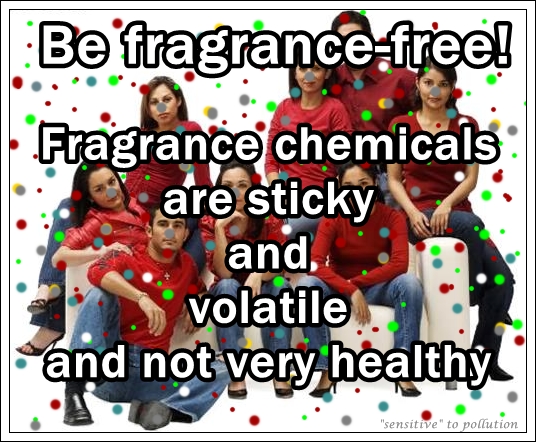
It’s Only A Little Fragrance

How many times have we heard it’s “only a little fragrance”?

Telling a person with MCS/ES that there is “only a little fragrance”

is like

telling someone with Celiac Disease that there’s “only a little gluten”

or

 telling someone with a peanut allergy that there’s “only a little peanut”

or

telling someone who uses a wheelchair that there are “only a few steps”.

It’s not ok.

telling 103It’s NOT ok.

Individual images follow: Continue reading

Do It Yourself Air Filtering Mask

When air is polluted both indoors and out, when people use fragrances and other products with toxic chemicals, when we are made ill and disabled by the pollutants, then we can’t wait for better regulations to take effect, we need to do something to protect our health now.

Sometimes we can buy masks that work for us, especially if we tolerate synthetic materials, but sometimes making our own is the only way. When we make our own, we can use safe-for-us fabrics and even coordinate them to our outfits (if we’re lucky enough to have safe-to-wear outfits).

Some people use scarves as masks. You can sew a pouch on the inside to hold filtering Continue reading

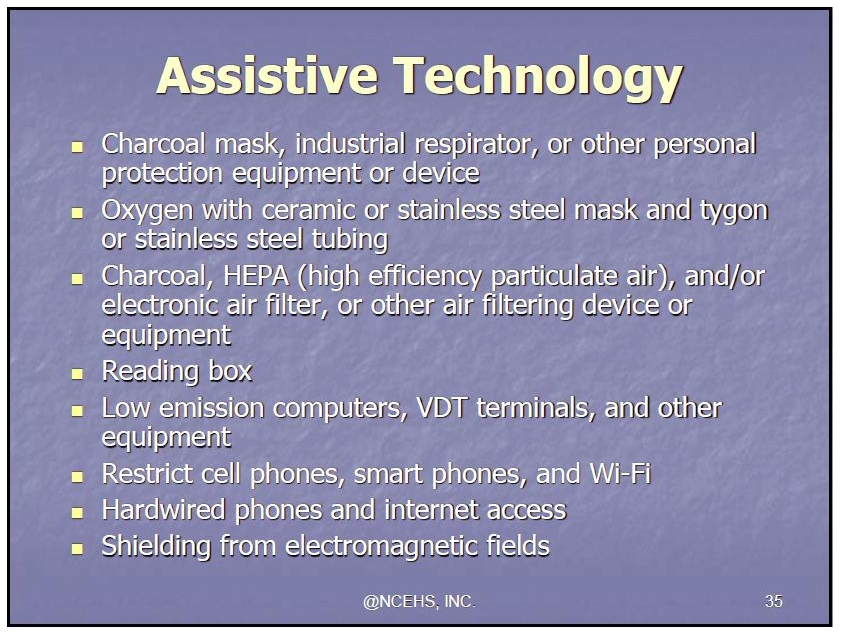
Assistive Devices For People With MCS/ES

For people with MCS/ES, assistive devices can allow us to remain functional, independent, and able when we can’t control everything in our environments.

MCS ES assistive technologySlide with a few options from New MCS/ES Accommodation Resource

In addition to fragrance, chemical, and wireless free policies, these and other devices can help reduce or eliminate exposures to the pollutants that can otherwise completely disable people with MCS/ES. They can make the difference for people to remain employed when provided early enough, effectively minimizing the effects of MCS/ES.

Continue reading

Wendy is NOT a Widget and She Shouldn’t be Treated Like One

Wendy is NOT a widget. Widgets can go anywhere. Wendy can’t.

“Widget” is used in texts and speech, especially in the context of accounting, to indicate a hypothetical “any-product”. Companies in such texts will frequently be given names such as “ABC Widgets” or “Acme Widget Corp.” to indicate that the particular business of the hypothetical company is not relevant to the topic of discussion.
(Widget economics – wikipedia)

“Economists often use the term widget to refer to an abstract unit of production.”

Wendy is NOT a widget as her local housing authority seems to believe. They have a capacity problem, but instead of addressing the need for improved (and accessible) capacity, they want to re-arrange people’s lives as if they were widgets, with little to no regard or understanding of the consequences.

INVESTOPEDIA EXPLAINS ‘Capacity’

“The widget manufacturer may be able to produce 150,000 widgets in a month. However, due to downtime because of equipment maintenance and worker illness, only about 130,000 widgets can actually be produced per month. Over the long run, a business can increase its capacity and output by acquiring more factors of productions. For example, if market demand for widgets spikes, the widget manufacturer can buy more equipment and hire more workers, and thus increase its capacity to 175,000 widgets per month.”

Wendy is not a widget. She is a living, breathing, human being, a human being with a complex, chronic environmentally linked condition and disability related needs, needs that widgets don’t have.

Wendy Kearly photo by ADAM MACINNIS – THE NEWS

Wendy Kearly photo by ADAM MACINNIS – THE NEWS

The housing authority from which Wendy rents her safe home has deemed her over-housed, and are in the process of evicting her, despite the fact that Wendy has no other option for medically required, safe housing available, and no safe access to any of the other places most people take for granted (see below).

In the following audio interview with Wendy, among other things, she talks about the process her grown children take to detox themselves enough to be able to safely visit with her, so that she is able to safely hug them when they come to town.

Continue reading

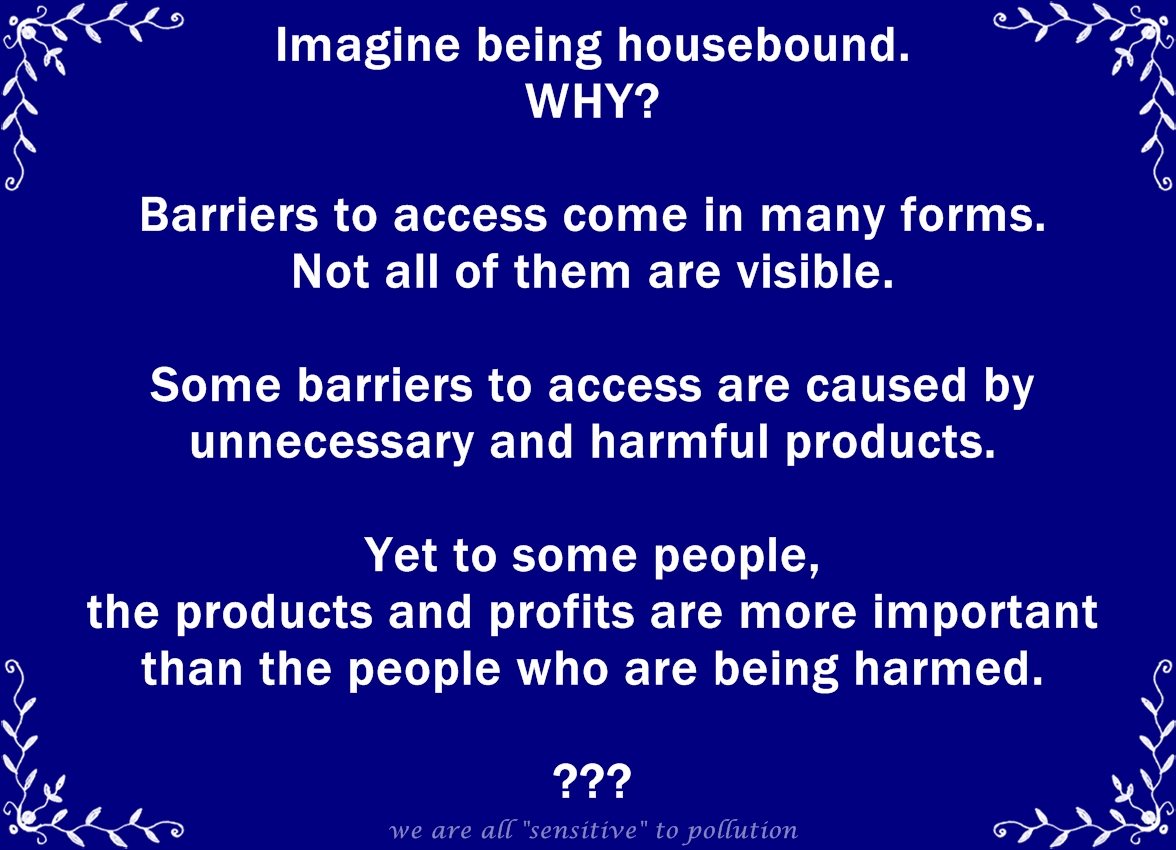
What If an Industry was Allowed to Disable Us and Keep Us Housebound?

Something Is Really Wrong With This Picture

Imagine this 1

There’s a global proliferation of artificial fragrance and methods of dispersing it. Fragrance concoctions are added to almost everything imaginable (with more ridiculous ideas emerging all the time). They are sold and used everywhere at the same time as more people are developing adverse health effects from them, effects like serious allergies, disabling “sensitivities”, migraines, asthma, neurological disorders, lowered IQ, birth defects, etc. (the list keeps growing).

These health problems are due to unregulated and secret ingredients, ingredients which pollute our bodies, our air, and the waterways they get washed into from our sinks, tubs, and showers, ingredients that are impossible to avoid now, even when we don’t want them in our lives.

If you or your child had celiac disease or a severe peanut allergy, it would be the same as the peanut and gluten industries adding peanuts and gluten or peanut and gluten mist along with doses of mood altering drugs to every product imaginable, including building materials. That would be in addition to having peanut and gluten essences worn by everyone (in their hair, armpits, clothing …), pumped out of air ducts, automated devices in public washrooms, transportation, stores, apartments, offices, hotels, even medical offices, and your neighbours burning peanuts and gluten in their fireplaces, washing with laundry with them, and then pumping the residues out of their dryer vents 24/7.

You could imagine cat allergies too, but they are usually more inconvenient than life threatening and disabling.

The fragrance industry is very aware of the adverse effects its products have on people and the environment, yet they continue to look for more ways to pollute us and every product and environment conceivably possible. They knowingly create concoctions that harm and act like drugs! Yet they consider these risks reasonable and acceptable, and choose to dismiss or ridicule those who have problems, using similar tactics the tobacco industry used to deny there are problems and to continue to profit from them.

Continue reading

Laundry Woes Six Years Later

6 years

Continue reading

How to Have Company (or Repairmen) In Your Home When You Have MCS/ES

Even when people try to be fragrance (and other chemical) free, they can have 2nd and 3rd hand residues from personal care, cleaning, and laundry products all over them. Air “fresheners” and scented candles are other items that leave residues on everything. It can take weeks to get it out of skin and pores, and longer to get it out of clothing and bedding, all the while re-contaminating the body and anything else that has contact with the fragranced surfaces or air.

rigmarole

Fragrance (and other toxic) chemicals are just all-pervasive now. Unless people are completely fragrance-free and stay out of fragrance filled places, they will have some degree of fragrance saturation in their clothes, skin, and hair. Some of the residues are also impossible to remove no matter how hard one tries, because of chemicals that are designed to penetrate and remain active for long periods of time (think of the  laundry commercials where they boast you can smell the fresh scent days later – except some of us can be affected years later, because that’s how permanent those chemicals are).

If people who use those products come to visit, not only can they leave us gasping for air (or worse) during their visit, they can leave chemical residues that will keep off-gassing from the couch and anyplace else they touched for days or weeks to come.

fragrance around a sofa

Depending on how severe one’s MCS/ES is,there are different things that can be done.

Continue reading

MCS/ES Accommodation Resources

When people develop MCS/ES, it can be extremely challenging maintaining access to jobs, housing, or other services due to the prevalence of indoor air pollution and pollutants, fragrance chemicals being a huge factor. When MCS/ES becomes disabling, it becomes a human rights issue requiring accommodation under the law in many places around the world.

Here then are some accessibility tools:

In the presentation from ADA Audio Conferencing – A program of the ADA National Network

One important point made was this:

MCS ES fragrance free policy

For people with EHS, a wireless-free policy is required, as well as other accommodations mentioned in the presentation.

Here are a few of the slides from Accommodating Persons with Environmental Sensitivities: Challenges and Solutions (which is available to download from the link below):

Continue reading

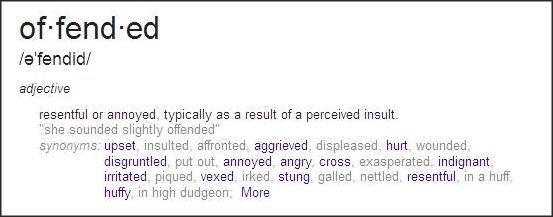
It’s Not Personal, It’s The Chemicals

offended

Have you ever noticed how some people get offended when we are disabled by, or get sick from something in the products they’ve used?

What’s up with that?

???

What about those who feign disbelief that we could be harmed by something they are using? Or that they could be using something that is harmful?

disbelief

While I am not up to delving into the psychological and emotional intricacies of those responses here, or how industry pays big money to create them, I did come up with a few simple images with variations of the following text:

It’s not you! It’s not personal! It’s the chemicals!

Fragrances, personal care, and laundry products
contain toxic chemicals that make it impossible
for some people to be around those who use them.

Continue reading