Tag Archives: petrochemicals

Fragrance Facts Brochure

I’ve been looking through some of my old files and ran across this printable brochure about fragrances. Made by Betty Bridges in 2002, it has very useful information that is still relevant.

What has changed since then is that fragrance industry members voluntarily disclosed over 3000 ingredients that they commonly use (only they know how many were not disclosed, as the fragrance industry is still not regulated), and more research has come out on how harmful many of the fragrance ingredients are.

Additionally,  many  more people have become permanently disabled with MCS/ES, often originally triggered from fragrance chemical exposures (in Canada, there was a 31% increase in people diagnosed with MCS between 2005 and 2010, with many more undiagnosed due to a lack of doctors trained in environmental health matters), and  now it has become impossible to avoid 1st, 2nd and 3rd hand fragrance chemical exposures in the “developed” world, so everyone is constantly being exposed to these chemicals.

Fragrance Brochure 1- horz screenshots

Screenshot of brochure. Download the document at link below.

 ∴

Continue reading

Fragrances, Hormones, Women, and Children

While these resources are primarily directed at women of childbearing age and children, they are really applicable to all of us. If a mother stops using perfume, but the father still piles on the scented deodorant, aftershave, and cologne, then his sperm, the mother, and children (born or unborn) are still being exposed to harmful chemicals.

If other family members, friends, and places like daycares are using scented laundry,  personal care, and cleaning products, they too are putting moms-to-be and kids at risk.

The adverse effects from these chemicals can be life-long, even longer. Our exposures can affect our grandchildren. Eliminating them from our lives now will ensure better health all around, including downstream, where fish and wildlife are also being affected.

WECF Pregnancy and EDCs

The short video below, produced by Women in Europe for a Common Future  (WECF), provides simple, important information on how you can protect yourself and your child from Endocrine Disrupting Chemicals (EDCs). They are found in so many places now.

WECF have also developed a new website, NESTING, which is another good resource for all of us. They have assembled a lot of good advice there.

Here’s an example from their Cleaning & personal care page:

Continue reading

Do It Yourself Air Filtering Mask

When air is polluted both indoors and out, when people use fragrances and other products with toxic chemicals, when we are made ill and disabled by the pollutants, then we can’t wait for better regulations to take effect, we need to do something to protect our health now.

Sometimes we can buy masks that work for us, especially if we tolerate synthetic materials, but sometimes making our own is the only way. When we make our own, we can use safe-for-us fabrics and even coordinate them to our outfits (if we’re lucky enough to have safe-to-wear outfits).

Some people use scarves as masks. You can sew a pouch on the inside to hold filtering Continue reading

Fibro Flare From Underwear

 fibro flare from underwear 1 Original image from GettyYes way…sighs…

Most of us wear underwear all the time. We don’t think much about it.

I remember when I used to be able to find decent 100% cottom undies with enclosed elastic waistbands at the dollar stores! I could throw them in the wash once, and they were good to go. Those were the days!

More recently, I’ve been disabled from a serious fibro flare caused by trace (?) levels of chemical residues from wearing organic undies that cost me $20 a pair. Even after soaking and washing them at least a dozen times, and then boiling them several times after.

Disabled?
Yes, disabled!

My alternate title for this post was Disabled by Underwear… Here’s what happened:

Continue reading

3o Things

30 Things

The following is a list of products many of us use or have contact with every day. Each and every one of these usually contains unregulated synthetic chemical ingredients, many of which pose known health hazards.

How many of these things did you touch or breathe in today?
What is protecting you?

Continue reading

MCS is International

People all over the industrialized world have been developing Multiple Chemical Sensitivities and Environmental Sensitivities, or Environmental Illnesses. We are exposed to so many petrochemical pollutants, in our air, water, foods, clothes, furnishings, homes, and elsewhere in daily life, substances which are now known to cause many kinds of adverse health effects, and some of us just have the epigenetic disposition to feel the effects faster and more extremely than others who may develop cancer or some other condition many years later.

Amelia Hill (aka the Amazing Amelia Hill) lives in Australia and developed very severe, or extreme MCS after not being properly diagnosed for too many years. A lack of proper diagnosis and precautionary measures usually results in a debilitating worsening of the condition, which is best addressed with avoidance of the triggering substances, and building up health in very targeted ways. This is much more difficult to do the longer one isn’t able to take the steps to avoid exposures and rebuild life with safe alternatives.

Amelia’s life is probably unlike any you have ever heard of (even mine) although there are many similarities between the experiences those of us who have severe MCS/ES share. Amelia is known as “amazing” because of the ways she handles her life.

You will see why here.

Amelia 01

Amelia’s story has been featured as the cover story in what may be South Australia’s most popular newspaper weekend magazine: Continue reading

Can You Imagine A World Where…

imagine a world

Can you imagine a world where it’s unacceptable to profit from polluting people and the environment we all depend on for life?

Someone imagined it was ok to pollute for profit, it wasn’t always happening or acceptable.

What if it’s possible to live good lives while looking after the planet and each other?

For things to change, we have to imagine something different first.

Then, if we can imagine it, we can work together to make it happen!

which world do we want 2

But I Don’t Smell Anything!

Guest Post by Leah Spitzer

I have Multiple Chemical Sensitivity (MCS) – a “multi-system illnesses as a result of contact with, or proximity to, a variety of airborne agents and other substances. (Environmental Protection Agency).” In other words, I react to fragrances, building products and more. It is not a histamine reaction, but rather, a systemic reaction to the chemicals in fragrance and other products.

As someone with MCS, I’m also known as a “canary” with deference to the Canaries in the Coal Mine. As a canary, I often encounter looks of disbelief when I mention I can smell someone’s laundry detergent, or fragrance. I can smell it on them, their dog, their cat, their clothes, or even the package they are bringing me. I smell it in their home and in their car.

Often times, if it’s just a passing moment, I try to step back, or just tough it out, but sometimes I have to speak out. When I do, the most common response, after the surprised look, are:

“I didn’t put any perfume on this morning”
or
“I don’t smell anything”

I don't smell anything

Why the disparity in perception? There are several reasons that I have observed:

Continue reading

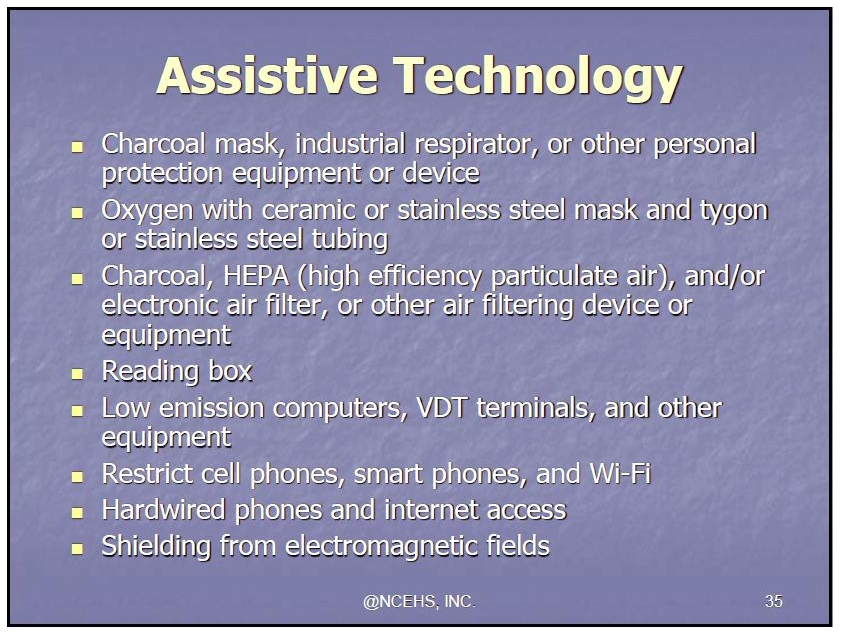
Assistive Devices For People With MCS/ES

For people with MCS/ES, assistive devices can allow us to remain functional, independent, and able when we can’t control everything in our environments.

MCS ES assistive technologySlide with a few options from New MCS/ES Accommodation Resource

In addition to fragrance, chemical, and wireless free policies, these and other devices can help reduce or eliminate exposures to the pollutants that can otherwise completely disable people with MCS/ES. They can make the difference for people to remain employed when provided early enough, effectively minimizing the effects of MCS/ES.

Continue reading

Multiple Chemical Sensitivity (MCS) Brochure

For your information, here are scans of the MCS brochure from the Environmental Health Clinic at Women’s College Hospital in Toronto, Ontario. Note that they see mostly patients with milder to middling MCS/ES (and there’s usually a 6-12 month wait list), as those with more severe MCS/ES are unable to access the clinic, it being in a regular hospital with hand sanitizers, hundreds of toxic people and plenty of unsafe materials everywhere.

MCS clinic brochure 2 exerpt 1a

The brochure is an introduction, and reducing exposures is always a good thing, but sometimes people with MCS/ES need to eliminate exposures to remain at all functional, and that’s where things become a lot more complicated, and why we need the OCEEH.

Continue reading