Category Archives: Health

Fragrances, Hormones, Women, and Children

While these resources are primarily directed at women of childbearing age and children, they are really applicable to all of us. If a mother stops using perfume, but the father still piles on the scented deodorant, aftershave, and cologne, then his sperm, the mother, and children (born or unborn) are still being exposed to harmful chemicals.

If other family members, friends, and places like daycares are using scented laundry,  personal care, and cleaning products, they too are putting moms-to-be and kids at risk.

The adverse effects from these chemicals can be life-long, even longer. Our exposures can affect our grandchildren. Eliminating them from our lives now will ensure better health all around, including downstream, where fish and wildlife are also being affected.

WECF Pregnancy and EDCs

The short video below, produced by Women in Europe for a Common Future  (WECF), provides simple, important information on how you can protect yourself and your child from Endocrine Disrupting Chemicals (EDCs). They are found in so many places now.

WECF have also developed a new website, NESTING, which is another good resource for all of us. They have assembled a lot of good advice there.

Here’s an example from their Cleaning & personal care page:

Continue reading

Do It Yourself Air Filtering Mask

When air is polluted both indoors and out, when people use fragrances and other products with toxic chemicals, when we are made ill and disabled by the pollutants, then we can’t wait for better regulations to take effect, we need to do something to protect our health now.

Sometimes we can buy masks that work for us, especially if we tolerate synthetic materials, but sometimes making our own is the only way. When we make our own, we can use safe-for-us fabrics and even coordinate them to our outfits (if we’re lucky enough to have safe-to-wear outfits).

Some people use scarves as masks. You can sew a pouch on the inside to hold filtering Continue reading

3o Things

30 Things

The following is a list of products many of us use or have contact with every day. Each and every one of these usually contains unregulated synthetic chemical ingredients, many of which pose known health hazards.

How many of these things did you touch or breathe in today?
What is protecting you?

Continue reading

MCS is International

People all over the industrialized world have been developing Multiple Chemical Sensitivities and Environmental Sensitivities, or Environmental Illnesses. We are exposed to so many petrochemical pollutants, in our air, water, foods, clothes, furnishings, homes, and elsewhere in daily life, substances which are now known to cause many kinds of adverse health effects, and some of us just have the epigenetic disposition to feel the effects faster and more extremely than others who may develop cancer or some other condition many years later.

Amelia Hill (aka the Amazing Amelia Hill) lives in Australia and developed very severe, or extreme MCS after not being properly diagnosed for too many years. A lack of proper diagnosis and precautionary measures usually results in a debilitating worsening of the condition, which is best addressed with avoidance of the triggering substances, and building up health in very targeted ways. This is much more difficult to do the longer one isn’t able to take the steps to avoid exposures and rebuild life with safe alternatives.

Amelia’s life is probably unlike any you have ever heard of (even mine) although there are many similarities between the experiences those of us who have severe MCS/ES share. Amelia is known as “amazing” because of the ways she handles her life.

You will see why here.

Amelia 01

Amelia’s story has been featured as the cover story in what may be South Australia’s most popular newspaper weekend magazine: Continue reading

Can You Imagine A World Where…

imagine a world

Can you imagine a world where it’s unacceptable to profit from polluting people and the environment we all depend on for life?

Someone imagined it was ok to pollute for profit, it wasn’t always happening or acceptable.

What if it’s possible to live good lives while looking after the planet and each other?

For things to change, we have to imagine something different first.

Then, if we can imagine it, we can work together to make it happen!

which world do we want 2

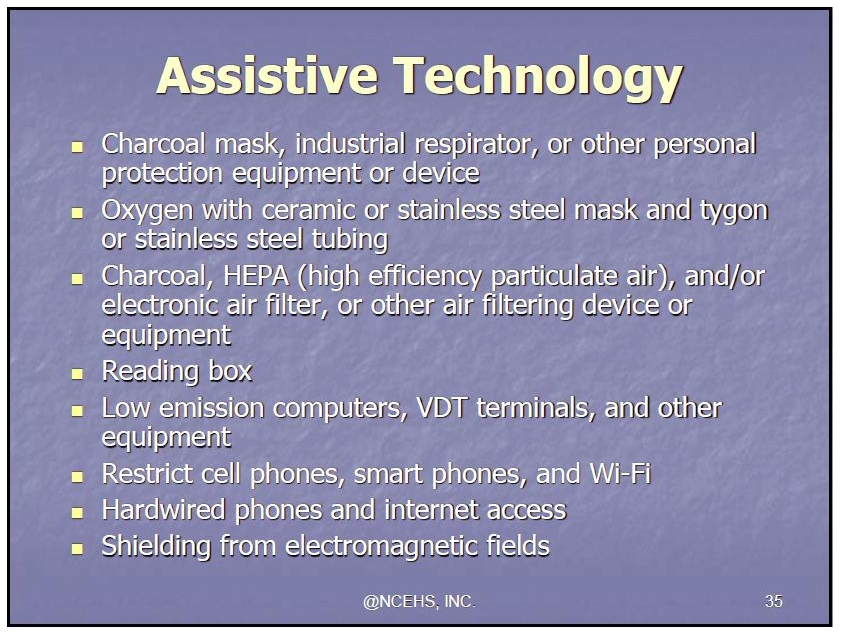
Assistive Devices For People With MCS/ES

For people with MCS/ES, assistive devices can allow us to remain functional, independent, and able when we can’t control everything in our environments.

MCS ES assistive technologySlide with a few options from New MCS/ES Accommodation Resource

In addition to fragrance, chemical, and wireless free policies, these and other devices can help reduce or eliminate exposures to the pollutants that can otherwise completely disable people with MCS/ES. They can make the difference for people to remain employed when provided early enough, effectively minimizing the effects of MCS/ES.

Continue reading

Multiple Chemical Sensitivity (MCS) Brochure

For your information, here are scans of the MCS brochure from the Environmental Health Clinic at Women’s College Hospital in Toronto, Ontario. Note that they see mostly patients with milder to middling MCS/ES (and there’s usually a 6-12 month wait list), as those with more severe MCS/ES are unable to access the clinic, it being in a regular hospital with hand sanitizers, hundreds of toxic people and plenty of unsafe materials everywhere.

MCS clinic brochure 2 exerpt 1a

The brochure is an introduction, and reducing exposures is always a good thing, but sometimes people with MCS/ES need to eliminate exposures to remain at all functional, and that’s where things become a lot more complicated, and why we need the OCEEH.

Continue reading

Are Essential Oils Too Popular For Our Own Good?

Did you know that essential oils are not harmless?

Essential Oils have been, in limited circumstances,  a good thing. Some have useful healing properties when used medicinally in very specific and temporary ways, but too much of anything is not a good thing. Essential oils  are now used and diffused everywhere, and have become more of a serious health hazard than something beneficial. Indeed,  for an ever growing percent of the population they have become life-threatening accessibility barriers.

They can be sensitizers and allergens, and can cause other serious health problems too.
They can emit and create hazardous air pollutants. Some are made with synthetic ingredients, or from pesticided plants, and are processed using toxic solvents.

They are WAY over-used and over-promoted, and any beneficial uses the organic oils may have, risk being lost due to this careless over-use.

They should not be used as a popular way to make money the way they are now.

They should be kept for medicinal use under the guidance of qualified, trained professionals, and  not the MLM (multi-level-marketing) folks who are inventing new ways to use them so that they can sell more product.

Some people have severe adverse reactions to them, and their proliferation is causing new barriers to access, meaning people can’t access food from health food stores,  other essentials, or even alternative health care, because the oils are so prevalent and contaminating everything (1st, 2nd, and 3rd hand) in what should be healthy places with clean, fragrance-free air.

Fore more information, here are a few links to check out: Continue reading

Home Dental Extraction SUCCESS (#2)!

Another One Bit the Dust

I survived my second home extraction on the weekend. It was a very infected tooth, an upper rear molar, one that I had somehow managed to retain a year longer than expected. It was actually the first one to get infected last year, but then the other tooth went ballistic, and by the time that extraction site healed, this tooth had calmed down enough to be very useful for eating with.

In hindsight, waiting so long may not have been such a great idea, as in the end, the infection was nasty. Very nasty. It put me into a terrible funk that was really difficult to push my way through, similar to the depression some kinds of mold can cause, and created the same challenges MCS/ES exposures cause, like brain fog, difficulty thinking and doing things, and a real lack of energy. And it stank when pulled. Really stank.

I am so grateful for the home visiting dentist in this area. Not only is he fragrance-free, but he is willing (and able!) to take other precautions to make things safe for me.

Last year, before my first home extraction, we discussed everything that was needed for the procedure, and what was necessary to make it as safe as possible for me.

This year I couldn’t find my old list (despite seeing it a month or 2 ago) and hoped he remembered his. This is what I do remember, and what we did:

Continue reading

About Those Fragrance-Free Laundry Products

Some of us have gone to great lengths to encourage others to use fragrance-free products, especially for laundry, as many of the chemicals in fragrances cause such  disabling effects for us.

Not only that, but fragranced laundry products pollute entire neighbourhoods with hazardous chemicals when pumped out of dryer vents (which were designed to emit moisture, not toxic chemicals), meaning that we (and others with asthma, migraines, COPD, etc) can’t sit or work outside in our gardens, open our windows for fresh air, or go for walks safely when other people are doing laundry with regular commercial  products (and when are they not?), because we could be felled at any time from the emissions.

Much to our chagrin, many of us have discovered that some fragrance-free products can also make us dizzy, cause breathing difficulties like asthma, create cognitive confusion and memory problems, give us headaches, chemical hangovers, and more.

This has caused all kinds of difficulties, not just for us, but for the people who switched products only to discover that their efforts were not “good enough” for us.

“Can’t they EVER be happy?  Why are they still complaining?”

Anne Steinemann’s recently published research regarding VOCs emitted from regular personal care, cleaning, and laundry products, (the popular ones used by most people in the “developed” world) sheds some much needed light on the problems.

So what did she find?

Continue reading