Category Archives: Human Rights

The Canadian Human Rights Commission’s “Environmental sensitivity and scent-free policies”

The Canadian Human Rights Commission’s
Policy on Environmental Sensitivities
has been updated to add more on scent-free policies.

Image description: “Environmental sensitivity and scent-free policies” text on a blue background to the left, with a photo of a dark haired woman resting her chin on her hand, while looking wistfully (towards the title  text) out a window with rain drops on it, on the right side.

The new policy includes this:

“A scent-free policy is similar to other workplace policies such as
anti-harassment policies. It applies to all employees and is intended to guide
their conduct. If an employee does not comply with the policy, disciplinary
action can be taken.”

and this:

“If an employee with environmental sensitivities needs to leave because of a trigger, this person should not suffer negative impacts because of their disability
or their need for accommodation.”


Visit the CHRC website to download the PDF:
https://www.chrc-ccdp.gc.ca/eng/content/policy-environmental-sensitivities


Full text of the policy
(as copied from their PDF for people who have difficulties with PDFs):

Continue reading

Diffusing Health Harm on Unsuspecting Shoppers and Outrageously False Product Claims

Here’s yet another example of a systemic issue regarding health harming accessibility barriers, happening in a province (and country) where we have Human Rights laws that recognize people with environmental ‘sensitivities’ as having a disability, and where everyone is encouraged to remove accessibility barriers instead of creating new ones.

Unsuspecting Oshawa Costco Canada shoppers are being subjected to this fragrance assault and/or accessibility barrier between November 26, 2019 and December 8, 2019.

Info which was found buried on Costco Canada’s website in the Special Events page, there may be other locations as well.
How many members see these announcements?

In December, it appears that those who shop at  Costco’s Ste Foy location will also be sprayed, without alternative accommodations made for member shoppers whose lives are harmed by this kind of thing (unless there’s a public outcry before it happens).

Not only is the store air thoroughly polluted by this kind of diffusion (as experienced by someone who reported it to their mother who has environmental sensitivities and is severely allergic to fragranced products) for the 2 week duration of this “special event”, but everything in their store(s), *including food*, will also have absorbed substantial residues of undisclosed (and not food-safe) fragrance substances, that may be difficult if not impossible to remove.

This ‘special event’ can cause significant harm to people with asthma, autism, chemical and environmental sensitivities, fragrance allergies, migraines, and mast cell activation syndrome (to name a few). Even 2nd and 3rd hand residues of this type can cause serious (and life-threatening) health problems and long lasting disabling effects, so a suggestion of having someone else do the shopping is not a reasonable or feasible accommodation.

See below for the product details and the store manager’s and assistant manager’s responses when called.

Continue reading

Persil: Just STOP!

When you need a product that says it’s fragrance-free

and the product’s web page states:

“It’s 100% dye-free, perfume-free and dermatologist-tested. Take laundry day to the next level. … With Persil® Sensitive Skin you can achieve a deep clean without scents and perfumes that can aggravate skin sensitivities.”

Guess what? You still need to read the ingredient list, because some manufacturers think it’s ok to do this:

Continue reading

Human Rights and Housing: New Resources for Community Workers Supporting Clients with Chemical and Environmental Sensitivities

Canadian Lawyer Magazine and The Law Foundation of Ontario have shared the news about CERA’s new resources for community workers, to help support clients with chemical and environmental sensitivities in rental housing:

Continue reading

Video Discussions about Environmental Illnesses, “Sensitivities”, and Disability

It’s not often that we hear people discussing chemical and environmental “sensitivities” and other environmentally linked chronic health problems and disabling  conditions, or how they relate in the bigger picture.

Two such discussions have taken place in August of 2019, and you can watch the videos below.

Continue reading

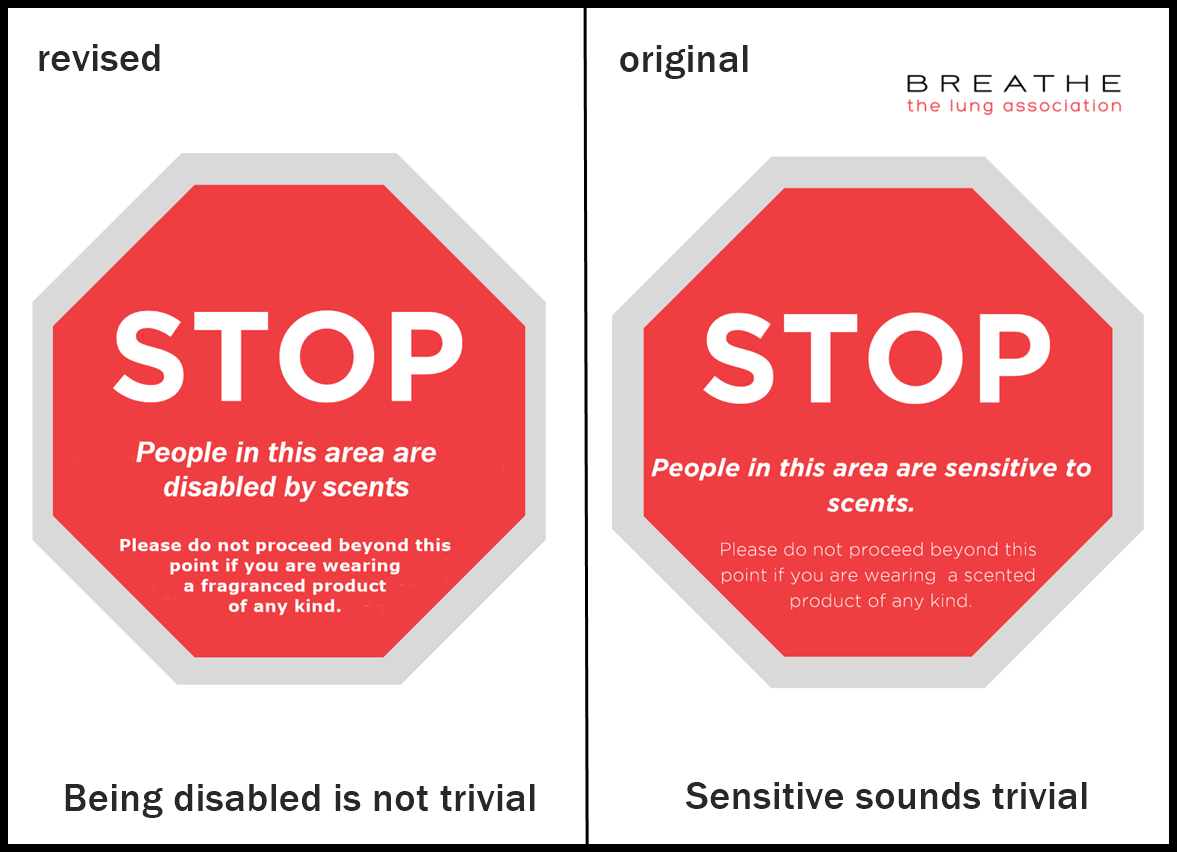
Accessibility STOP Signs

I ran across a sign that the lung association had created, and while I am glad they are doing something , I found the message and visual required some tweaking.

Of course, the lung association didn’t come up with the term “sensitive”, it’s what is used in human rights laws, but it seems to have created an impression in the public’s mind that chemical and environmental sensitivities are trivial, and not disabling or even life threatening like they can be.

It also needs to be said that signs without enforcement are endangering lives and perpetuating harm, systemic accessibility barriers, discrimination, and forced isolated segregation for those who are disabled by any or repeated exposures.

To download printable posters, see below.

Continue reading

Three New Videos About Environmental Sensitivities


EHAQ (Environmental Health Association of Québec) is presenting three new videos for

Environmental Sensitivity Awareness Day – May 12, 2019

Presentations are from:

John Molot MD.

“Numerous papers have been published supporting a biological explanation for MCS. These will be reviewed as well as the evolving medical and political perspective.”

David Fancy Ph.D.

…”Drawing from insights from the ‘social model of disability’ this presentation identifies how the current cultural moment presents systematic barriers, negative attitudes and ongoing electromagnetic wounding that puts the responsibility on society for being the main contributing factor in disabling EHS persons.”

Meg Sears Ph.D.

…” Sears notes the urgency of curbing harmful products and thus chronic disease because as people are getting sicker, families and society also suffer and the healthcare budget balloons faster than the Gross Domestic Product – clearly an unsustainable situation.”


The videos are available in both English and French.
There’s no need to register this year, just visit the website:

Continue reading

MCS/ES: Societal Neglect = No More Fun and Games for Life on the Planet


Please take a moment to feel your heart beating.
Not everyone can do this anymore.

While some progress has been made, it’s still too little,
too late for far too many people.

This will not change until more people who have MCS/ES come forward with their stories, and more  healthy people start advocating and helping us in daily life, as well as pushing governments and medical institutions to pull their heads out of the sand (and industry pockets) and get into (at least) the 20th century as far as the very serious environmental and related health issues are concerned.


“Business as usual is a disaster”
Robert Watson


“Unfortunately, many physicians, employers, family, and friends
are in effect assisting in suicide through their disbelief.”
(and neglect)

“The Consequences of Disbelief”

“Twelve years as an advocate for the chemically sensitive has led me to the sad realization that a large number of chemically sensitive people have taken their own lives and many others are inching ever closer to that decision because they find it such a daunting task to locate a safe place to live or work and are rapidly running out of money. And at the same time that they are engaged in this herculean struggle, far too many of them are facing a discouraging skepticism from those about them.”


From
“Amputated Lives: Coping with Chemical Sensitivity”
2008
By Alison Johnson
With a Foreword by L. Christine Oliver, M.D., Harvard Medical School


Links to several chapters of the book, where stories about people’s lives are featured are available here:

Continue reading

Can’t Ban Fragrances? Consider a Fragrance Free Zone

This article appears in The Job Accommodation Network’s
ENews: Volume 17, Issue 2, Second Quarter, 2019

JAN provides free, confidential technical assistance about job accommodations and the Americans with Disabilities Act (ADA).

Can’t Ban Fragrances?
Consider a Fragrance Free Zone

Dig into developing a fragrance free zone

From the desk of Linda Carter Batiste, J.D., Principal Consultant/Legislative Specialist

Employees with fragrance sensitivity often need a fragrance free work environment to avoid triggering symptoms. However, it can be difficult to completely eliminate fragrances in some workplaces. Fragrance sensitivity can be triggered by not only perfumes and colognes, but also in some cases by personal products such as deodorant, shampoo, laundry detergent, and lotion. In workplaces with a lot of employees or in which the public has access, trying to control what products people use and enforcing a total fragrance ban can be virtually impossible. So what else can be done? Continue reading

Welcome to the 2019 Edition of MCS/ES Awareness Month

It’s that time of year again!

We’re only a little tired of folks keeping their heads in the sand for decades.

The good (and sad) news is:

we’ve multiplied too much to ignore anymore!
(and there are more joining our ranks every day)

Major brands have started making fun of us and are co-opting our language,
so we know we’re making progress, even if it seems slow.


SPEAKING UP MAKES A DIFFERENCE!


If you are new to this, to learn more about  MCS/ES, you can start here:
Continue reading