Category Archives: Multiple Chemical Sensitivities

Fragrance-Free Door Signs

Many of us who have MCS/ES find answering the door can be hazardous to our health because frequently those on the other side of the door are marinating in toxic fragrance chemicals.

Sometimes a simple sign like this will do.

No Fragrance

Other times it is not enough and we need to provide more information.

Continue reading

Right to Housing hearing over – Court will decide by autumn if the case moves ahead

righttohousing's avatarWe need a national housing strategy now!

Thank you to all of you who came for a few hours or a few days to watch the housing & homelessness human rights case unfold. We really appreciated your being there and it was good for the judge to see that people are interested and concerned about the outcome.

Fay Faraday and Peter Rosenthal did a brilliant job on behalf of the applicants and Molly Reynolds, Jackie Esmonde/Martha Jackman and Kent Roach/Cheryl Milne were all outstanding on behalf of the interveners. We just finished the 3 days of argument and it’s not clear which way the decision will go. Justice Lederer does not expect to have a decision until next fall.

There was a good article in the Toronto Star about the motion:
http://www.thestar.com/news/gta/2013/05/26/landmark_homeless_charter_challenge_may_never_be_heard_if_government_wins_bid_to_quash_case.html

View original post

Who Needs A Healthy Home?

We All Do! But for Children and People With MCS/ES, it is Crucial!

Healthy Homes and Healthy Environments Sustain Life

Love is always a good thing too!

So, what’s the problem? Check out this great short video:

A Wake-Up Story

See some great tips for creating healthy housing here:

Continue reading

MCS/ES Symptoms and Environmental Incitants

sensitive to pollution 3

Information about the materials most likely to cause adverse health effects, and the kinds of symptoms commonly experienced from exposures, copied from the 2007 Canadian Human Rights Commission’s  document “The Medical Perspective on Environmental Sensitivities By: Margaret E. Sears (M.Eng., Ph.D.), and a few other resources and links follow:

Continue reading

Canadian Human Rights Documents Archived

The Government here has been re-organizing and changing all of their web pages lately and some types of information seem to be disappearing.

The_Canadian_Flag

The policy on accommodating people with MCS/ES is no longer available on the website. This is what used to be there (2007-2013):

Policy on Environmental Sensitivities

This policy is issued to encourage employers and service providers to proactively address issues of accommodation for persons with environmental sensitivities.

Policy on Environmental Sensitivities

Individuals with environmental sensitivities experience a variety of adverse reactions to environmental agents at concentrations well below those that might affect the “average person”. This medical condition is a disability and those living with environmental sensitivities  are entitled to the protection of the Canadian Human Rights Act, which prohibits discrimination on the basis of disability. The Canadian Human Rights Commission will receive any inquiry and process any complaint from any person who believes that he or she has been discriminated against because of an environmental sensitivity. Like others with a disability, those with environmental sensitivities are required by law to be accommodated.

Continue reading

Support the Right to Housing legal challenge – in court May 27 & 28th

Important court case regarding housing in Ontario and Canada. If you are in Toronto, please attend, and show your support.

righttohousing's avatarWe need a national housing strategy now!

In the spring of 2010, several individuals and the Centre for Equality Rights in Accommodation filed a landmark legal challenge at the Ontario Superior Court. The ‘Right to Housing challenge’ argues that the governments of Canada and Ontario are in violation of the Charter of Rights and Freedoms for their failure to address, and their contribution to, the growing crisis of homelessness and inadequate housing. Almost 10,000 pages of expert witness evidence were submitted to support this case on National Housing Day in the fall of 2011.

The governments of Canada and Ontario have responded by seeking to have the case struck, before the evidence can be heard by a judge.

On Monday, May 27th and Tuesday, May 28th, Fay Faraday, Peter Rosenthal and the Advocacy Centre for Tenants Ontario will argue that the case must proceed.

Amnesty International & the Economic Social and Cultural Rights Network…

View original post 205 more words

Accessible Customer Service – What to do When A Store is Too Polluted to Enter

Having invisible disabilities can present challenges most people don’t think of.

Modified from original image by Eurofin

Modified from original image by Eurofin

Indoor air can be too polluted for some of us to safely breathe. Those of us with MCS/ES can develop serious and life-threatening symptoms from breathing in toxic chemicals commonly found in indoor air. Even a mask may not be enough to protect us.

Or we may be having a bad Fibromyalgia flare and just be in too much pain to shop.

So what can we do when we need something?

Continue reading

Harvard Medical School Associate Professor Speaks about MCS: Video

Dr. L. Christine Oliver is an Associate Professor of Clinical Medicine at Harvard Medical School and Co-Director of Occupational and Environmental Medicine at Massachusetts General Hospital.

This is an excellent half hour presentation.

Dr Oliver packs so much about the issues faced by people with MCS into the first 16 minutes of this video. If you can’t watch the whole video, at least watch this much.  Alison Johnson finishes off by reading from her important book Amputated Lives.

Alison Johnson is the author/producer/director of books and documentaries on Multiple Chemical Sensitivity. Visit http://www.alisonjohnsonmcs.com to download a transcript or to purchase her books or DVDs.

amputated-lives-chemical-sensitivity

How My Descent to Fragrance Hell Began

Manufactured fragrance ingredients have had a huge and mostly negative impact on my life, beginning with the “Chanel No.5 Eau de Cologne” my mother used to douse herself with in the 70’s. I remember running around opening windows and doors to air out the house after my parents went out on the town.

“Chanel No.5” happens to be the first fragrance that was created with synthetic substances. Nice to have a video about that now:

(August 13, 2014: I just watched the Chanel No 5 video that I had posted here, and they have completely changed it to remove all mentions of the synthetic (and toxic) substances that they were first to use!!! I have removed the video from the post, as it is now just an insipid commercial for the perfume.)

I remember as children (in the 60’s) my sister and I were often given tiny bottles of “4711” as gifts, most likely free samples that family members received when purchasing larger bottles of it. I don’t remember it bothering me at the time.

It was during the 70’s that more and more products (shampoos, moisturizers, cleaning products, etc) started to bother me. At the time, I thought it was normal that some products just didn’t agree with me. I had no idea I was actually being poisoned by them. I even ended up in the hospital for a week of tests in my late teens, after developing stroke-like migraine symptoms while applying one of my sister’s scented facial cremes after I had spent the night back home instead of where I was living then.

No connections to products were made at the time… It was also the week I learned to read food labels, as one evening the ice cream I was given for dessert started foaming up instead of melting into a puddle while I was eating my dinner…

As a young adult, I had to search high and low for a perfume or eau de cologne that I could wear on special occasions, because we were taught that it was an important part of the ritual. I don’t think I made it through two tiny bottles of “L’Air du Temp” before having to abandon that ritual. Just reading their evocative description now leads me to a never never land, one I don’t remember if I was influenced by back in those days. (According to the Nina Ricci website’s legal notice, I am not allowed to link to their site without written authorization, so you’ll have to google it for yourself!!! But beware, the site has some annoying hurdles to go through before you get to the perfume’s page).

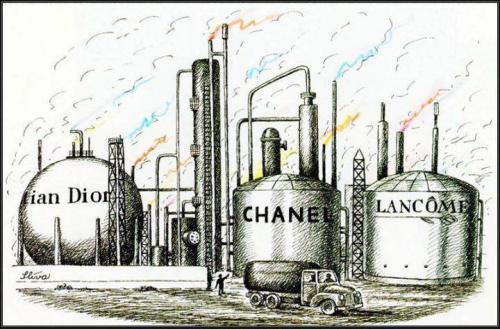
Now there are hundreds, if not thousands of synthetic, petro-chemical ingredients used in fragrances. And fragrance chemicals are everywhere. It is pretty much impossible to avoid them unless you are alone in the middle of no-where. They are in the air, in our water, even in our supermarket foods.

I am housebound now because fragrance chemicals are everywhere, even in my yard when others are using their dryer vents and the wind blows this way. I have a very difficult time finding even basic essentials (like baking soda, food and clothing) that are un-contaminated by fragrance ingredients. I wrote about how fragrance residues basically left me homeless in the previous post.
eau de petroleum

The International Fragrance Association (IFRA) reports that 3090 materials have been reported (voluntarily via membership surveys, there was no forced compliance) as being used in fragrance compounds in 2008 and updated in 2011.

Here’s the list. Some are known to be quite hazardous. Most have never been tested for safety.

Check the sidebar here > > > for some links about fragrances and their health impacts. You can also read what I’ve previously posted about them.

Fragrance chemicals are clearly just as bad, if not worse for our health than tobacco smoke. It’s time to ban toxic chemicals from fragrances. At the very least, label them on products, so people know what they are applying to their bodies and forcing everyone else to breathe. Being forced to breathe in toxic chemicals is toxic trespass.

I love clean air

Here are some fragrance free policies from around the world.

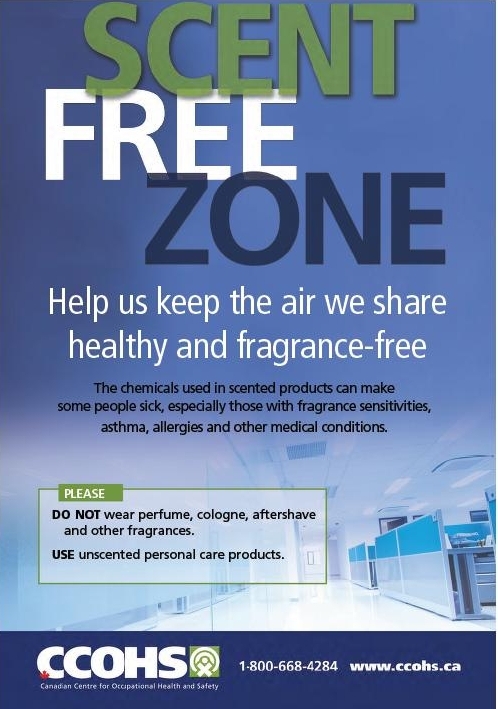
CCOHS Scent Free Zone

You Can Help Provide Medically Required Safe Housing!

Safe, non-toxic housing is the primary medical need of people with MCS/ES and EHS. The number of lives affected and needing this kind of medically required housing is growing, and far too little is being done by the various governments or medical associations to address the needs of all the people who are being injured and disabled by common everyday chemical and EMF/EMR exposures.

For us, safe housing is like the cast after we break a bone. It protects us and allows us to heal while preventing re-injury, especially if the housing is in an area where the outdoor air is also safe for us to breathe. Especially for those of us who have been repeatedly and seriously injured. That means no dryer vents that emit hazardous laundry chemicals, no pesticide use, or industrial emissions or busy roads nearby.

The good people at  the Environmental Health Association of Québec (ASEQ-EHAQ) see and understand the need and are working to do something about it, by developing an ECOASIS in the Laurentian Mountains of Quebec, but they need your help to make it happen.

Help Provide An ECOASIS

If you are already convinced this is a great cause to support and just want the link to where you can donate, then please click here.

If you need to know more about why this is so important, then please keep reading…

Continue reading