Have Your Say for May by Mimi

Mimi from Ontario, Canada has this to say to us:

I wish that you could accept that this is real and that your habits make me ill.

I wish you could understand how switching to fragrance-free products is such a small act that means a world of difference to me – literally.

It means being able to have a clear mind in order to work effectively and support myself, it means being able to receive hugs, it means not suffering every day.

Mimi

Can You Imagine A World Where…

imagine a world

Can you imagine a world where it’s unacceptable to profit from polluting people and the environment we all depend on for life?

Someone imagined it was ok to pollute for profit, it wasn’t always happening or acceptable.

What if it’s possible to live good lives while looking after the planet and each other?

For things to change, we have to imagine something different first.

Then, if we can imagine it, we can work together to make it happen!

which world do we want 2

But I Don’t Smell Anything!

Guest Post by Leah Spitzer

I have Multiple Chemical Sensitivity (MCS) – a “multi-system illnesses as a result of contact with, or proximity to, a variety of airborne agents and other substances. (Environmental Protection Agency).” In other words, I react to fragrances, building products and more. It is not a histamine reaction, but rather, a systemic reaction to the chemicals in fragrance and other products.

As someone with MCS, I’m also known as a “canary” with deference to the Canaries in the Coal Mine. As a canary, I often encounter looks of disbelief when I mention I can smell someone’s laundry detergent, or fragrance. I can smell it on them, their dog, their cat, their clothes, or even the package they are bringing me. I smell it in their home and in their car.

Often times, if it’s just a passing moment, I try to step back, or just tough it out, but sometimes I have to speak out. When I do, the most common response, after the surprised look, are:

“I didn’t put any perfume on this morning”
or
“I don’t smell anything”

I don't smell anything

Why the disparity in perception? There are several reasons that I have observed:

Continue reading

Assistive Devices For People With MCS/ES

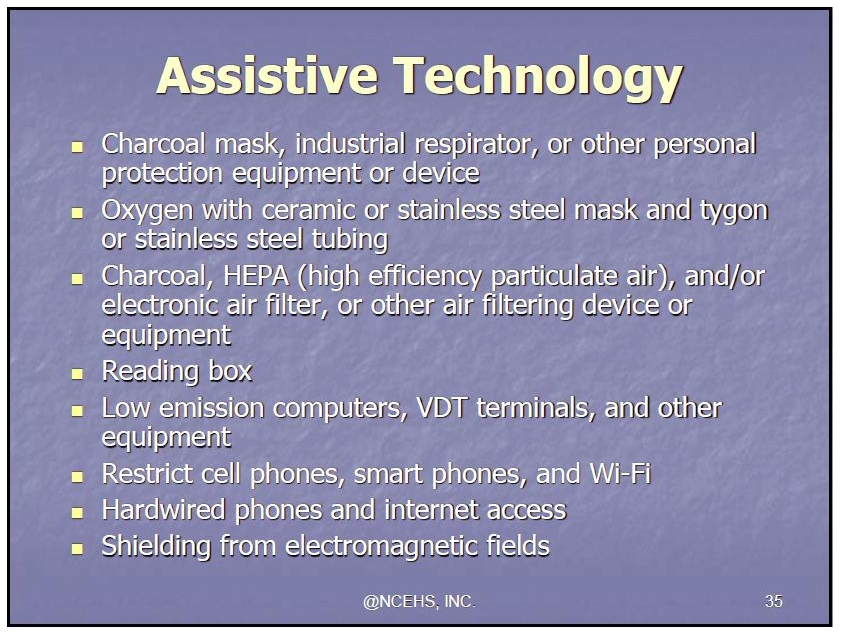
For people with MCS/ES, assistive devices can allow us to remain functional, independent, and able when we can’t control everything in our environments.

MCS ES assistive technologySlide with a few options from New MCS/ES Accommodation Resource

In addition to fragrance, chemical, and wireless free policies, these and other devices can help reduce or eliminate exposures to the pollutants that can otherwise completely disable people with MCS/ES. They can make the difference for people to remain employed when provided early enough, effectively minimizing the effects of MCS/ES.

Continue reading

Multiple Chemical Sensitivity (MCS) Brochure

For your information, here are scans of the MCS brochure from the Environmental Health Clinic at Women’s College Hospital in Toronto, Ontario. Note that they see mostly patients with milder to middling MCS/ES (and there’s usually a 6-12 month wait list), as those with more severe MCS/ES are unable to access the clinic, it being in a regular hospital with hand sanitizers, hundreds of toxic people and plenty of unsafe materials everywhere.

MCS clinic brochure 2 exerpt 1a

The brochure is an introduction, and reducing exposures is always a good thing, but sometimes people with MCS/ES need to eliminate exposures to remain at all functional, and that’s where things become a lot more complicated, and why we need the OCEEH.

Continue reading

Are Essential Oils Too Popular For Our Own Good?

Did you know that essential oils are not harmless?

Essential Oils have been, in limited circumstances,  a good thing. Some have useful healing properties when used medicinally in very specific and temporary ways, but too much of anything is not a good thing. Essential oils  are now used and diffused everywhere, and have become more of a serious health hazard than something beneficial. Indeed,  for an ever growing percent of the population they have become life-threatening accessibility barriers.

They can be sensitizers and allergens, and can cause other serious health problems too.
They can emit and create hazardous air pollutants. Some are made with synthetic ingredients, or from pesticided plants, and are processed using toxic solvents.

They are WAY over-used and over-promoted, and any beneficial uses the organic oils may have, risk being lost due to this careless over-use.

They should not be used as a popular way to make money the way they are now.

They should be kept for medicinal use under the guidance of qualified, trained professionals, and  not the MLM (multi-level-marketing) folks who are inventing new ways to use them so that they can sell more product.

Some people have severe adverse reactions to them, and their proliferation is causing new barriers to access, meaning people can’t access food from health food stores,  other essentials, or even alternative health care, because the oils are so prevalent and contaminating everything (1st, 2nd, and 3rd hand) in what should be healthy places with clean, fragrance-free air.

Fore more information, here are a few links to check out: Continue reading

Home Dental Extraction SUCCESS (#2)!

Another One Bit the Dust

I survived my second home extraction on the weekend. It was a very infected tooth, an upper rear molar, one that I had somehow managed to retain a year longer than expected. It was actually the first one to get infected last year, but then the other tooth went ballistic, and by the time that extraction site healed, this tooth had calmed down enough to be very useful for eating with.

In hindsight, waiting so long may not have been such a great idea, as in the end, the infection was nasty. Very nasty. It put me into a terrible funk that was really difficult to push my way through, similar to the depression some kinds of mold can cause, and created the same challenges MCS/ES exposures cause, like brain fog, difficulty thinking and doing things, and a real lack of energy. And it stank when pulled. Really stank.

I am so grateful for the home visiting dentist in this area. Not only is he fragrance-free, but he is willing (and able!) to take other precautions to make things safe for me.

Last year, before my first home extraction, we discussed everything that was needed for the procedure, and what was necessary to make it as safe as possible for me.

This year I couldn’t find my old list (despite seeing it a month or 2 ago) and hoped he remembered his. This is what I do remember, and what we did:

Continue reading

About Those Fragrance-Free Laundry Products

Some of us have gone to great lengths to encourage others to use fragrance-free products, especially for laundry, as many of the chemicals in fragrances cause such  disabling effects for us.

Not only that, but fragranced laundry products pollute entire neighbourhoods with hazardous chemicals when pumped out of dryer vents (which were designed to emit moisture, not toxic chemicals), meaning that we (and others with asthma, migraines, COPD, etc) can’t sit or work outside in our gardens, open our windows for fresh air, or go for walks safely when other people are doing laundry with regular commercial  products (and when are they not?), because we could be felled at any time from the emissions.

Much to our chagrin, many of us have discovered that some fragrance-free products can also make us dizzy, cause breathing difficulties like asthma, create cognitive confusion and memory problems, give us headaches, chemical hangovers, and more.

This has caused all kinds of difficulties, not just for us, but for the people who switched products only to discover that their efforts were not “good enough” for us.

“Can’t they EVER be happy?  Why are they still complaining?”

Anne Steinemann’s recently published research regarding VOCs emitted from regular personal care, cleaning, and laundry products, (the popular ones used by most people in the “developed” world) sheds some much needed light on the problems.

So what did she find?

Continue reading

Trust Us, They Said

We’re telling the truth… they implied!

These days, there are some who will stop at nothing to protect and increase their profits, no matter what the consequences. I’m grateful to the others who are sharing some wisdom on what is going on and how to spot the red flags.

First off, in this TEDx talk, veteran investigative journalist Sharyl Attkisson shows how astroturf, or fake grassroots movements funded by political, corporate, or other special interests very effectively manipulate and distort media messages.

I’ve noticed so many of those tactics used. Have you?


Next, the new film Merchants of Doubt from Robert Kenner and Kim Roberts, inspired by the book of the same name by Naomi Oreskes and Erik M. Conway, is  “a satirically comedic, yet illuminating ride into the heart of conjuring American spin”.

How do you decide who is trustworthy and who is not?

Wendy is NOT a Widget and She Shouldn’t be Treated Like One

Wendy is NOT a widget. Widgets can go anywhere. Wendy can’t.

“Widget” is used in texts and speech, especially in the context of accounting, to indicate a hypothetical “any-product”. Companies in such texts will frequently be given names such as “ABC Widgets” or “Acme Widget Corp.” to indicate that the particular business of the hypothetical company is not relevant to the topic of discussion.
(Widget economics – wikipedia)

“Economists often use the term widget to refer to an abstract unit of production.”

Wendy is NOT a widget as her local housing authority seems to believe. They have a capacity problem, but instead of addressing the need for improved (and accessible) capacity, they want to re-arrange people’s lives as if they were widgets, with little to no regard or understanding of the consequences.

INVESTOPEDIA EXPLAINS ‘Capacity’

“The widget manufacturer may be able to produce 150,000 widgets in a month. However, due to downtime because of equipment maintenance and worker illness, only about 130,000 widgets can actually be produced per month. Over the long run, a business can increase its capacity and output by acquiring more factors of productions. For example, if market demand for widgets spikes, the widget manufacturer can buy more equipment and hire more workers, and thus increase its capacity to 175,000 widgets per month.”

Wendy is not a widget. She is a living, breathing, human being, a human being with a complex, chronic environmentally linked condition and disability related needs, needs that widgets don’t have.

Wendy Kearly photo by ADAM MACINNIS – THE NEWS

Wendy Kearly photo by ADAM MACINNIS – THE NEWS

The housing authority from which Wendy rents her safe home has deemed her over-housed, and are in the process of evicting her, despite the fact that Wendy has no other option for medically required, safe housing available, and no safe access to any of the other places most people take for granted (see below).

In the following audio interview with Wendy, among other things, she talks about the process her grown children take to detox themselves enough to be able to safely visit with her, so that she is able to safely hug them when they come to town.

Continue reading