Tag Archives: allergies

Down is Harder After Up

Alternate title: Be Grateful or Be Miserable!

I had some really good brain and body days in the early spring, enough that they left an imprint on me of how it felt to feel (relatively, and almost) normal. instead of the usual:
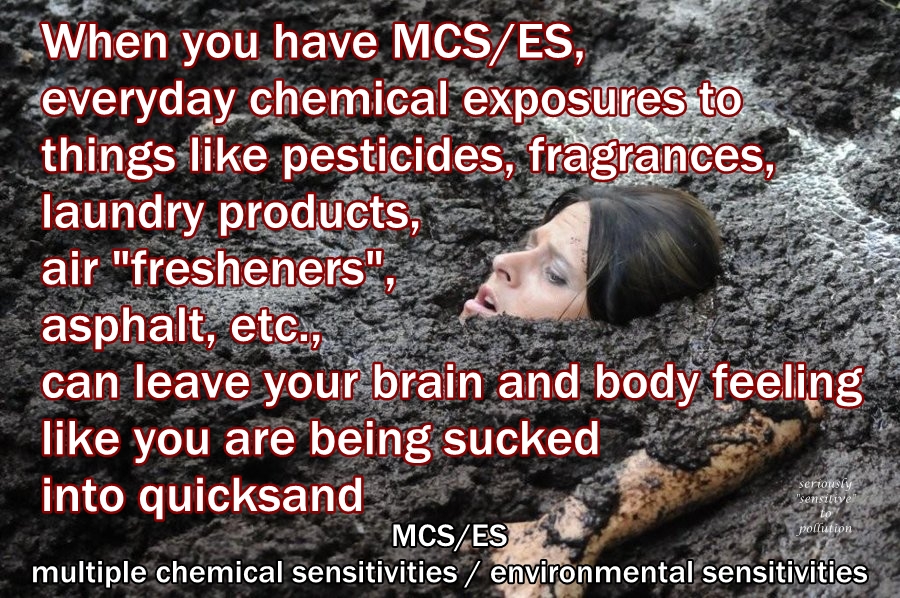
feels like quicksand-3

Then shit happened… (sorry, I don’t usually use language like that, but I’ve lost access to some parts of my vocabulary lately as a result of the toxic stuff I was exposed to).

Pesticides, dental infections and extractions, toxic products and materials (including trying to replace a SS kitchen kettle -simple, yes? Actually, NO), summer road work, more and more pesticides, heat,  VOCs, lack of ventilation and air filtration, which meant no ability to cook, and more…all of which resulted in some serious brain fog, cognitive problems,  and drastically reduced physical abilities.

Back to the drawing board…

After having some good days this year, I crashed again, and I haven’t been able to recover… much… There can be a few better mini-moments here and there if the outdoor air quality is exceptional and the breezes have been blowing the “right” way, but nothing like how well I was doing for a while in the spring.

Which makes it so much harder now, because I can actually remember what it was like to be more functional. It was so long ago before, that it didn’t really come into play or into my thoughts, as for so many years, I couldn’t remember what it was like to think clearly, or to function without effort, with relative ease.

Is it really too much to ask to be able to function with relative ease? To not have every thought, every action be like climbing a mountain or navigating an obstacle course?

Continue reading

V’s Canary Cries

Guest Post by V from the USA

This was originally posted to an online support group. V granted her permission to share it here. She has been able to put this part of her life story into words that so many of us find hard to express, and I thank her deeply for sharing her words with you too.


Canary V

It’s about 1:30 a.m. and this is about the time where I start to feel despair about everything in my life. I just can’t seem to adapt to the isolation and lack of a routine or purpose. Also, I can’t seem to find any pain meds for my chronic pain. I have been in physical pain for so long.

I know this post may seem disjointed which is apropos considering how I feel.

I AM so tired of spinning my wheels…Along with MCS I have so many other medical issues…non terminal that I know of but still…I have asthma and allergies.. I can’t be around dogs or cats, the weather determines my breathing status for the day and my physical mobility.

I can only eat about 10 things and it’s exhausting to try to rotate these foods and I spend excessive time trying to plan. Even planning a rotation I still get itching throat and sometimes a swollen throat with some of the ten things I think I can eat…it’s horrible to start eating and not know how I will feel ..

Continue reading

“Artificial scents have no place in our hospitals”

Canada’s top medical journal, the Canadian Medical Association Journal (CMAJ), says
Artificial scents have no place in our hospitals

Hospital NO Fragrance

“These patients may be involuntarily exposed to artificial scents from staff, other patients and visitors, resulting in worsening of their clinical condition. As patients,
family members and emergency physicians will attest, the attacks can be quite sudden and serious. There is little justification for continuing to tolerate artificial scents in our
hospitals.” …

Continue reading

Why We Need “Sensitive” Human Canaries

“Sensitive” humans are not defective or here to inconvenience you.

maybe it is not me

Some canary history:

“Carbon monoxide, a potentially deadly gas devoid of color, taste or smell, can form underground during a mine fire or after a mine explosion.

Today’s coal miners must rely on carbon monoxide detectors and monitors to recognize its presence underground. However, before the availability of modern detection devices, miners turned to Mother Nature for assistance.

Canaries — and sometimes mice — were used to alert miners to the presence of the poisonous gas. Following a mine fire or explosion, mine rescuers would descend into the mine carrying a canary in a small wooden or metal cage.


Any sign of distress from the canary was a clear signal that the conditions underground were unsafe, prompting a hasty return to the surface.


Continue reading

Webinar to Increase Smoke-Free Policies in Federally Assisted Housing (US)

Smoke and chemicals (such as fragrances, air “fresheners”, laundry products, pesticides, and other VOCs) do not respect property lines as they travel throughout space, often making others quite sick, even disabling them in their own homes. This is especially a problem in multi-unit housing, and where housing units are built close together.

This is also a very serious accessibility issue for people with MCS/ES, as there are few affordable housing options available, and most of these put people at risk of further  harm due to indoor air pollution issues, despite HUD and other federal agencies in the US and Canada recognizing MCS/ES as a disability that needs to be accommodated.

The following webinar is about addressing smoke, but the issues are applicable to other forms of indoor air pollutants as well. It should also be available as a podcast later.

For those of you who are interested and able,  the webinar is being offered on Wed, Aug 5, 2015 2:00 PM – 3:30 PM EDT by the Asthma Community Network

Breathing Easy at Home: Partnering to Increase Smoke-Free Policies in Federally Assisted Housing

live smoke free webinarMore info: Continue reading

Shouldn’t Cleaning Products REMOVE Pollutants Instead of ADDING Them?

Here’s yet another scientific report about how dangerous chemicals and VOCs are being released from the everyday cleaning products most people use in their homes!

Environmental Defense (Canada) recently released their report THE DIRTY TRUTH, which found that products from some of the biggest cleaning brands (Mr. Clean, Clorox, Lysol, Windex, and PineSol ) pollute the air in Canadians’ homes with harmful chemicals. (Note that these products are not significantly, if at all different in the US, but the EU does have some bans on ingredient that are still allowed here).

ED’s The Dirty Truth follows hot on the heels of Women’s Voices For the Earth’s DEEP CLEAN report, and while both of these reports name names, they had a slightly different focus.

In Deep Clean, Women’s Voices For the Earth graded four major cleaning product manufacturers based on key indicators to expose their commitment to product safety: Product Ingredient Disclosure, Responsiveness to Consumer Concerns, Toxic Chemical Screening Process and Removal of WVE’s Chemicals of Concern.

Dr. Anne Steinemann’s research from earlier this year did not name product names, but she named numerous harmful volatile organic chemicals (VOCs) that the many popular products she tested do release into the air we breathe.

One has to wonder why this is allowed to be going on?

We should not be subjected to harmful industrial pollutants in our own homes!

cleaning pollution 1.

“Our new report found that products from some of the biggest cleaning brands (Mr. Clean, Clorox, Lysol, Windex, and PineSol ) pollute the air in Canadians’ homes with harmful chemicals called Volatile Organic Compounds. These chemicals have been linked to respiratory problems such as asthma and lower IQs.”

.

 Volatile Organic Compounds and Your Health

Continue reading

Industry Approved Actions to Spare Your Air, Lungs, and Brain

.
If only the air was this good all the time!

If only the air was in the blue range all the time!

.

Sometimes summer air just plain sucks. It can and does cause all kinds of health problems. Here then are some tips from Air Quality Ontario on what we humans can do to reduce our exposure to harmful pollutants and our impact on outdoor air.
 .
Note that none of these suggestions are enforceable. They are entirely voluntary for those of us who manage to learn of their existence. Many of us only find out about these tips once we are so adversely affected by pollutants that we couldn’t do these things even if we wanted to, which means the tips are most useful for the people who aren’t personally affected enough (yet) to understand the need for them.
 .
(reducing industry impacts on air will just have to wait until enough of us demand it)
 …
 .
During a Special Air Quality Statement, there are a number of actions that you can take to help spare the air:

Continue reading

Why Exposure Monitoring Would Be Medically Validating

We (as a society) are facing unprecedented kinds of health problems and challenges that can easily (if you do any research) be explained by our 24/7 exposure to toxic chemicals in everyday products and materials, GMOs (and pesticides) in our “food” supply, and 24/7 exposure to unsafe levels of wireless radiation.

Harmful pollutants are now in our air, water, food, clothing, and you name it, it’s likely to be either made with toxic materials, or has 2nd or 3rd hand toxic chemical contamination from passing through a toxic environment. These exposures add up, and are messing with our health and well-being in ways that are not yet well-understood, but point to the urgent need to stop business as usual, and stop burdening our bodies with so many harmful pollutants that we were simply not designed to process.

There is money to be made by selling drugs, even if the drugs aren’t appropriate to the condition,  do nothing to heal what’s wrong, and often just make things worse, much worse.

Stephen Genuis is a researcher who has published many peer reviewed articles dealing with environmental health. In 2014 the official journal of the Canadian Family Physician published two of them. I shared the abstract from one of them last year.

I am going to “quote” extensively from the other article here, as most of you don’t follow the links, but will read what I have here.

Pandemic of idiopathic multimorbidity
Stephen J. Genuis, MD FRCSC DABOG DABEM

Canadian Family Physician June 2014 vol. 60 no. 6 511-514

“Sitting among colleagues in the private room of a swank eatery, I recently had the pleasure of participating in a pharmaceutical industry–sponsored medical education event allegedly exploring the management of patients presenting to their health providers with multisystem health complaints.

The animateur for the evening—an eloquent orator with impressive credentials—raised the issue of the rising prevalence of patients who present with a laundry list of ongoing and seemingly unrelated persistent complaints often including headache, joint pain, fatigue, brain fog, bloating, chemical intolerance,1 muscle aches, itchy skin, and so on.”

Continue reading

The Effort and “Inconvenience” of Single-Handedly Trying to Remove Systemic Barriers to Access

.

When she needed accommodation, you won’t believe the rigmarole that ensued.

(unless you have MCS/ES)

equal opportunity 1

“They should not have to make significantly more effort to access or obtain service. They should also not have to accept lesser quality or more inconvenience.”

.

Someone with MCS (who wishes to remain anonymous) was asked about how her efforts to receive appropriate, safe, accommodation were going, so she could see a health care provider. She is one of a growing number of people who become disabled from exposures to toxic chemicals found in many everyday products and materials, especially in fragrances.

This is pretty much how the story goes:

She contacted a health care provider by phone and talked to a receptionist.

She asked her if they had a scent-free policy and was told they didn’t.

Continue reading

It’s Only A Little Fragrance

How many times have we heard it’s “only a little fragrance”?

Telling a person with MCS/ES that there is “only a little fragrance”

is like

telling someone with Celiac Disease that there’s “only a little gluten”

or

 telling someone with a peanut allergy that there’s “only a little peanut”

or

telling someone who uses a wheelchair that there are “only a few steps”.

It’s not ok.

telling 103It’s NOT ok.

Individual images follow: Continue reading