Tag Archives: environmental sensitivities

What I Wear In Bad Air :: Ellie


2016 Ellie

“Instead of cancer, I got MCS, meaning I stop breathing on contact with your everyday chemicals (plus a multitude of other symptoms.) Hey, there’s another perk! You might finally have the excuse you need to buy an expensive gas mask that can also be used with costumes! After all, once you get MCS, you can’t leave the house without one, so you’ll always be dressed for an adventure! #GoNatural”

Ellie uses this mask:

Continue reading

What I Wear In Bad Air :: Marie

2016 Marie LeBlanc 1

“I have to  wear my mask to do laundry in the basement because of mustiness and other people’s fragrances.”

~ Marie LeBlanc

Marie also shared an artistically altered image of her wearing her mask while waiting to see a doctor, because people were ignoring the fragrance-free signs on the wall behind her. Continue reading

When We HAVE to Wear A Mask to Breathe and Function

When breathing the air hurts…

When we have to filter and “purify” the air just to breathe…

What options do we have?

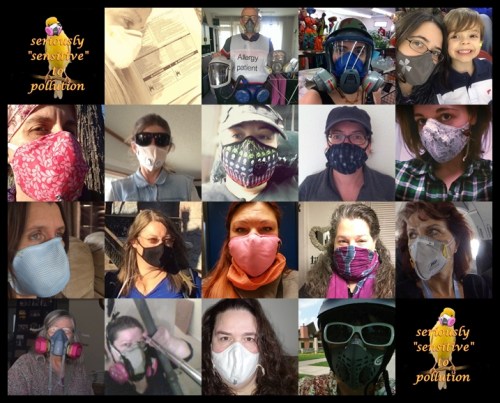
2016 MCS-ES Awareness Month Compilation

The Courageous Canaries of MCS/ES (and mask) Awareness Month 2016

Having an invisible disability is difficult, especially when many of the adverse effects are delayed and we have to deal with them in isolation.  Some people feel  self conscious about wearing a mask, especially if we can’t find a “pretty” one that we are able to use, despite how they can reduce adverse effects. If there’s any good that comes from wearing one (in addition to protecting our health a bit) wearing a mask when we have an invisible disability helps make us visible.

The type of mask we benefit most from will depend on our “sensitivities” and circumstances. Masks will filter the air we breathe in various degrees, but unless we have a full face respirator and wear a hazmat suit, our eyes and skin will still absorb chemicals that can have an adverse effect on our health and well-being. For this reason, they should not be thought of as complete protection from pollution, and are therefore best used only when absolutely necessary.

Information and resources about masks that filter out some of the different types of daily pollutants we are subjected to, and what kinds of filter materials are needed to purify what kinds of pollutants follows.

Continue reading

MCS Awareness Month and Masks

May is MCS/ES Awareness Month

Due to the wide variety of chemical pollutants in our air these days, many people with MCS/ES have to wear a mask when leaving home (and sometimes even at  home) to prevent or reduce debilitating and disabling symptoms.

may is mcs es awareness month

Having an invisible (and inconvenient, or so we are told) disability is difficult, especially when many of the adverse effects are delayed and we have to deal with them in isolation, out of sight, out of mind, and without witness to our suffering.

If there’s any good that comes from wearing a mask or respirator in public (in addition to protecting our health a bit) wearing one when we have an invisible disability helps make us visible, and alerts other people that they too are at risk.

Breathing is not optional.

Pollution is!

Wearing a protective breathing device can minimize some of the damaging effects exposures to pollutants cause, but people often feel self conscious about wearing a mask, especially if we can’t find a “pretty” one that we are able to use, Continue reading

MCS/ES and Mental Health

Living with MCS/ES creates challenges that seem unimaginable to most people. Despite some progress (more awareness), due in large part to so many more people being affected, the barriers and obstacles to living in the world as it currently is, can be never-ending when there is industry generated denial that everyday chemicals (or wireless) exposures are hurting and disabling people.

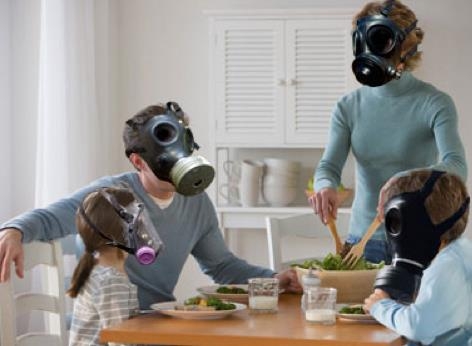
dinner time“Remember, don’t talk or breathe when you take your masks off to eat”

It is exhausting to have to constantly ask for accommodations just to be able to exist in a world where safe solutions are often hard to find, or when they do exist, they are not affordable. It can be like living in a world that wishes we’d just go away and leave them all alone, yet… there is no safe place to go away to…

Is it any wonder then, that people develop mental health problems?

When health problems (mental or otherwise) related to circumstances and experiences arise, one is (usually) only truly helped by people who have an understanding of the issues related to the circumstances that are connected to the problems. When that understanding doesn’t exist, appearances can create erroneous assumptions that perpetuate the kinds of harms that caused the problems in the first place.

For people with MCS/ES, exposures can  trigger temporary or long term brain and behavior issues that look like mental health problems to people who don’t know how toxic chemicals, molds, food sensitivities, or wireless exposures can affect our brains and bodies. And sometimes we are capable of doing some things, yet completely incapable of doing others, as exposures can affect different parts of our bodies and brains, and for varying amounts of time.

What people also don’t understand, is that when we are able to live free of those exposures, we can be free of the brain or behavior problems the exposures cause.

Finding ways to access goods and services without being subjected to disabling levels of exposures can take 10 to 100 times more effort than people normally have to extend for the same goods and services. Sometimes, despite our best efforts, we cannot safely access the goods and services everyone else takes for granted. These challenges can mean we may need to turn to others for help with survival and coping , yet not only is it difficult to receive practical support,

new research  also proves that access to knowledgeable mental health care providers is rare for people with MCS/ES!


“When asked to evaluate their provider’s knowledge of MCS on a scale of “not knowledgeable”, “somewhat knowledgeable”, or “highly knowledgeable”,

Continue reading

Advertising Harmful and Addictive Products

I’ve been observing advertising for fragranced products over the years and have found some of the ads to be quite telling.

For instance, every time I’ve seen an ad for this product, it looks like the people using it are inhaling drugs.

cheap and legal 1

And this product too. All the ads show adults and/or children who look like they are getting stoned:

Continue reading

My LOVE: Resist Toxic Chemicals

My LOVE!

Be fragrance-free!

valentine splatter RESIST 1

What’s love got to do with it?

Everything!

Who among us wants to harm another? Modern fragrances cause harm. Stop them!

Continue reading

‘Conceptual Breakthrough’ Regarding the Chemicals We’re Stewing In

This is BIG news in the everyday chemicals and human health research front!

This explains what many of us who have MCS/ES experience – we can feel these processes as they occur, we don’t have to wait for the cancer that will kill us if we don’t get away from the exposures and find tools to heal the already occurring damage.

chemical effects

‘Conceptual breakthrough’

“This is the first time scientists have figured out how widespread this is, and how many different layers of machinery within the cells themselves are being impacted by these chemicals.”

.

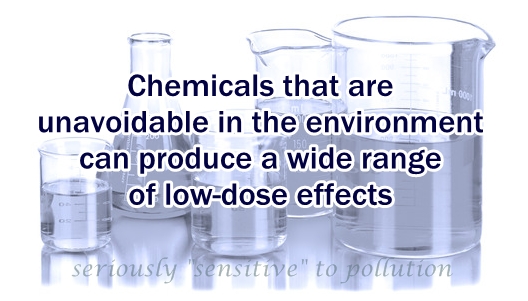
“We found definite evidence that chemicals that are unavoidable in the environment can produce a wide range of low-dose effects that are directly related to carcinogenesis. So the way we’ve been testing chemical safety is really quite out-of-date.”

“Every day we are exposed to an environmental ‘chemical soup’ and we need testing to evaluate the effects of our ongoing exposure to the mixtures in this soup.”

~ William Goodson III, a senior scientist at the California Pacific Medical Center in San Francisco.


“This research backs up the idea that chemicals not considered harmful by themselves are combining and accumulating in our bodies to trigger cancer and might lie behind the global cancer epidemic we are witnessing.

~ Cancer Biologist Dr Hemad Yasaei from Brunel University London

.

This would be all kinds of everyday chemicals, such as those that trigger MCS – they included chemicals found in items such as mobile phones, detergents and cooking pans, and pesticides used on fruits and vegetables!

Read the research or check out some of the media reports:

Continue reading

Vita

VITA

When humanity holds the future of life, as we know it, in their hands…

 let’s hold life with love…


Loneliness, Posttraumatic Growth, and Invisible Disabilities

Amelia Hill shared an eloquent post about enduring and working with loneliness (see below).  Amelia and I are both  housebound (and have been so for years), but she is currently confined to a much smaller space in her home than I am in mine.

loneliness - Amelia HillFrom Heal Amelia’s Life:

Loneliness. I’ve kinda learned to override the often relentless waves of loneliness one feels living an isolated existence like mine.I don’t deny the feelings of loneliness or push them down in an unhealthy way. But it’s more like a repetitive cycle of acknowledging it & letting it go, acknowledging it & letting it go. It’s how I survive.

Continue reading