My LOVE!
Be fragrance-free!

♥
What’s love got to do with it?
Everything!
Who among us wants to harm another? Modern fragrances cause harm. Stop them!

My LOVE!
Be fragrance-free!
♥
What’s love got to do with it?
Who among us wants to harm another? Modern fragrances cause harm. Stop them!
Guest Post by V from the USA
This was originally posted to an online support group. V granted her permission to share it here. She has been able to put this part of her life story into words that so many of us find hard to express, and I thank her deeply for sharing her words with you too.
It’s about 1:30 a.m. and this is about the time where I start to feel despair about everything in my life. I just can’t seem to adapt to the isolation and lack of a routine or purpose. Also, I can’t seem to find any pain meds for my chronic pain. I have been in physical pain for so long.
I know this post may seem disjointed which is apropos considering how I feel.
I AM so tired of spinning my wheels…Along with MCS I have so many other medical issues…non terminal that I know of but still…I have asthma and allergies.. I can’t be around dogs or cats, the weather determines my breathing status for the day and my physical mobility.
I can only eat about 10 things and it’s exhausting to try to rotate these foods and I spend excessive time trying to plan. Even planning a rotation I still get itching throat and sometimes a swollen throat with some of the ten things I think I can eat…it’s horrible to start eating and not know how I will feel ..
Canada’s top medical journal, the Canadian Medical Association Journal (CMAJ), says
“Artificial scents have no place in our hospitals“

“These patients may be involuntarily exposed to artificial scents from staff, other patients and visitors, resulting in worsening of their clinical condition. As patients,
family members and emergency physicians will attest, the attacks can be quite sudden and serious. There is little justification for continuing to tolerate artificial scents in our
hospitals.” …
Posted in Accessibility, Air Quality, Disability, Environmental Health, Fragrance, Health, Health Care, Hospital Protocols, Policy, Precaution, Public Health
Tagged allergies, asthma, autism, cancer, environmental sensitivities, Fragrance, fragrance-free policy, hazardous air pollutants, health care access for people with MCS/ES, Human Rights, IAQ, MCS, MCS/ES, multiple chemical sensitivity, petrochemicals, phthalates, toxic chemicals, toxic trespass
That may seem like a dumb question to people who haven’t been in a hospital, but to the rest of us, including those of us who can’t even go into a hospital in life or death situations, it’s a serious one.

.
Check out this TEDMED video where Robin Guenther* discusses connections between health and environmental design, and what she and others are doing to make things different:
People all over the industrialized world have been developing Multiple Chemical Sensitivities and Environmental Sensitivities, or Environmental Illnesses. We are exposed to so many petrochemical pollutants, in our air, water, foods, clothes, furnishings, homes, and elsewhere in daily life, substances which are now known to cause many kinds of adverse health effects, and some of us just have the epigenetic disposition to feel the effects faster and more extremely than others who may develop cancer or some other condition many years later.
Amelia Hill (aka the Amazing Amelia Hill) lives in Australia and developed very severe, or extreme MCS after not being properly diagnosed for too many years. A lack of proper diagnosis and precautionary measures usually results in a debilitating worsening of the condition, which is best addressed with avoidance of the triggering substances, and building up health in very targeted ways. This is much more difficult to do the longer one isn’t able to take the steps to avoid exposures and rebuild life with safe alternatives.
Amelia’s life is probably unlike any you have ever heard of (even mine) although there are many similarities between the experiences those of us who have severe MCS/ES share. Amelia is known as “amazing” because of the ways she handles her life.
You will see why here.

Amelia’s story has been featured as the cover story in what may be South Australia’s most popular newspaper weekend magazine: Continue reading
Posted in Chemicals, Disability, Education, Environmental Health, Environmental Sensitivities, Food, Health, Healthy Environment, Human Rights, Multiple Chemical Sensitivities, Public Health
Tagged allergies, Amelia, asthma, Australia, Chemicals, chemicals in clothing, EHS, elecrtosensitive, Food, fragrance-free, health care access for people with MCS/ES, indoor air quality, MCS, MCS housing, pesticides, petrochemicals, sensitive to pollution, wireless
For your information, here are scans of the MCS brochure from the Environmental Health Clinic at Women’s College Hospital in Toronto, Ontario. Note that they see mostly patients with milder to middling MCS/ES (and there’s usually a 6-12 month wait list), as those with more severe MCS/ES are unable to access the clinic, it being in a regular hospital with hand sanitizers, hundreds of toxic people and plenty of unsafe materials everywhere.

The brochure is an introduction, and reducing exposures is always a good thing, but sometimes people with MCS/ES need to eliminate exposures to remain at all functional, and that’s where things become a lot more complicated, and why we need the OCEEH.
∴
Recognition Inclusion and Equity is the name of the new website for the OCEEH. Their comprehensive reports and other information about this much needed project can all be found there now. Please check it out and also “like” their facebook page if you are on facebook.
Why? From their website:
MISSION
Our overarching goal is to achieve ‘recognition, inclusion and equity’ for people living with the often painful and disabling conditions of ES/MCS (environmental sensitivities/multiple chemical sensitivity), ME/CFS (myalgic encephalomyelitis/ chronic fatigue syndrome) and FM (fibromyalgia).
At present, more than 568,000 patients with these conditions lack the normal rights, benefits, policies, programs and facilities that Ontario makes available to those with conditions of comparable severity and prevalence. …
Dr. John Molot is a doctor who sees patients with complex, chronic, environmentally linked, and often disabling, health conditions. Although he is retiring from private practice, he is still a staff physician in the Environmental Health Clinic at Women’s College Hospital in Toronto.
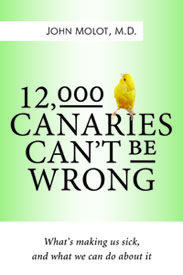
He recently released a book, “12,000 Canaries Can’t Be Wrong“, wrote a report in support of the Ontario Centre of Excellence in Environmental Health (OCEEH), and appears in a video presentation about the health effects of common chemical exposures (see below).
Check these out:
12,000 Canaries Can’t be Wrong
What’s making you sick & what can you do about it
Posted in Chemicals, Disability, Environmental Health, Fragrance, Health, MCS/ES, Pollution
Tagged allergies, autism, canaries, cancer, chronic illness, Dr. Molot, environment, fibromyalgia, health care access for people with MCS/ES, Human Rights, indoor air quality, MCS/ES, multiple chemical sensitivities, OCEEH, petrochemicals, sensitivities, toxic chemicals
The Myalgic Encephalomyelitis Association of Ontario (MEAO), along with others, has been working on a plan to get proper health care and supports established for the hundreds of thousands of people in Ontario who are affected by the “often overlapping, commonly disabling and sometimes life-threatening conditions of ES/MCS (Environmental Sensitivities/Multiple Chemical Sensitivity), ME/CFS (Myalgic Encepahlomyelitis/ Chronic Fatigue Syndrome) and FM (Fibromyalgia).”
A quick, easy summary document of the features and benefits of the OCEEH business case proposal for a comprehensive network of care and support has been sent to every MPP in Ontario. Here it is for you too (copied from the PDF 2014 OCEEH IN A NUTSHELL), so you can encourage your local elected representatives to support it in Ontario, and to support similar plans everywhere else in the world:
ONTARIO CENTRE OF EXCELLENCE IN ENVIRONMENTAL HEALTH (OCEEH)
‘IN A NUTSHELL’
“Five percent of Ontario’s population is affected by the often overlapping, commonly disabling and sometimes life-threatening conditions of ES/MCS (Environmental Sensitivities/Multiple Chemical Sensitivity), ME/CFS (Myalgic Encepahlomyelitis/ Chronic Fatigue Syndrome) and FM (Fibromyalgia).
As of 2010, over 568,000 Ontarians had been diagnosed with one or more of these conditions. This number grew from 439,000 in 2005, as reported in Statistics Canada’s Canadian Community Health Survey. It demonstrates prevalence comparable to diabetes, heart disease, cancer and effects of a stroke. These are very widespread conditions, and the 2010 figures are likely underestimates.
Recognition, diagnosis and treatment of these serious conditions are absent from Ontario’s health care system at present. Even though a commission of enquiry recommended services be put into place for ES/MCS as long ago as 1985, exclusion, discrimination and stigmatization of those living with these conditions have been the rule; and Ontario has lost physicians seeking to help these groups.
This is just a brief post to rejoice about the successful home extraction of a rear molar that was causing me unbearable problems.
The dentist who did this takes seriously his oath to “do no harm” and did not use it as an excuse to do nothing, like most dentists and doctors are prone to doing when they don’t want to change the way they do things to accommodate someone with disabilities.
 | linda @ Seriously "S… on MCS/ES |
| linda @ Seriously "S… on The CDC and MCS |
 | Tabatha Schnorr on MCS/ES |
| Tabatha Schnorr on The CDC and MCS |
| linda @ Seriously "S… on MCS and Housing |
| linda @ Seriously "S… on Hospital Protocols for People… |


 Seriously "Sensitive" to Pollution