Tag Archives: indoor air quality

MCS/ES Awareness Month 2014

 It’s that time of year again. Welcome to MCS “Awareness” Month!

People with disabilities have the right to equal treatment and equal access

Barriers to access can be physical, attitudinal or systemic. Conveniences can also create barriers. If you are unable to remove a barrier to accessibility, consider what else can be done to provide services to people with disabilities. No-one should live without safe access to the necessities of life.

What is disability? (Ontario Human Rights Commission)

“Disability” covers a broad range and degree of conditions, some visible and some not visible. A disability may have been present from birth, caused by an accident, or developed over time. There are physical, mental and learning disabilities, mental disorders, hearing or vision disabilities, epilepsy, drug and alcohol dependencies, environmental sensitivities, and other conditions.”

Removing barriers and designing inclusively

Persons with disabilities face many kinds of barriers every day. These can be physical, attitudinal or systemic. …

Identifying and removing barriers also makes good business sense. As well as meeting the needs of customers or employees with disabilities, removing barriers can also help other people…

Employers, unions, landlords and service providers can start by doing an accessibility review of their facilities, services and procedures to see what barriers exist. You can then make an accessibility plan and begin to remove the barriers.

It is also helpful to create an accessibility policy and a complaints procedure. These steps will help you remove existing barriers and avoid making new ones. The best way to prevent barriers is to design inclusively

Barriers aren’t just physical. Taking steps to prevent “ableism” – attitudes in society that devalue and limit the potential of persons with disabilities – will help promote respect and dignity, and help people with disabilities to fully take part in community life…

The duty to accommodate

Even when facilities and services are designed as inclusively as possible, you may still need to accommodate the individual needs of some people with disabilities. Under the Code, unions, landlords and service providers have a legal “duty to accommodate” persons with disabilities. The goal of accommodation is to allow people with disabilities to equally benefit from and take part in services, housing or the workplace.

Accommodation is a shared responsibility. Everyone involved, including the person asking for accommodation, should work together, exchange relevant information, and look for accommodation solutions together…

 

Some Resources: Continue reading

We Share the Air Canary

we share the air canary

Choose fragrance-free products. Clean air is fragrance-chemical-free. Fragrance chemicals create an invisible barrier to access for people who are disabled by pollutants and can cause health harm to everyone who breathes.

We share the air! Help keep it clean!

Property Manager’s Guides to MCS

From the Centre for Equality Rights in Accommodation (CERA):

Environmental Sensitivities and Housing

Every year, CERA receives a significant number of calls from tenants being made ill from the poor indoor air quality in their apartment buildings. Most of these individuals suffer from environmental sensitivities and are particularly sensitive to contaminants in the air. With funding assistance from the Ontario Trillium Foundation, CERA recently launched HomeSafe, an initiative to educate tenants and multi-unit housing providers on strategies to improve indoor air quality and create healthier living environments.

The resources section has some excellent documents that are designed to “help landlords, property managers, and co-operative and condominium boards of directors reduce the health impacts associated with multi-unit housing and create living environments that are as safe and “green” as possible… and make their properties more attractive…”

For example:

Continue reading

A Canary’s Cry

When it’s hard to think in words, it’s sometimes easier to do pictures…

No More

Take Action:

Continue reading

How to Enforce a Fragrance-Free Policy

How to Enforce a Fragrance-Free Policy

“Make it clear that the policy applies to everyone”

effective enforcement

WHY?

Fragranced consumer products: exposures and effects from emissions

“Overall, 34.7 % of the population reported one or more types of adverse health effects from exposure to one or more types of fragranced products.”

“72.6 % were not aware that even so-called natural, green, and organic fragranced products typically emit hazardous air pollutants.”

“20.2 % of the population reported that if they enter a business, and smell air fresheners or some fragranced product, they want to leave as quickly as possible.”

“Significantly, 15.1 % of the general population reported that exposure to fragranced products in their work environment has caused them to become sick, lose workdays, or lose a job.”


Health and societal effects from exposure to fragranced consumer products (AU)

…”Finally, for public officials, the problem of “secondhand scents,” or indirect exposure to fragranced products, has parallels to secondhand tobacco smoke. Prevention from fragrance product exposure will enable individuals to work in their workplaces, attend school, and function in society without suffering involuntary harm.” …


More Resources:

Continue reading

MCS/ES Symptoms and Environmental Incitants

sensitive to pollution 3

Information about the materials most likely to cause adverse health effects, and the kinds of symptoms commonly experienced from exposures, copied from the 2007 Canadian Human Rights Commission’s  document “The Medical Perspective on Environmental Sensitivities By: Margaret E. Sears (M.Eng., Ph.D.), and a few other resources and links follow:

Continue reading

Public Health Warning: Fragrance

Public Health Warning

Fragrance chemicals are linked to so many health problems now that they should be banned from indoor environments just like smoking.

Chemical Fragrance Public Health Warning

Resources

Continue reading

Harvard Medical School Associate Professor Speaks about MCS: Video

Dr. L. Christine Oliver is an Associate Professor of Clinical Medicine at Harvard Medical School and Co-Director of Occupational and Environmental Medicine at Massachusetts General Hospital.

This is an excellent half hour presentation.

Dr Oliver packs so much about the issues faced by people with MCS into the first 16 minutes of this video. If you can’t watch the whole video, at least watch this much.  Alison Johnson finishes off by reading from her important book Amputated Lives.

Alison Johnson is the author/producer/director of books and documentaries on Multiple Chemical Sensitivity. Visit http://www.alisonjohnsonmcs.com to download a transcript or to purchase her books or DVDs.

amputated-lives-chemical-sensitivity

How My Descent to Fragrance Hell Began

Manufactured fragrance ingredients have had a huge and mostly negative impact on my life, beginning with the “Chanel No.5 Eau de Cologne” my mother used to douse herself with in the 70’s. I remember running around opening windows and doors to air out the house after my parents went out on the town.

“Chanel No.5” happens to be the first fragrance that was created with synthetic substances. Nice to have a video about that now:

(August 13, 2014: I just watched the Chanel No 5 video that I had posted here, and they have completely changed it to remove all mentions of the synthetic (and toxic) substances that they were first to use!!! I have removed the video from the post, as it is now just an insipid commercial for the perfume.)

I remember as children (in the 60’s) my sister and I were often given tiny bottles of “4711” as gifts, most likely free samples that family members received when purchasing larger bottles of it. I don’t remember it bothering me at the time.

It was during the 70’s that more and more products (shampoos, moisturizers, cleaning products, etc) started to bother me. At the time, I thought it was normal that some products just didn’t agree with me. I had no idea I was actually being poisoned by them. I even ended up in the hospital for a week of tests in my late teens, after developing stroke-like migraine symptoms while applying one of my sister’s scented facial cremes after I had spent the night back home instead of where I was living then.

No connections to products were made at the time… It was also the week I learned to read food labels, as one evening the ice cream I was given for dessert started foaming up instead of melting into a puddle while I was eating my dinner…

As a young adult, I had to search high and low for a perfume or eau de cologne that I could wear on special occasions, because we were taught that it was an important part of the ritual. I don’t think I made it through two tiny bottles of “L’Air du Temp” before having to abandon that ritual. Just reading their evocative description now leads me to a never never land, one I don’t remember if I was influenced by back in those days. (According to the Nina Ricci website’s legal notice, I am not allowed to link to their site without written authorization, so you’ll have to google it for yourself!!! But beware, the site has some annoying hurdles to go through before you get to the perfume’s page).

Now there are hundreds, if not thousands of synthetic, petro-chemical ingredients used in fragrances. And fragrance chemicals are everywhere. It is pretty much impossible to avoid them unless you are alone in the middle of no-where. They are in the air, in our water, even in our supermarket foods.

I am housebound now because fragrance chemicals are everywhere, even in my yard when others are using their dryer vents and the wind blows this way. I have a very difficult time finding even basic essentials (like baking soda, food and clothing) that are un-contaminated by fragrance ingredients. I wrote about how fragrance residues basically left me homeless in the previous post.

eau de petroleum

The International Fragrance Association (IFRA) reports that 3090 materials have been reported (voluntarily via membership surveys, there was no forced compliance) as being used in fragrance compounds in 2008 and updated in 2011.

Here’s the list. Some are known to be quite hazardous. Most have never been tested for safety.

Check the sidebar here > > > for some links about fragrances and their health impacts. You can also read what I’ve previously posted about them.

Fragrance chemicals are clearly just as bad, if not worse for our health than tobacco smoke. It’s time to ban toxic chemicals from fragrances. At the very least, label them on products, so people know what they are applying to their bodies and forcing everyone else to breathe. Being forced to breathe in toxic chemicals is toxic trespass.

I love clean air

Here are some fragrance free policies from around the world.

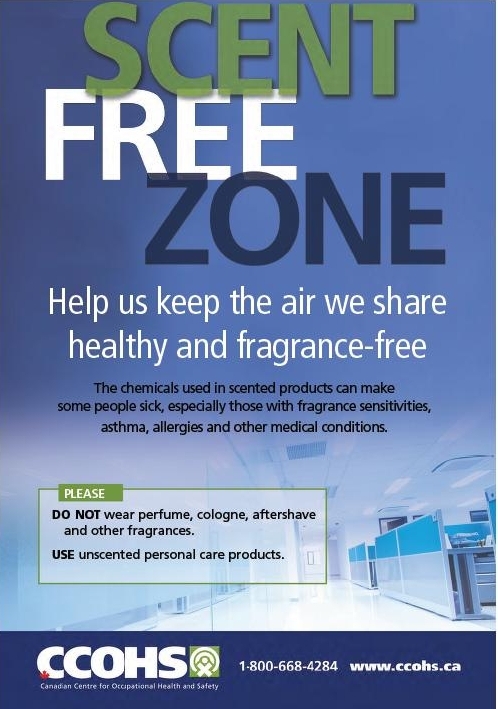
CCOHS Scent Free Zone

Event: MCS/EI/EHS, Housing & Human Rights: Press Conference

Derek Shanks is a 38 year old Toronto based black & white street and documentary photographer.

He recently photographed Olga, a woman who has commented here on my blog at times. The photos and some of her story can be seen on his blog:

All That I Am, All That I Have

Olga also let me know about an event she is organizing for the morning of Tuesday April 16th, 11am, if any of you are in Toronto and can attend to lend support.

Event details are on facebook:

MCS/EI/EHS, Housing & Human Rights: Press Conference