Tag Archives: petrochemicals

Proof: Pesticides Are MORE Toxic Than Declared!

‘Cides are designed to kill. Only the so-called “active” ingredients are listed and tested for how well they kill what they are sold to kill. Human, animal and other environmental effects are rarely if ever researched, and then it’s only for the active ingredients. The combinations of ingredients and the so-called “inert” ingredients which make the products flow or apply better are not taken into consideration. Those “inerts” can also be more toxic than the active ingredients, but don’t have to be listed!

Recent research tested and discovered that these combinations can be up to
1000 times more toxic than declared!

Roundup more TOXIC

Major Pesticides Are More Toxic to Human Cells Than Their Declared Active Principles

Abstract

Continue reading

There’s Petrochemicals in What?

We now breathe, drink, eat and wear petrochemicals every where, every moment, every day! There’s no getting away from them!

Where are they coming from?

“The petroleum industry includes the global processes of exploration, extraction, refining, transporting (often by oil tankers and pipelines), and marketing petroleum products… Petroleum (oil) is also the raw material for many chemical products, including pharmaceuticals, solvents, fertilizers, pesticides, and plastics.”

(https://en.wikipedia.org/wiki/Petroleum_industry)

So many of the things we use (and consume) are being made from petrochemicals.

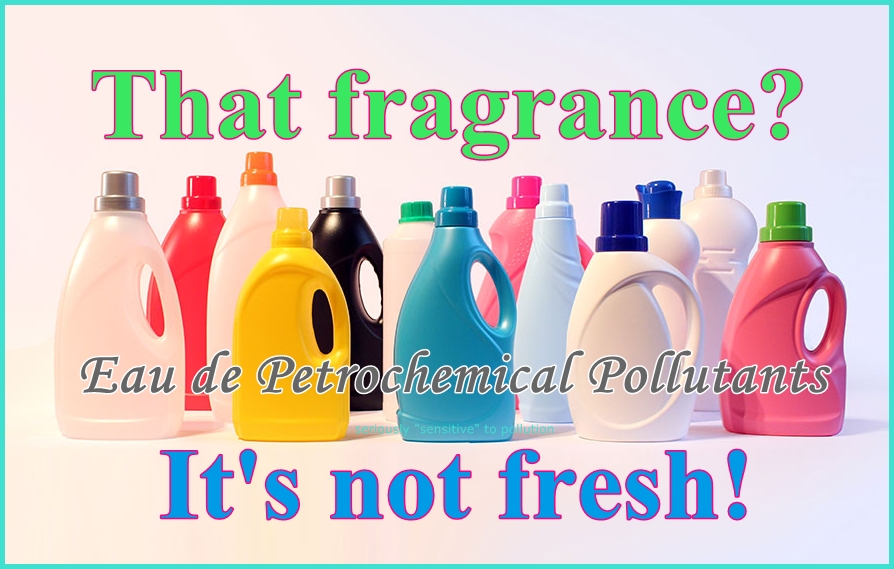
eau de petrochemical pollutants

Check out these two charts:

Continue reading

That fragrance? It’s not fresh!

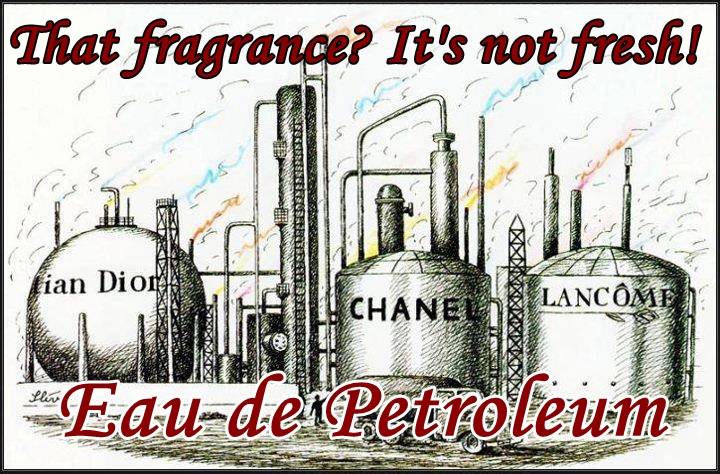
eau de not fresh

That fragrance?  It’s not fresh!

Secret Scents How Hidden Fragrance Allergens Harm Public Health (WVE)

Toxic Chemicals in Fragranced Laundry Products and Health Effects

Toxic Chemicals in Air “Fresheners” and Health Effects

Fragrance Decision Undermines EPA’s DfE Program

Allergic to a World Full of Cats

(check the sidebar and tags for additional links)

Fragrance Decision Undermines EPA’s DfE Program

EPA’s Design for the Environment (DfE) Program (claims to) work “to reduce risk to people and the environment by finding ways to prevent pollution”, yet they recently began allowing DfE-endorsed products to contain fragrances.

Of the first 119 fragrance chemicals okayed for use, 93 have “hazard profile issues” such as being known sensitizers or lacking vital data!!!

“Researchers, pediatricians, and other health experts agree that “Scented chemicals increase risk that some per cent of exposed people will have allergic and hypersensitivity reactions. Allergic and asthmatic children are at especially high risk”

Those of us with MCS/ES, along with many others who now experience adverse or disabling health effects from fragrance chemicals rarely had them before being exposed to some supposedly safe petrochemicals (in everyday use) that tipped our bodies over an edge. For too many of us, it was from fragranced products that we first experienced and continue to experience chronic health problems.

So it is wonderful to see health experts formally urging the EPA to

SAY NO TO FRAGRANCES

No Fragrance

“Pediatricians and respiratory experts, including the American Lung Association and the American Academy of Pediatrics, wrote to the EPA Administrator today raising concerns about the health impact of the recent decision of the US EPA’s Design for the Environment program to allow fragrances.”

it is standard environmental health practice to discourage the use of air fresheners, scented products, and fragrances in homes and other indoor spaces.

We were surprised and deeply disappointed to learn that the Agency’s Design for the Environment program (DfE) created a “fragrance” category of chemicals for commercial and consumer cleaning products. The vast majority of chemicals listed — 93 of the 119 total — have “hazard profile issues” because they are identified in one of
Continue reading

Report: RECOGNITION, INCLUSION AND EQUITY – THE TIME IS NOW

Many of us have been waiting for action for decades, let’s hope that this is the project that finally makes it happen. It has been a long time coming…

‘RECOGNITION, INCLUSION AND EQUITY – THE TIME IS NOW: PERSPECTIVES OF ONTARIANS LIVING WITH ES/MCS, ME/CFS AND FM’

Recognition Inclusion and Equity the Time is Now

From Varda Burstyn:

At long last, I am writing to let you know about four new groundbreaking reports – products of a 5-year initiative that I and colleagues began in 2008 – that present exciting new research on the three environmentally linked conditions of ES/MCS, ME/CFS and FM, and that develop a wonderful new model of care and support for those living with the conditions in Ontario.

Continue reading

New PAGE on Statistics for MCS/ES, FM and ME/CFS

I’ve assembled prevalence statistics from Canada and the US into one place, including images and links to documents with more information.

Included are links and images with Canadian stats for MCS/ES, FM, and ME/CFS, and US stats for MCS. I will update to include more stats from more countries when I have reliable sources for them. Please share any that you are aware of.

The new page is located at the top of this site under the MCS/ES page, or via this link:

Statistics for MCS/ES, FM and ME/CFS

Here is a sample of what you will find there:

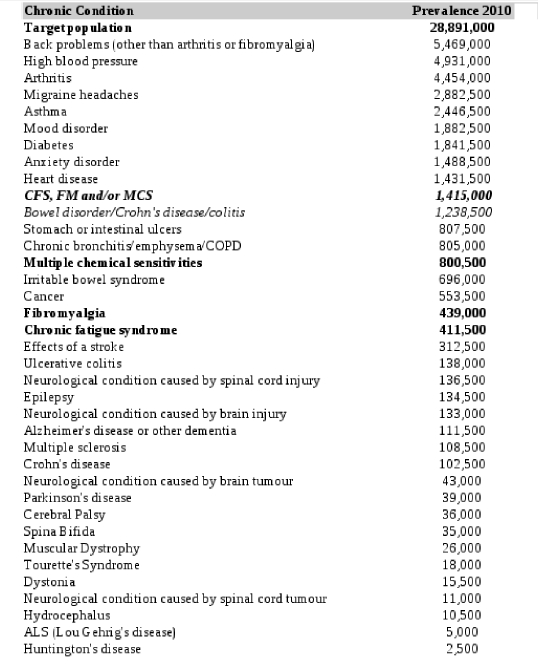
According to The Canadian Community Health Survey (CCHS) and Statistics Canada, between 2005 and 2010 the rates of people diagnosed with Multiple Chemical Sensitivities (MCS), Fibromyalgia (FM) and Chronic Fatigue Syndrome (CFS) in Canada increased significantly.

The number of people diagnosed with MCS increased by 31%
The number of people diagnosed with FM increased by 15%
The number of people diagnosed with CFS increased by 24%

Chronic Conditions Prevalence Comparisons
(for perspective)

You can find all the statistics, links and images in the ‘Statistics for MCS/ES, FM and ME/CFS’ page at the top of this site under the MCS/ES page, or click on this link:

https://seriouslysensitivetopollution.wordpress.com/mcses/statistics-for-mcses-fm-and-mecfs/

With gratitude to the National ME/FM Action Network for much of the material.

“The Big Fix”… Why We Need Peace, Not More Ecocide…

The Big Fix 

The BP Deepwater Horizon Oil Spill

Watch.

It’s explanatory.

The oil industry is not about peace. This film documents one of the greatest cases of Ecocide in our time, and the story behind it. Sadly, it’s not over yet.

Ecocide is the extensive damage to, destruction of or loss of ecosystem(s) of a given territory, whether by human agency or by other causes, to such an extent that peaceful enjoyment by the inhabitants of that territory has been or will be severely diminished.

Help make Ecocide a crime:

http://eradicatingecocide.com/what-you-can-do/

fish filters

Bucky

Some Weblinks:

Continue reading

20 Petrochemicals to Avoid in Personal Care and Laundry Products


Re-posting with permission

20 of the most common Petrochemical Skin Care Ingredients to Avoid

The Organic Natural Beauty Directory urges all consumers to carefully read the ingredient labels on the products they intend to buy and be fully aware of what goes in them, that way you will know what to avoid. Ingredients are listed most used to least used (meaning that the first ingredient listed is what makes up the largest part of the product). It is extremely alarming to know that many major brands of skin care and personal care products contain petrochemicals in them.

It pains and angers me to see big beauty brands advertising on TV that they are ‘natural’ but when you look at their ingredients they may also contain some petrochemicals- so make sure you know your ingredients. This is why modern day consumers need to beware of ‘greenwashing’ and become educated on what the ingredients being used are.Your safest bet as a consumer is to choose products that contain all natural, whole and unprocessed botanical ingredients.

According to the ‘campaign for safe cosmetics website’.

“Many of these petrochemicals are known and scientifically proven to be toxic.”

“They can cause eye impairment, intestinal damage, kidney and liver problems, breathing problems, cysts, skin spots, rashes, premature aging and hair loss. Some are endocrine disruptors (that can cause hormonal disruptions and produce adverse developmental, reproductive, neurological, and immune effects), and some even carcinogenic (that can cause cancer, and in particular breast cancer)”.

Our skin is the largest organ in our body so it makes sense that we as consumers wake up & start taking control of what we feed ourselves.

Here is the A-Z list of the 20 most common petrochemicals used in personal care products:

toxic skull and bones

Continue reading

Endocrine Disruption… Huh? Why Should We Care?

Many of us have no idea what “those people” are talking about when they mention endocrine disruptors. Sounds like something foreign and insignificant, or at least it did to me, until something caught my attention a few years ago.

It turns out that the endocrine system is a hugely busy and important system in our bodies, one well worth looking into and trying to understand. When we start to understand how important this system is, we might start to notice how we are (unwittingly) damaging ourselves, or rather, being damaged, because there are so many endocrine disrupting chemicals allowed into our daily lives now.

It is so much easier to stop causing harm (in whatever ways we are able) when we understand what the problems are, and so difficult, if not impossible, when we remain oblivious. In this case, sticking our heads in the sand will not only harm us, it has the potential to also harm our grandchildren and their grandchildren.

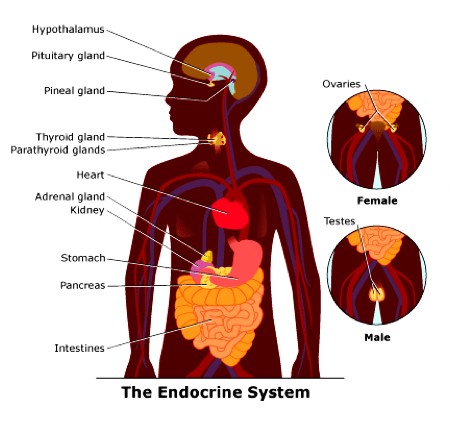
endocrine system


(image from EcoWatch, link below)

Continue reading

MCS/ES Symptoms and Environmental Incitants

sensitive to pollution 3

Information about the materials most likely to cause adverse health effects, and the kinds of symptoms commonly experienced from exposures, copied from the 2007 Canadian Human Rights Commission’s  document “The Medical Perspective on Environmental Sensitivities By: Margaret E. Sears (M.Eng., Ph.D.), and a few other resources and links follow:

Continue reading