…
Get something stinky
as a gift?
Don’t toss it
on the street
or in the trash.
Don’t regift it
to a friend
or enemy.
Don’t donate it
to a charity.
Do send a message
loud and clear!
Now’s the time Continue reading

…
Get something stinky
as a gift?
Don’t toss it
on the street
or in the trash.
Don’t regift it
to a friend
or enemy.
Don’t donate it
to a charity.
Do send a message
loud and clear!
Now’s the time Continue reading
… ♥ …

It can be hard for some people to imagine what a safe, non-toxic, emf or rf free gift could be for those of us who have MCS/ES (multiple chemical sensitivities / environmental sensitivities).
As always, ask the recipient for details about specific allergies and sensitivities, as well as any precautions that might be needed to remove or prevent contamination, because many of these things come in a wide variety ranging from safe (or just safer) to toxic and life threatening.
Continue reading
♥ Christmas, Birthdays, and Other Holidays with MCS/ES ♥
For most people, these special occasions are times of joy and celebration in the company of friends and loved ones, but for people with invisible disabilities and chronic illnesses like MCS/ES, they can be sad reminders of the lives that we no longer have access to.
We are still seldom included in the festivities and are usually left alone to fend for ourselves. Unfortunately, since human beings are social beings, not everyone is well equipped to self occupy, and some people become seriously depressed and even suicidal because of this.
To realize it’s because some friends, family, neighbours, and co-workers prefer to keep using certain products instead of using other products so we can safely be around them and enjoy their company, makes it even harder for us, knowing they care more about the products they buy than they care about us. It’s a heart breaking thing to have to live with.
♥ Thankfully, not everyone chooses products over people ♥
Before I became too chemically injured to socialize in crowds, I had a wonderful friend who happily made the effort to make her place and parties safe for me!
In 2005 her invites were all sent out with these words:
Posted in Accessibility, Community, Environmental Health, Environmental Sensitivities, Fragrance, Friendship, Gifts, Support
Tagged allergies, chemical sensitivity, chronic illness, coping, environmental sensitivities, fragrance-free, Gifts, holidays, invisible disabilities, MCS, MCS/ES, toxic chemicals, visiting
I saw something that shocked me, and I don’t know how anyone involved with this could have thought it was a good idea.
This is what I saw
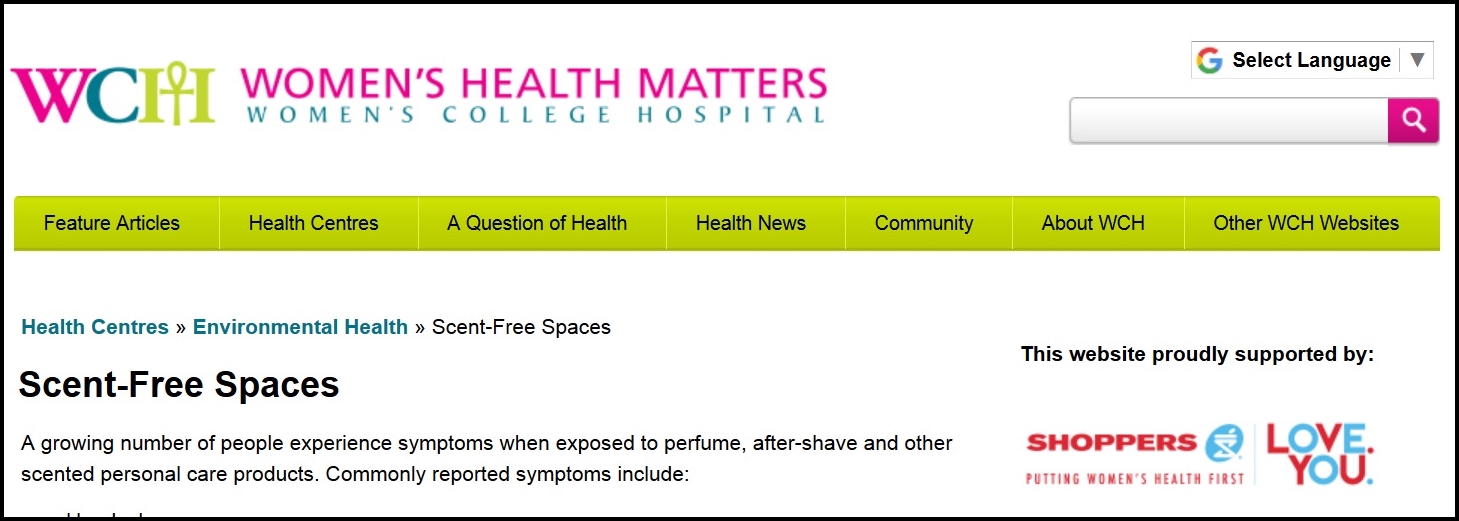 If you are a Canadian, you will probably understand.
.
It’s pretty much the same thing as this (slightly revised) image:
 (pretend it’s done all the way)
What would you think if you saw that?
Shoppers Drug Mart is the antithesis of scent or fragrance free!
Posted in Accessibility, Disability, Environmental Health, Fragrance, Health Care, Human Rights
Tagged accessibility barriers, allergies, asthma, cancer, chemical sensitivity, Environmental Health Clinic, environmental sensitivities, fibromyalgia, fragrance-free, gaslighting, hazardous air pollutants, health care access for people with MCS/ES, IAQ, invisible disabilities, MCS, MCS/ES, multiple chemical sensitivities, petrochemicals, ShoppersDrug Mart, smoke-free, tobacco, toxic chemicals, VOCs, WHO
My article “Invisible Barriers, Invisible Disabilities, Invisible People” is now available to read in the
Special Issue on Ecopsychology and Environmental Sensitivities:
Chemical, Electrical, and Beyond
All the articles in the entire special issue will be available for free until Sept. 5 2017, which is unprecedented access!
Please check them out and share as widely as possible!
Table of Contents:
Posted in Disability, Environmental Health, Environmental Sensitivities, Human Rights, Public Health
Tagged chemical sensitivity, ecopsychology, EHS, environment, fibromyalgia, Gibson, health, invisible disabilities, MCS, MCS/ES, multiple chemical sensitivities, Ontario, petrochemicals, Research, systemic discrimination, toxic chemicals, toxic trespass
I ran across some striking photos by Alex Kisilevich (you can see them in the banner above if you squint) and I shared the link with the intro “Food for thought… what’s outside the bubble preventing access?” Someone responded with “tell me about it”, so I wrote a short story before seeing what the photographer’s intent was, if it was indeed as a writer wrote, to say:
Posted in Accessibility, Air Quality, Environmental Health, Fragrance, Human Rights, Public Health
Tagged allergies, asthma, autism, bubble, cancer, chemical sensitivity, EHS, environmental sensitivities, hazardous air pollutants, health, invisible disabilities, MCS, MCS/ES, petrochemicals, toxic chemicals, toxic trespass
It’s hard to get anyone to take the time to read (let alone understand) scientific research, but it’s so important that we educate ourselves when the opportunity arises. People have short attention spans these days, probably from all the neurotoxins and wireless radiation we’re all being exposed to on a daily basis, so it’s great when we find information that is short and to the point.
Here is a great short video series from
the UCSF Program on Reproductive Health and the Environment.
 Please watch and share!
Posted in Child Health, Education, Environmental Health, Health, Pollution, Public Health, Toxic Trespass
Tagged allergies, asthma, autism, cancer, Chemicals, hazardous air pollutants, IAQ, neurotoxins, petrochemicals, phthalates, Research, science, toxic, toxic chemicals, toxic trespass, video
WHO Says We Need Fresh Air?!
Guest Post from Marie LeBlanc
 Bringing awareness to chemical sensitivity
Marie LeBlanc at the Centennial Concert Hall in Winnipeg. May 12th 2017.
I am an artist in Winnipeg who lives with multiple chemical sensitivity (MCS) and environmental illness caused by mold exposure. My art has been in relation to multiple chemical sensitivity (MCS)/Environmental Illness (EI) and toxic environments.
“WHO says we need fresh air?!” is a series of quotes from sufferers of Multiple Chemical Sensitivity, Environmental Illness, Mold Exposure, Electrohypersensitivity Syndrome, Lyme Disease and other conditions related to Chronic/Complex Immunological Neurological Diseases.
The art installation was on display during the evening of Fri. May 12, on Multiple Chemical Sensitivity (MCS)/Environmental Sensitivities Awareness Day, outside the Centennial Concert Hall (with a few quotes displayed on the indoor screens), and is dedicated to my friend Eliana from Mexico.
Posted in Accessibility, Disability, Environment, Environmental Health, Health, Housing, Human Rights
Tagged allergies, anaphylaxis, asthma, chemical sensitivity, chemicals in clothing, CIND, creativity, EHS, environmental illness, environmental sensitivities, Fragrance, hazardous air pollutants, homeless, Housing, invisible disabilities, Lyme Disease, MCS, MCS/ES, Mold, multiple chemical sensitivities, suicide, toxic chemicals
Unilever, the company responsible for making disabling products like AXE (aka LYNX) has announced they will be expanding their product ingredient lists to include fragrance ingredients above 0.01 percent (100 parts per million) in a product’s formulation (via the SmartLabel app, but not on the actual labels *)
* 20 parts per million (ppm) is the FDA’s standard for ‘gluten-free’ *
Which means that people who are allergic or “sensitive” can suffer serious and life threatening effects from substances at well below 100 ppm, and we still won’t know what is causing the symptoms, or what we need to avoid to stay alive.

This plan may help people who aren’t knowingly or immediately affected by fragrance exposures to choose their products more wisely, but it doesn’t go nearly far enough to help those of us who are disabled by or have life threatening reactions to their products.
Edited to add:
Unilever’s fragrance transparency is a major green-wash at 100 ppm, when gluten-free has to be below 20 ppm, and people with isothiazolinone (aka MI) allergy react to as little as 3 ppm, perhaps less.
Also, long-term health limit for fumes from dry-cleaning solvents has dropped from 20 parts per billion to an infinitesimal 2 parts per billion because long-term exposure to even very low concentrations can result in cancer, as well as fetal development problems for pregnant women.
Other interesting tidbits about Unilever:
If you prefer getting your research information by watching and listening instead of reading, here are a couple of video presentations by the esteemed Dr Stephen J. Genuis, who is one of the leading experts on environmental health.
In these presentations he discusses the increases in chronic illness and mental health problems, chemical and other causes and effects, shortcomings in our health care systems, as well as some treatment options to improve health.
I’ve also linked to related research for those of you who like to read.

Posted in Disability, Education, Environmental Health, Health, Public Health, Research
Tagged allergies, autism, cancer, chronic illness, exposures, fibromyalgia, invisible disabilities, MCS, MCS/ES, mental health, multimorbidity, pain, petrochemicals, sensitivities, Stephen J. Genuis, toxic chemicals, video
 | linda @ Seriously "S… on MCS/ES |
| linda @ Seriously "S… on The CDC and MCS |
 | Tabatha Schnorr on MCS/ES |
| Tabatha Schnorr on The CDC and MCS |
| linda @ Seriously "S… on MCS and Housing |
| linda @ Seriously "S… on Hospital Protocols for People… |


 Seriously "Sensitive" to Pollution