Category Archives: Disability

It’s What You Can’t See that Hurts You

What it can be like having a friend with MCS… from a real friend <3
“I would go through all those steps, put on my safe clothes and Colleen would still say “Nope. Still contaminated.” I wanted to punch something. Here I would do just about anything for a friend, and it still didn’t work. It didn’t dampen her spirits, though. After that happened, she would just smile and say how I had worked harder than anyone else to solve this problem, and it was too bad that it hadn’t worked. That really didn’t help me much. I still felt frustrated.”

Joe's avatarStepping Out with an Agoraphobic

Invisible Illness

This week is National Invisible Chronic Illness Awareness Week. It runs through September 14th. It was suggested to me that I write about my experiences in dealing with my illnesses, and I will – perhaps at a later date. Instead of looking within myself, I thought I would broaden the scope of my focus and talk about an invisible illness that has hit close to home, and changed how I live my life.

To have a loved one succumb to an illness is one of the most painful things imaginable – and that pain applies to friends, as well as to family. What is even worse is when that illness is new, uncommon, or even invisible. This is what has been happening to my friend, Colleen, who has Multiple Chemical Sensitivities, a crippling disease that has rendered her disabled.

I must admit that sometimes I don’t feel like…

View original post 1,156 more words

Severe MCS/ES… What Does It Mean?

To some degree, severe MCS/ES (like pain) is subjective. In other ways it’s a moving target, as we can be fine (or almost fine) one minute, and be completely incapacitated the next hour (day, week, or month) from an exposure, or combination of exposures. One day, a perfume exposure during lunch with friends might “just” give someone a throbbing headache for the rest of the day, but the next day, because there was also a cloud of diesel smoke, a fragrance contaminated piece of mail, someone installed wi-fi in the apartment next door, and someone else’s dryer vent was pumping out chemicals when we walked by with the dog, the same 3 breaths of perfume at the pet store we were trying to buy dog food from, could send us to bed for a week, or longer.

To make matters more difficult for others to accurately assess (and assumptions and clueless opinions are rampant where invisible disabilities are concerned), the recovery period, when most incapacity takes place, occurs when no-one is around to witness the effects, as many symptoms are delayed reactions. This means that people with severe MCS/ES are usually only seen during better moments, not when we’re at our worst.

severe mcs es

Something else I often see is that people’s ability to tolerate change and adversity varies greatly. Some people fall apart when faced with the slightest challenge, while others can endure unbelievably difficult circumstances and suffering without ever complaining.

One person’s severe is another person’s “just another day”. And, as I found out, when we think things are as bad as they can possibly be, they can get 1000 times worse (especially where brain function is concerned). This can really confuse people, ourselves included…

That said, there are tools that have been designed to help medical professionals assess all kinds of health and disabilities. And accurate assessment is especially important when applying for disability benefits.

What follows are a few tools that can help us understand. This information is not meant for acquiring disability benefits. I’m providing it for educational purposes only.

How can “sensitivity” symptoms affect life?

Continue reading

Home Dental Extraction SUCCESS (#1)!

This is just a brief post to rejoice about the successful home extraction of a rear molar that was causing me unbearable problems.

The dentist who did this takes seriously his oath to “do no harm” and did not use it as an excuse to do nothing, like most dentists and doctors are prone to doing when they don’t want to change the way they do things to accommodate someone with disabilities.

Continue reading

“Smart” Meter Trouble In Paradise

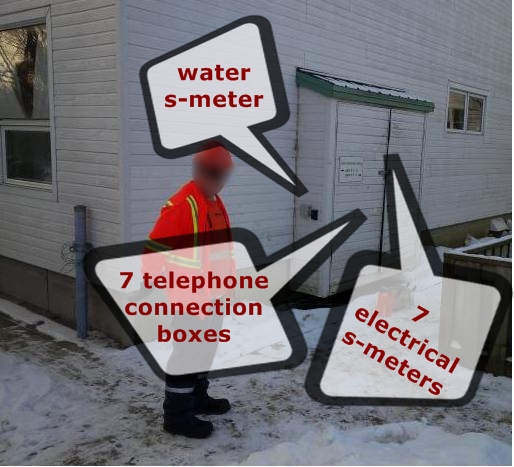
Ok, so the s-meters aren’t smart, and this really isn’t paradise, but this IS supposed to be safer housing for people with environmental sensitivities and there’s an issue here that isn’t getting resolved and could put a third person at risk of serious health harm.

I was hoping I wouldn’t have to write this post, but it has come to my attention that a unit here is being shown to prospective tenants, when that unit should remain empty until the contents of the attached utility cabinet are moved away from the building.

The empty unit is currently unsafe for anyone to live in, never mind someone with environmental “sensitivities”.

I have to warn people, no matter how desperate you may be for chemically safer housing, please DO NOT try to live in the currently vacant bachelor unit here if you value your life! Even if it doesn’t affect you immediately, it will.

utility cabinet attached to bachelor unit wall

utility cabinet attached to bachelor unit wall

Above is the side view of the unit, the little windows on the left are above the sleeping area. A raised glass door technology cabinet divides that area from the “living room” in the front, which is on the other side of the utility cabinet. In the photo below you can see the rest of the living room window and the unit’s front door (taken on an angle from the next yard).

Continue reading

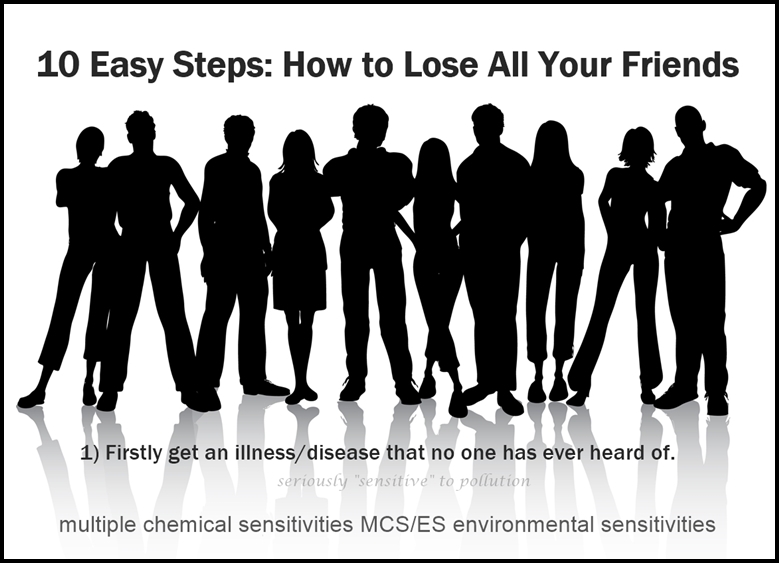
How to Lose All Your Friends

Guest Post by Candy Martin

1) Firstly get an illness/disease that no one has ever heard of. As everyone knows everything about every disease that exists, what you have can’t possibly be true or real as they have never heard of it.

2) Try to explain your illness to your friends. They still won’t believe you because they still haven’t heard of it, and frankly your explanation bores them.

3) Try to give a clearer explanation, because YOU REALLY WANT THEIR UNDERSTANDING. Now you will be accused of complaining or of being negative because you have talked about your illness for more than 1 minute.

4) Try to explain why their suggestions to get well aren’t feasible. Now you’re just being difficult and are not worth “helping” any more. Despite knowing nothing about your illness they “know’’ that exercise will help, getting out more will help, eating magic marshmallows will help etc etc. (Even if your Dr advises against it)

Continue reading

MCS/ES Awareness Month 2014

 It’s that time of year again. Welcome to MCS “Awareness” Month!

People with disabilities have the right to equal treatment and equal access

Barriers to access can be physical, attitudinal or systemic. Conveniences can also create barriers. If you are unable to remove a barrier to accessibility, consider what else can be done to provide services to people with disabilities. No-one should live without safe access to the necessities of life.

What is disability? (Ontario Human Rights Commission)

“Disability” covers a broad range and degree of conditions, some visible and some not visible. A disability may have been present from birth, caused by an accident, or developed over time. There are physical, mental and learning disabilities, mental disorders, hearing or vision disabilities, epilepsy, drug and alcohol dependencies, environmental sensitivities, and other conditions.”

Removing barriers and designing inclusively

Persons with disabilities face many kinds of barriers every day. These can be physical, attitudinal or systemic. …

Identifying and removing barriers also makes good business sense. As well as meeting the needs of customers or employees with disabilities, removing barriers can also help other people…

Employers, unions, landlords and service providers can start by doing an accessibility review of their facilities, services and procedures to see what barriers exist. You can then make an accessibility plan and begin to remove the barriers.

It is also helpful to create an accessibility policy and a complaints procedure. These steps will help you remove existing barriers and avoid making new ones. The best way to prevent barriers is to design inclusively

Barriers aren’t just physical. Taking steps to prevent “ableism” – attitudes in society that devalue and limit the potential of persons with disabilities – will help promote respect and dignity, and help people with disabilities to fully take part in community life…

The duty to accommodate

Even when facilities and services are designed as inclusively as possible, you may still need to accommodate the individual needs of some people with disabilities. Under the Code, unions, landlords and service providers have a legal “duty to accommodate” persons with disabilities. The goal of accommodation is to allow people with disabilities to equally benefit from and take part in services, housing or the workplace.

Accommodation is a shared responsibility. Everyone involved, including the person asking for accommodation, should work together, exchange relevant information, and look for accommodation solutions together…


Some Resources: Continue reading

We Share the Air Canary

we share the air canary

Choose fragrance-free products. Clean air is fragrance-chemical-free. Fragrance chemicals create an invisible barrier to access for people who are disabled by pollutants and can cause health harm to everyone who breathes.

We share the air! Help keep it clean!

Property Manager’s Guides to MCS

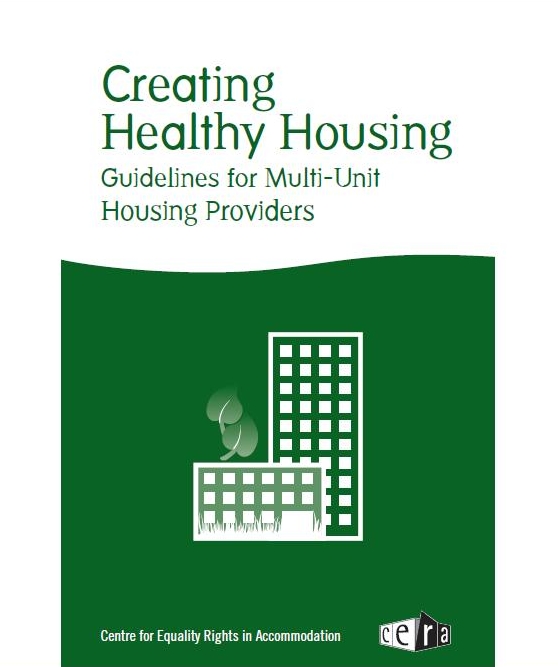
From the Centre for Equality Rights in Accommodation (CERA):

Environmental Sensitivities and Housing

Every year, CERA receives a significant number of calls from tenants being made ill from the poor indoor air quality in their apartment buildings. Most of these individuals suffer from environmental sensitivities and are particularly sensitive to contaminants in the air. With funding assistance from the Ontario Trillium Foundation, CERA recently launched HomeSafe, an initiative to educate tenants and multi-unit housing providers on strategies to improve indoor air quality and create healthier living environments.

The resources section has some excellent documents that are designed to “help landlords, property managers, and co-operative and condominium boards of directors reduce the health impacts associated with multi-unit housing and create living environments that are as safe and “green” as possible… and make their properties more attractive…”

For example:

Continue reading

Money, Masks and MCS

Here is yet another way petro-chemical and wireless pollutants and policies create barriers to access, barriers that personal actions and responsibility alone cannot overcome…

Background: Michellina  wrote about her masked experiences on her blog The-Labyrynth, which inspired Colleen to write about her mask breakthrough on her blog Life in the City with a Future, which inspired me to share her link and post on the subject here, which then inspired Suki to chime in here adding her experiences, as well as a link to some really great resources from from The (US) National Center for Independent Living on environmental health barriers to access, which links back here to one of my  posts! And here’s an example of just how prevalent fragrance chemicals are.

And then… my friend Melody posted this photo, which brings up another issue:

How can we have access to our money when wearing disability related “accessories”?

What about the masks we wear to be able to breathe cleaner air?

What about the masks we wear  to breathe? Or the hats and scarves we wear to keep some of the fragrance chemicals off of our hair? Or the special fabric head-coverings to protect from wireless radiation? These are necessary “accessories” which prevent further disability, and allow some of us to lead somewhat more normal lives, kind of like what wheelchairs are for people who can’t walk.

Do they have these signs (and policies) everywhere now?

How do you manage?

Continue reading

Personal Update: It’s No Longer All In My Head!

Well, it never really ever was all in my head.

My arms, legs and the rest of my body have been affected too. But most of it was because things weren’t functioning as intended in my brain (which still IS in my head), and since brain functions control so many other things (like how our body functions, and how we communicate), when brain chemistry is altered (with or without choice or permission) then body functions will be altered too.

Think of what happens when you have a drink, then a few more, and then finish the bottle… Are you functioning the same way before drinking as after?

Personal Update Part One:

I am doing a lot better these days, in some ways even thousands of times better than I was doing by the time I left Bloor Street in May of 2010. I can now usually get through most of my days without everything requiring constant, exhausting effort, but it hasn’t turned into me being able to do or accomplish that much more in actual practical terms.

I still have brain issues and most of the other practical limitations that come from MCS/ES and a toxic brain injury, but recently, I have started feeling so much better!

I am trying to wrap my mind around that because it doesn’t make logical, rational sense to me. How is it that I can feel so much better without doing so much better?

Maybe it has just been so long since I’ve felt even halfway ok, and because some part of my brain chemistry is working differently and more normally…?

Whatever it is, it isn’t tangible, but it is a very welcome change!

water dance

Part Two: Insights

Continue reading