Category Archives: Environmental Sensitivities

Parabens: endocrine disruptors in cosmetics and food?

Paul Whaley posted this eye-opening news at the Health & Environment blog:

Parabens: endocrine disruptors in cosmetics and food?.

“Parabens … are widely used as preservatives in cosmetics…  and have appeared in the news because of concern about their endocrine-disrupting potential, in particular their ability to mimic oestrogen…”

“However, people may be less aware of the use of parabens in foodstuffs, identifiable on labelling as additives E214-219. The most commonly-used parabens in food are methylparaben (food additive E218) and ethylparaben (E214)…”

I had no idea! And I’ve looked into a lot of contamination issues with foods! These are chemicals we wouldn’t normally think we are ingesting orally. Pesticides we now know about, some of us knew about phthalates, but parabens too?

Ok, it turns out some folks already knew, but only so far as those that are listed on labels, (and I haven’t bought much food requiring a label in years) but this new research shows them also appearing in foods that do not require ingredient labels! And these weren’t just the naturally occurring parabens, (as there are some, it turns out) but  synthetic parabens were also found!

phthalates and parabens are found in almost all supermarket foods that were tested

phthalates and parabens are found in almost all supermarket foods that were tested

I recently wrote about other research that confirmed how commonly phthalates are found in supermarket foods, contamination from fragrance and plastic, but it seems we have more reasons to be careful about the foods and drinks we choose:

From the Abstract: “Parabens are esters of p-hydroxybenzoic acid and are widely used as preservatives in cosmetics, pharmaceuticals, foodstuffs, including beverages”
Continue reading

Endocrine Disruption… Huh? Why Should We Care?

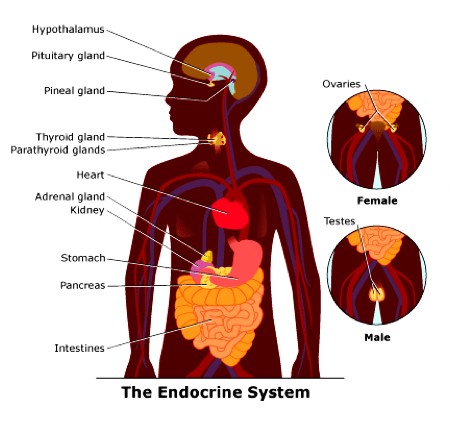
Many of us have no idea what “those people” are talking about when they mention endocrine disruptors. Sounds like something foreign and insignificant, or at least it did to me, until something caught my attention a few years ago.

It turns out that the endocrine system is a hugely busy and important system in our bodies, one well worth looking into and trying to understand. When we start to understand how important this system is, we might start to notice how we are (unwittingly) damaging ourselves, or rather, being damaged, because there are so many endocrine disrupting chemicals allowed into our daily lives now.

It is so much easier to stop causing harm (in whatever ways we are able) when we understand what the problems are, and so difficult, if not impossible, when we remain oblivious. In this case, sticking our heads in the sand will not only harm us, it has the potential to also harm our grandchildren and their grandchildren.

endocrine system


(image from EcoWatch, link below)

Continue reading

Fragrance-Free and Healthy Schools

I’ve updated this post here:

https://seriouslysensitivetopollution.wordpress.com/2013/08/16/fragrance-free-and-healthy-schools-updated/

Accessibility, Human Rights and MCS/ES

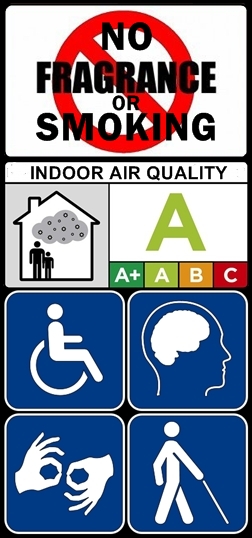
Someday, indoor air and environmental quality information could be posted on the front door of every building and most buildings and services (products and materials too) could be safe and accessible for everyone

ACCESSIBILITY 2

In the meantime, we have Human Rights laws (in some places) that we can use in order to gain safe(r) access to neccessities like employment, housing, apartment buildings… facilities (restaurants, shops, hotels and theatres…) and services (health care etc), transit and other public places, so it is a good start, since access is something many of us with MCS/ES do not have now, although equal access is, for now, probably too much of a stretch in this chemical and wireless addicted society.

Some (but not all) of the information and resources I present here are from Ontario, Canada, but they can be used to inspire similar actions everywhere.

Continue reading

Fragrance-Free Door Signs

Many of us who have MCS/ES find answering the door can be hazardous to our health because frequently those on the other side of the door are marinating in toxic fragrance chemicals.

Sometimes a simple sign like this will do.

No Fragrance

Other times it is not enough and we need to provide more information.

Continue reading

MCS/ES Symptoms and Environmental Incitants

sensitive to pollution 3

Information about the materials most likely to cause adverse health effects, and the kinds of symptoms commonly experienced from exposures, copied from the 2007 Canadian Human Rights Commission’s  document “The Medical Perspective on Environmental Sensitivities By: Margaret E. Sears (M.Eng., Ph.D.), and a few other resources and links follow:

Continue reading

Canadian Human Rights Documents Archived

The Government here has been re-organizing and changing all of their web pages lately and some types of information seem to be disappearing.

The_Canadian_Flag

The policy on accommodating people with MCS/ES is no longer available on the website. This is what used to be there (2007-2013):

Policy on Environmental Sensitivities

This policy is issued to encourage employers and service providers to proactively address issues of accommodation for persons with environmental sensitivities.

Policy on Environmental Sensitivities

Individuals with environmental sensitivities experience a variety of adverse reactions to environmental agents at concentrations well below those that might affect the “average person”. This medical condition is a disability and those living with environmental sensitivities  are entitled to the protection of the Canadian Human Rights Act, which prohibits discrimination on the basis of disability. The Canadian Human Rights Commission will receive any inquiry and process any complaint from any person who believes that he or she has been discriminated against because of an environmental sensitivity. Like others with a disability, those with environmental sensitivities are required by law to be accommodated.

Continue reading

Podcast: Kim Goldberg on Electrosensitivity

People First Radio Interview with Kim Goldberg about wi-fi and health effects… Apparently the high schools that have installed wi-fi see students with heart attacks, but instead of removing wi-fi, they buy defibrillators!!!???

Kim Goldberg's avatarRefugium

I was interviewed earlier today on People First Radio (CHLY, Nanaimo BC) about electrosensitivity, Wi-Fi sickness, smart meters, and more.

Here is a link to the podcast of my 15-minute segment of the show:  http://www.columbiancentre.org/wp-content/uploads/2013/05/473_may_09_2013_sm.mp3

People First Radio is produced by Columbian Centre Society in Nanaimo, BC, and airs every Thursday, from Noon-1:00 pm on Radio CHLY 101.7 FM.leaves


View original post

Group of parents upset Peel schools may install Wi-Fi

Children’s health is being affected by WiFi  

“Frank Clegg, Citizens 4 Safe Technology and former president of Microsoft Canada, says Wi-Fi is an unproven technology and until it’s considered safe, we shouldn’t be using children as a science experiment.”

Accessible Customer Service – What to do When A Store is Too Polluted to Enter

Having invisible disabilities can present challenges most people don’t think of.

Modified from original image by Eurofin

Modified from original image by Eurofin

Indoor air can be too polluted for some of us to safely breathe. Those of us with MCS/ES can develop serious and life-threatening symptoms from breathing in toxic chemicals commonly found in indoor air. Even a mask may not be enough to protect us.

Or we may be having a bad Fibromyalgia flare and just be in too much pain to shop.

So what can we do when we need something?

Continue reading