Tag Archives: fragrance-free

How to Basics: Accessible Washrooms for People With MCS/ES

So many accessibility guidelines completely skip the fact that these necessary and super easy to implement accessibility measures make it possible for perhaps  1/3 of the population to use (or use without harm) a public (or other) washroom, and especially help provide access for those who have disabling chemical and or environmental “sensitivities” (a term that trivializes the condition and effects).

Fragranced products not only create accessibility barriers for people with chemical and environmental “sensitivities”, fragrance sensitivity, autism, sensory sensitivities, migraines, asthma, MCAS/MCAD, and others, but fragrance ingredients have been linked to a number of other short and serious long term health effects in the general population.

It has come to our attention that too many places that hang up a scent or fragrance-free sign in the front office, have air effers and scented soaps in the washrooms. That’s not how this is done.

How to Basics:
Accessible washrooms for people with environmental sensitivities

Image is of a public washroom with sinks on the left side, a cleaning cart in the middle, and garbage cans holding open the stall doors on the right. There are purple bars across the image with the following lines of accessibility tips text:
Continue reading

Accessibility STOP Signs

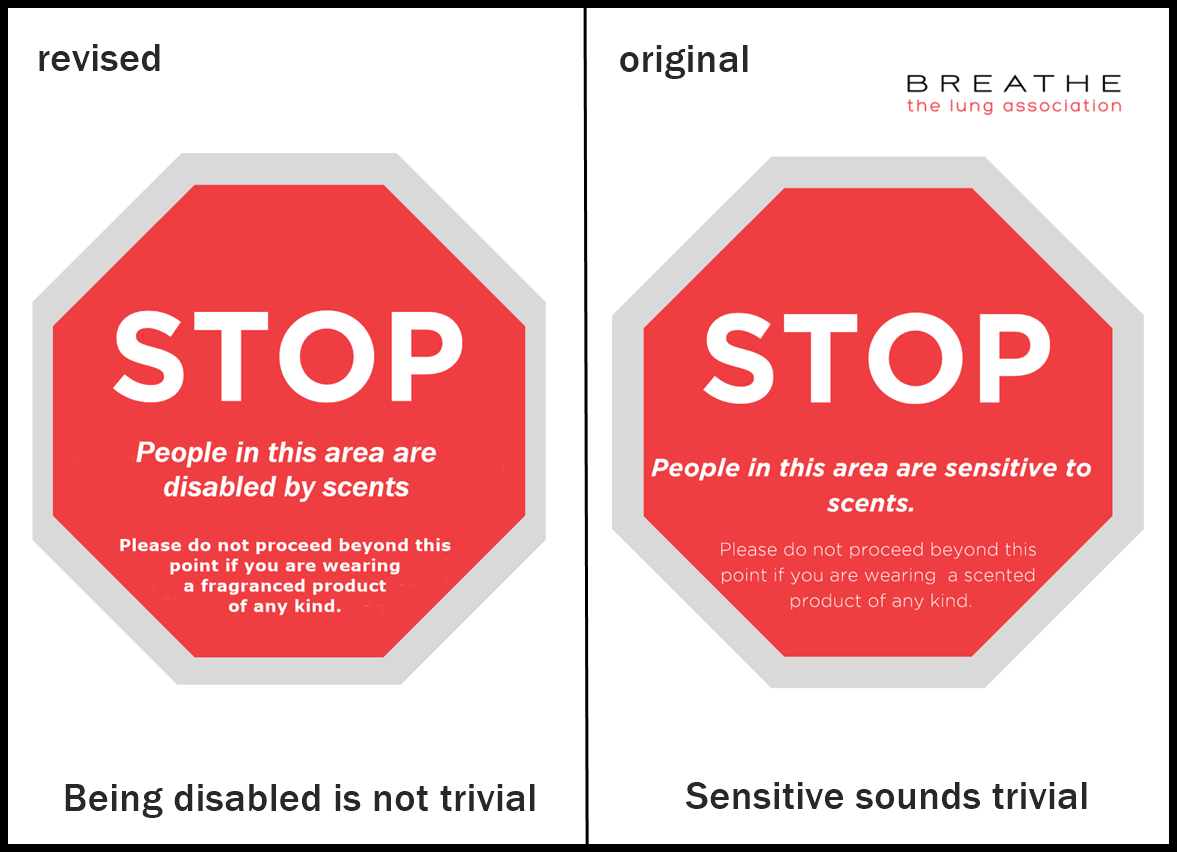
I ran across a sign that the lung association had created, and while I am glad they are doing something , I found the message and visual required some tweaking.

Of course, the lung association didn’t come up with the term “sensitive”, it’s what is used in human rights laws, but it seems to have created an impression in the public’s mind that chemical and environmental sensitivities are trivial, and not disabling or even life threatening like they can be.

It also needs to be said that signs without enforcement are endangering lives and perpetuating harm, systemic accessibility barriers, discrimination, and forced isolated segregation for those who are disabled by any or repeated exposures.

To download printable posters, see below.

Continue reading

Simple Fragrance-Free Posters in English and French

People have asked for simple printable signs that can be posted at home or elsewhere.  There are 2 versions of each sign, one being mostly black and white.

Click on the images below to save and print

Continue reading

Can’t Ban Fragrances? Consider a Fragrance Free Zone

This article appears in The Job Accommodation Network’s
ENews: Volume 17, Issue 2, Second Quarter, 2019

JAN provides free, confidential technical assistance about job accommodations and the Americans with Disabilities Act (ADA).

Can’t Ban Fragrances?
Consider a Fragrance Free Zone

Dig into developing a fragrance free zone

From the desk of Linda Carter Batiste, J.D., Principal Consultant/Legislative Specialist

Employees with fragrance sensitivity often need a fragrance free work environment to avoid triggering symptoms. However, it can be difficult to completely eliminate fragrances in some workplaces. Fragrance sensitivity can be triggered by not only perfumes and colognes, but also in some cases by personal products such as deodorant, shampoo, laundry detergent, and lotion. In workplaces with a lot of employees or in which the public has access, trying to control what products people use and enforcing a total fragrance ban can be virtually impossible. So what else can be done? Continue reading

Are Natural Fragrances Really Any Better?

Awareness is growing about the harmful effects of synthetic, artificial fragrances. This is with good reason, but now, many people have jumped onto the natural fragrance and essential oil (EO) bandwagons, believing them to be safe alternatives.

Is this a good thing?

Some believe so, after all, what could be wrong with something that’s natural?

It’s time to have a closer look.

Continue reading

Review Finds Ontario Far From Accessible but Report Includes People With Environmental Sensitivities

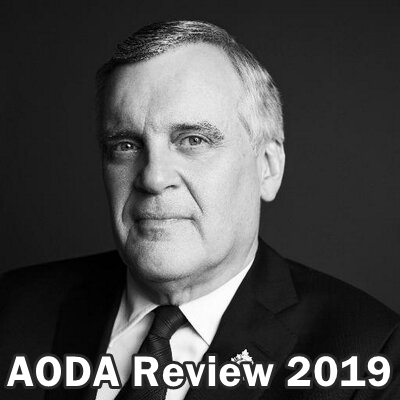
The Honourable David C. Onley, the 28th Lieutenant Governor of Ontario (2007-2014) was appointed to lead the Third Review of the Accessibility for Ontarians with Disabilities Act (AODA).

The report has now been released.

LISTENING TO ONTARIANS WITH DISABILITIES
REPORT OF THE THIRD REVIEW OF THE ACCESSIBILITY FOR ONTARIANS WITH DISABILITIES ACT, 2005

For most disabled persons, Ontario is not a place of opportunity but one of countless, dispiriting, soul-crushing barriers

Thanks to everyone who wrote in, those of us with environmental sensitivities have been recognized, and thanks to David C. Onley, we’ve been included in the report and the final recommendations:


In the SUMMARY OF RECOMMENDATIONS (on pg 80):

7. Ensure that accessibility standards respond to the needs of people with environmental sensitivities.


Other mentions of environmental sensitivities and details:

Continue reading

Petitions! Fragrance-free Health Care in the U.S. & Safe Housing in B.C.

Two new petitions have been brought to my attention. Both of them are on change.org.
Please sign and share if you are able:


Make all health care facilities and services “fragrance free.”

https://www.change.org/p/us-department-of-health-and-human-services-make-all-health-care-facilities-and-services-fragrance-free

…”Please ask the secretary of HHS to provide leadership on addressing this issue and require all health care facilities and service providers to be scent free.”…


and


Stop the Human Rights Violations of Disabled British Columbians.

https://www.change.org/p/dear-bc-provincial-gov-t-and-vancouver-municipal-gov-t-leaders-stop-the-human-rights-violations-of-disabled-british-columbians

…”Health supporting housing is needed for low income British Columbians living with MCS. Currently there is no safe, affordable housing in BC for people with this chronic illness. In fact, the housing that is available is making people with MCS more ill by exposing them to off gassing building materials, strong chemicals used in building maintenance, laundry venting, cigarette smoke, and toxicant containing household and body products used by fellow renters.” …

Continue reading

Harm Reduction Policy for People With Autism

Recent research that Anne Steinemann conducted in  three countries (United States, Australia, and the UK), found that 83.7% autistic adults reported adverse health effects from exposures to  fragranced products, effects such as:

migraine headaches (42.9%),
neurological problems (34.3%),
respiratory problems (44.7%), and
asthma attacks (35.9%)

In particular,
62.9% of autistic adults report health problems from air fresheners or deodorizers,
57.5% from the scent of laundry products coming from a dryer vent,
65.9% from being in a room cleaned with scented products, and
60.5% from being near someone wearing a fragranced product.

Health problems can be severe, with 74.1% of these effects considered potentially disabling under legislation in each country. Further, 59.4% of autistic adults have lost workdays or lost a job, in the past year, due to fragranced product exposure in the workplace.

Results show that vulnerable individuals, such as those with autism or autism spectrum disorders, can be profoundly, adversely, and disproportionately affected by exposure to fragranced consumer products.

Continue reading

The Fragrance-free Checklist


It seems like the best way to clear up some confusion about being fragrance-free, is to provide a checklist of products and places where fragrances that can make you not be fragrance-free are found, so that you don’t inadvertently bring fragrances with you when going  somewhere with a strict fragrance-free policy.

The checklist addresses some common misconceptions about what being fragrance-free really means.

Being fragrance-free is about more than not using perfume or cologne.
It’s also not about skipping deodorant, as some people seem to think.

Continue reading

Your Very Own Neighbourhood Chemical Distribution Device

Did you know?

If you use conventional laundry products, you might not knowingly be feeling the effects now, but you more than likely have some neighbours who do!

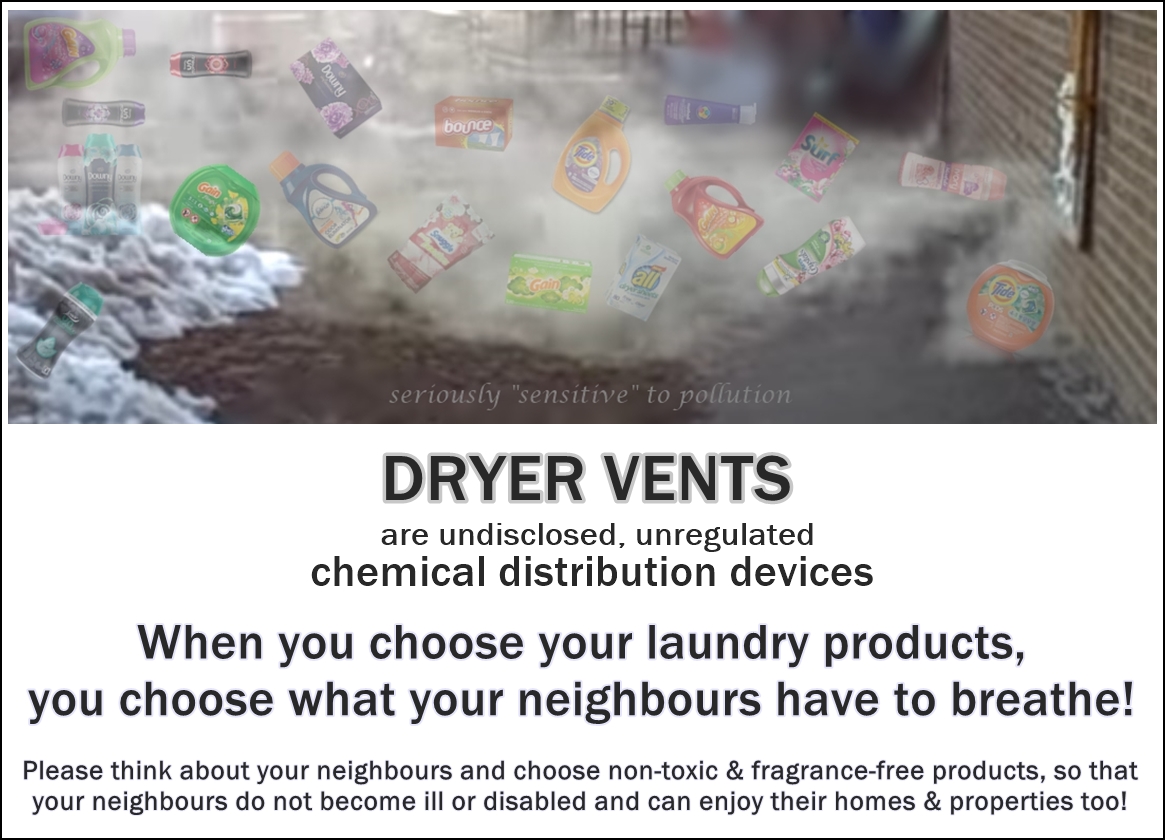
Dryer vents are undisclosed, unregulated chemical distribution devices.

When you choose your laundry products,
you choose what your neighbours have to breathe!

Please think about your neighbours and choose non-toxic & fragrance-free products, so that your neighbours do not become ill or disabled
and can enjoy their homes and properties too!

A growing number of people (millions, not handfuls) cannot enjoy walking about their neighbourhoods, sitting or working in their own outdoor spaces, or even open the windows of their homes due to the harmful pollutants released from dryer vents that were designed to emit moisture, not drifting toxic chemicals.

Laundry products should not be disabling people or cause short term adverse health effects like asthma, headaches, migraines, confusion, vomiting, dizziness, etc., or longer term effects like reproductive and neurodevelopmental problems!

EWG has a website where you can check the ratings for the products you use. It’s a great place to start learning which products to avoid, and which are safer options.

Continue reading