Tag Archives: VOCs

Fume Enclosure Boxes for Reading, Computers, and Appliances

Since papers, inks, and computers can release fumes that are too toxic for some of us to breathe, adversely affecting our ability to remain functional, and since there’s no getting away from papers and technology in modern society, an assistive device was invented some decades ago that could be useful to bring back as a more popular accessory: the reading box!

I recently ran across an ad on Craigslist for one that was for sale in the US, and then someone found an old catalogue (2002 PDF) with a few other pics, so I thought I’d share the info and images here in case they can help anyone else.

A reading box is basically a box made of wood, glass, or metal, with an opening in the front, and glass on top to read through. A vented box will also have a dryer hose out the back, and a fan of some sort to push the air through the hose and out of a window. A barrier with a vent sized exhaust hole would also be needed to cover the window opening being used.

reading box for computer 1This computer box is from the catalogue.
Continue reading

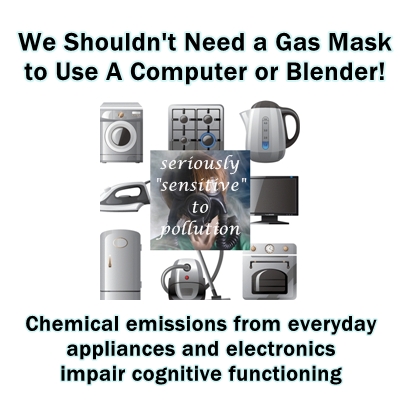
We Shouldn’t Need a Gas Mask to Use A Computer or Blender!

Ever notice how when you buy a new appliance or electronic device, and take it out of the box, or plug it in, the smell makes you nauseous, dizzy, and gives you a headache? Or worse?

That smell is made up of some really toxic chemical fumes. Benzene, styrene, and toluene, among others… in everyday technology!

.

New research from the Exposure, Epidemiology & Risk Program, Department of Environmental Health, Harvard T.H. Chan School of Public Health, on how the pollutants in indoor environments affect people’s cognitive functioning (people who are still able to work in polluted offices, not the people who are already too disabled to work in polluted offices) discovered that

Green office environments linked with higher cognitive function scores

…”People who work in well-ventilated offices with below-average levels of indoor pollutants and carbon dioxide (CO2) have significantly higher cognitive functioning scores–in crucial areas such as responding to a crisis or developing strategy–than those who work in offices with typical levels, according to a new study from the Harvard T.H. Chan School of Public Health’s Center for Health and the Global Environment, SUNY Upstate Medical University, and Syracuse University.

“We have been ignoring the 90%. We spend 90% of our time indoors and 90% of the cost of a building are the occupants, yet indoor environmental quality and its impact on health and productivity are often an afterthought,” said Joseph Allen, assistant professor of exposure assessment science, director of the Healthy Buildings Program at the Harvard Center for Health and the Global Environment, and lead author of the study.

“These results suggest that even modest improvements to indoor environmental quality may have a profound impact on the decision-making performance of workers.”

Researchers wanted to look at the impact of ventilation, chemicals, and carbon dioxide on workers’ cognitive function because, as buildings have become more energy efficient, they have also become more airtight, increasing the potential for poor indoor environmental quality.

Building-related illnesses and “sick building syndrome” were first reported in the 1980s as ventilation rates decreased. In response, there has been an emphasis on sustainable design–“green” buildings that are energy efficient and are also designed to enhance indoor environmental quality. The researchers designed this study to identify the specific attributes of green building design that influence cognitive function, an objective measure of productivity.

“The major significance of this finding lies in the fact that these are the critical decision making parameters that are linked to optimal and productive functioning. Losing components of these skills impacts how people handle their day to day lives.”

In other words, pollution prevents people from being smart!

appliance gas mask

Here are just some of the harmful emissions from computers:

Continue reading

When Programmers Send Old Computers Into ICU and Palliative Care

My computer and old Operating System have seen better days. Things are crashing almost hourly now. I am so grateful that the original donor was twice able to get this computer back up again (with telephone advice) after a partial freeze and fully appearing meld-down, but it is still malfunctioning online, so I have to shut it down frequently, as the sites I use seem to have updated using technology that is no longer inclusive of XP and my  minimal RAM (adding more would be cost-prohibitive).

I  therefore find myself in critical need of a new computer, even with all the toxicity and adverse health risks involved, and without the time to mitigate them (like running things somewhere else that is also fragrance free, for however long it takes to off-gas everything).

Eeks! image from pixabay 2

Here are some details:

Continue reading

Scent-Free Buildings Guide from CCIAQB

From The Canadian Committee on Indoor Air Quality (CCIAQB) 

“This Module provides building owners and managers with information about the sources and effects of scents and fragrances. It also suggests ways to move toward scent-free buildings. The information covers scents and fragrances brought into a workplace by people wearing personal products such as perfume as well as those scents and fragrances that originate from custodial products such as washroom hand soap.”

scent-free buildings guide banner

Continue reading

Who Wants to Help Me Get New Air Purifier Filters?

I need several air purifiers to clean the air of pollutants from unavoidable everyday products and materials (like the mail, receipts, product labels, food packaging, replacement of any basic essentials, etc) and also the neighbourhood pollution (trains, planes, laundry products, pesticides, BBQs, fireplace smoke, etc) from my indoor air so that my brain and body can work more like they were intended to.

To cook, clean, and take care of my very basic needs, (nothing extra going on here, I am housebound) I am dependent on clean air to be able to function. My filters need to be changed annually or every other year (depending on what the air quality has been like) and mine were last changed in 2012, three years ago.

I have looked all over the place for funding to purchase new filters and there just isn’t anyone out there with a mandate to provide clean air to those who require it for medical reasons.

! ! !

IAQ help

Last summer was a disaster for me, this year was even worse. I’ve had a horrid three  months from area roadwork and pesticide use (there was massive spraying of Wild Parsnip around this part of Ontario during the summer, and the pesticide drift got to me really bad), and now other simpler exposures that hadn’t been bothering me as much as they used to, are again having more serious adverse effects on me because my indoor air is not being filtered anymore.

Continue reading

Shouldn’t Cleaning Products REMOVE Pollutants Instead of ADDING Them?

Here’s yet another scientific report about how dangerous chemicals and VOCs are being released from the everyday cleaning products most people use in their homes!

Environmental Defense (Canada) recently released their report THE DIRTY TRUTH, which found that products from some of the biggest cleaning brands (Mr. Clean, Clorox, Lysol, Windex, and PineSol ) pollute the air in Canadians’ homes with harmful chemicals. (Note that these products are not significantly, if at all different in the US, but the EU does have some bans on ingredient that are still allowed here).

ED’s The Dirty Truth follows hot on the heels of Women’s Voices For the Earth’s DEEP CLEAN report, and while both of these reports name names, they had a slightly different focus.

In Deep Clean, Women’s Voices For the Earth graded four major cleaning product manufacturers based on key indicators to expose their commitment to product safety: Product Ingredient Disclosure, Responsiveness to Consumer Concerns, Toxic Chemical Screening Process and Removal of WVE’s Chemicals of Concern.

Dr. Anne Steinemann’s research from earlier this year did not name product names, but she named numerous harmful volatile organic chemicals (VOCs) that the many popular products she tested do release into the air we breathe.

One has to wonder why this is allowed to be going on?

We should not be subjected to harmful industrial pollutants in our own homes!

cleaning pollution 1.

“Our new report found that products from some of the biggest cleaning brands (Mr. Clean, Clorox, Lysol, Windex, and PineSol ) pollute the air in Canadians’ homes with harmful chemicals called Volatile Organic Compounds. These chemicals have been linked to respiratory problems such as asthma and lower IQs.”

.

 Volatile Organic Compounds and Your Health

Continue reading

Industry Approved Actions to Spare Your Air, Lungs, and Brain

.
If only the air was this good all the time!

If only the air was in the blue range all the time!

.

Sometimes summer air just plain sucks. It can and does cause all kinds of health problems. Here then are some tips from Air Quality Ontario on what we humans can do to reduce our exposure to harmful pollutants and our impact on outdoor air.
 .
Note that none of these suggestions are enforceable. They are entirely voluntary for those of us who manage to learn of their existence. Many of us only find out about these tips once we are so adversely affected by pollutants that we couldn’t do these things even if we wanted to, which means the tips are most useful for the people who aren’t personally affected enough (yet) to understand the need for them.
 .
(reducing industry impacts on air will just have to wait until enough of us demand it)
 …
 .
During a Special Air Quality Statement, there are a number of actions that you can take to help spare the air:

Continue reading

Are Essential Oils Too Popular For Our Own Good?

Did you know that essential oils are not harmless?

Essential Oils have been, in limited circumstances,  a good thing. Some have useful healing properties when used medicinally in very specific and temporary ways, but too much of anything is not a good thing. Essential oils  are now used and diffused everywhere, and have become more of a serious health hazard than something beneficial. Indeed,  for an ever growing percent of the population they have become life-threatening accessibility barriers.

They can be sensitizers and allergens, and can cause other serious health problems too.
They can emit and create hazardous air pollutants. Some are made with synthetic ingredients, or from pesticided plants, and are processed using toxic solvents.

They are WAY over-used and over-promoted, and any beneficial uses the organic oils may have, risk being lost due to this careless over-use.

They should not be used as a popular way to make money the way they are now.

They should be kept for medicinal use under the guidance of qualified, trained professionals, and  not the MLM (multi-level-marketing) folks who are inventing new ways to use them so that they can sell more product.

Some people have severe adverse reactions to them, and their proliferation is causing new barriers to access, meaning people can’t access food from health food stores,  other essentials, or even alternative health care, because the oils are so prevalent and contaminating everything (1st, 2nd, and 3rd hand) in what should be healthy places with clean, fragrance-free air.

Fore more information, here are a few links to check out: Continue reading

Home Dental Extraction SUCCESS (#2)!

Another One Bit the Dust

I survived my second home extraction on the weekend. It was a very infected tooth, an upper rear molar, one that I had somehow managed to retain a year longer than expected. It was actually the first one to get infected last year, but then the other tooth went ballistic, and by the time that extraction site healed, this tooth had calmed down enough to be very useful for eating with.

In hindsight, waiting so long may not have been such a great idea, as in the end, the infection was nasty. Very nasty. It put me into a terrible funk that was really difficult to push my way through, similar to the depression some kinds of mold can cause, and created the same challenges MCS/ES exposures cause, like brain fog, difficulty thinking and doing things, and a real lack of energy. And it stank when pulled. Really stank.

I am so grateful for the home visiting dentist in this area. Not only is he fragrance-free, but he is willing (and able!) to take other precautions to make things safe for me.

Last year, before my first home extraction, we discussed everything that was needed for the procedure, and what was necessary to make it as safe as possible for me.

This year I couldn’t find my old list (despite seeing it a month or 2 ago) and hoped he remembered his. This is what I do remember, and what we did:

Continue reading

Verified Fragrance-Free Supply Chains

Due to the increasing numbers of people with allergies and sensitivities to, and injuries from VOCs and other fragrance ingredients, there is a growing need for fully verified fragrance-free supply chains.

Many of us need products and foods handled in such a way from beginning to end, as to prevent first, second and third hand fragrance and other chemical contamination.

Organic food that has been handled by someone with scented hand lotion, or that has sat in a store full of fragrance molecules will absorb those chemicals, and potentially be as toxic as food that has pesticide residues (for people who must, for medical and health reasons, avoid petrochemical exposures). Clothing, bedding toilet paper and other materials also absorb fragrances, which can be hard (if not impossible) to remove.

This presents a business opportunity for entrepreneurs, to provide a service for people whose health depends on it, as well as for those who wish to prevent health problems.

verified fragrance-free zone NO FRAGRANCE Continue reading