Category Archives: Environmental Sensitivities

Scientists to WHO: Recognize MCS and EHS

International Scientists Invite WHO to Recognize MCS and EHS

Paris, September 4th 2015.

“Following the fifth Paris Appeal congress, which took place on the 18th of May, 2015, the attending European, American and Canadian scientists unanimously decided to create a working group and to write a Common International Declaration to request an official recognition of these new diseases and of their sanitary consequences worldwide.

The declaration calls upon national and international bodies and institutions and particularly the WHO, for taking urgently their responsibility for recognizing electrohypersensitivity and multiple chemical sensitivity as real diseases, including them in the International Classification of Diseases.

This International Declaration also asks national and international institutions to adopt simple precautionary measures of prevention, to inform populations and requires the appointment of real independent expert groups to evaluate these sanitary risks in total scientific objectivity, which is not the case today.”
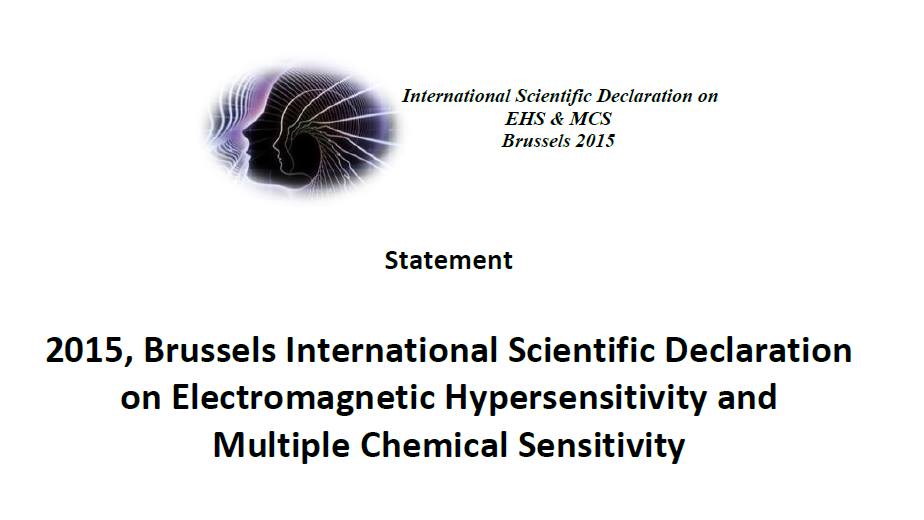
2015 WHO MCS EHSThe links to download the Declaration Statement and Press Release are below, as well as the link to see the presentations that took place during the meetings in May of 2015.

Continue reading

Accessible Meetings Guide Addresses Chemical and Electrical Sensitivities

Another great resource shared by Mary Lamielle, this time on how to make events accessible for people with MCS/ES.

Accessible Meetings Guide Addresses Chemical and Electrical Sensitivities

accessible events

Continue reading

Industry Approved Actions to Spare Your Air, Lungs, and Brain

.
If only the air was this good all the time!

If only the air was in the blue range all the time!

.

Sometimes summer air just plain sucks. It can and does cause all kinds of health problems. Here then are some tips from Air Quality Ontario on what we humans can do to reduce our exposure to harmful pollutants and our impact on outdoor air.
 .
Note that none of these suggestions are enforceable. They are entirely voluntary for those of us who manage to learn of their existence. Many of us only find out about these tips once we are so adversely affected by pollutants that we couldn’t do these things even if we wanted to, which means the tips are most useful for the people who aren’t personally affected enough (yet) to understand the need for them.
 .
(reducing industry impacts on air will just have to wait until enough of us demand it)
 …
 .
During a Special Air Quality Statement, there are a number of actions that you can take to help spare the air:

Continue reading

Why Exposure Monitoring Would Be Medically Validating

We (as a society) are facing unprecedented kinds of health problems and challenges that can easily (if you do any research) be explained by our 24/7 exposure to toxic chemicals in everyday products and materials, GMOs (and pesticides) in our “food” supply, and 24/7 exposure to unsafe levels of wireless radiation.

Harmful pollutants are now in our air, water, food, clothing, and you name it, it’s likely to be either made with toxic materials, or has 2nd or 3rd hand toxic chemical contamination from passing through a toxic environment. These exposures add up, and are messing with our health and well-being in ways that are not yet well-understood, but point to the urgent need to stop business as usual, and stop burdening our bodies with so many harmful pollutants that we were simply not designed to process.

There is money to be made by selling drugs, even if the drugs aren’t appropriate to the condition,  do nothing to heal what’s wrong, and often just make things worse, much worse.

Stephen Genuis is a researcher who has published many peer reviewed articles dealing with environmental health. In 2014 the official journal of the Canadian Family Physician published two of them. I shared the abstract from one of them last year.

I am going to “quote” extensively from the other article here, as most of you don’t follow the links, but will read what I have here.

Pandemic of idiopathic multimorbidity
Stephen J. Genuis, MD FRCSC DABOG DABEM

Canadian Family Physician June 2014 vol. 60 no. 6 511-514

“Sitting among colleagues in the private room of a swank eatery, I recently had the pleasure of participating in a pharmaceutical industry–sponsored medical education event allegedly exploring the management of patients presenting to their health providers with multisystem health complaints.

The animateur for the evening—an eloquent orator with impressive credentials—raised the issue of the rising prevalence of patients who present with a laundry list of ongoing and seemingly unrelated persistent complaints often including headache, joint pain, fatigue, brain fog, bloating, chemical intolerance,1 muscle aches, itchy skin, and so on.”

Continue reading

Report: RF EMR and the Health of Canadians

The_Canadian_Flag
… “Numerous concerns relating to radiofrequency (RF) exposure were raised by witnesses during Committee meetings on Safety Code 6 as well as in the briefs that were submitted. …
Witnesses also spoke to possible links between RF exposure and cancer, reproductive issues and autism.These concerns tied in to other testimony that expressed unease about RF exposure in schools as a result of the use of Wi-Fi; the need for RF exposure limits and guidelines to protect vulnerable populations such as pregnant women, infants and children, and others who may be more susceptible to the effects of RF exposure; and electromagnetic hypersensitivity (EHS).
While witness testimony and briefs often emphasized the need for Health Canada to take a precautionary approach to RF exposure by reducing the limits established by Safety Code 6 (and sometimes provided examples of limits and other measures taken to protect populations from RF exposure in other jurisdictions), they also referred to steps that individuals can take to reduce their own RF exposure. Finally, some witnesses stated that industry should play a role in reducing RF exposure.” …
RADIOFREQUENCY ELECTROMAGNETIC RADIATION AND THE HEALTH OF CANADIANS
 ∴
Report of the Standing Committee on Health
This much awaited report contains 12 major recommendations by effectively echoing the expert evidence heard by eight MPs during the recent hearings this Committee.
 
 ∴
The List of Recommendations:

Continue reading

MCS and EHS Included in New National Council on Disability Transportation Report

Press Release from National Center for Environmental Health Strategies

~ Mary Lamielle

Transportation Update NCD

… excerpts …

National Council on Disability Transportation Report Addresses Chemical and Electrical Sensitivities; Recommends Changes in Policies and Practices to Improve Access

Continue reading

MCS is International

People all over the industrialized world have been developing Multiple Chemical Sensitivities and Environmental Sensitivities, or Environmental Illnesses. We are exposed to so many petrochemical pollutants, in our air, water, foods, clothes, furnishings, homes, and elsewhere in daily life, substances which are now known to cause many kinds of adverse health effects, and some of us just have the epigenetic disposition to feel the effects faster and more extremely than others who may develop cancer or some other condition many years later.

Amelia Hill (aka the Amazing Amelia Hill) lives in Australia and developed very severe, or extreme MCS after not being properly diagnosed for too many years. A lack of proper diagnosis and precautionary measures usually results in a debilitating worsening of the condition, which is best addressed with avoidance of the triggering substances, and building up health in very targeted ways. This is much more difficult to do the longer one isn’t able to take the steps to avoid exposures and rebuild life with safe alternatives.

Amelia’s life is probably unlike any you have ever heard of (even mine) although there are many similarities between the experiences those of us who have severe MCS/ES share. Amelia is known as “amazing” because of the ways she handles her life.

You will see why here.

Amelia 01

Amelia’s story has been featured as the cover story in what may be South Australia’s most popular newspaper weekend magazine: Continue reading

But I Don’t Smell Anything!

Guest Post by Leah Spitzer

I have Multiple Chemical Sensitivity (MCS) – a “multi-system illnesses as a result of contact with, or proximity to, a variety of airborne agents and other substances. (Environmental Protection Agency).” In other words, I react to fragrances, building products and more. It is not a histamine reaction, but rather, a systemic reaction to the chemicals in fragrance and other products.

As someone with MCS, I’m also known as a “canary” with deference to the Canaries in the Coal Mine. As a canary, I often encounter looks of disbelief when I mention I can smell someone’s laundry detergent, or fragrance. I can smell it on them, their dog, their cat, their clothes, or even the package they are bringing me. I smell it in their home and in their car.

Often times, if it’s just a passing moment, I try to step back, or just tough it out, but sometimes I have to speak out. When I do, the most common response, after the surprised look, are:

“I didn’t put any perfume on this morning”
or
“I don’t smell anything”

I don't smell anything

Why the disparity in perception? There are several reasons that I have observed:

Continue reading

Multiple Chemical Sensitivity (MCS) Brochure

For your information, here are scans of the MCS brochure from the Environmental Health Clinic at Women’s College Hospital in Toronto, Ontario. Note that they see mostly patients with milder to middling MCS/ES (and there’s usually a 6-12 month wait list), as those with more severe MCS/ES are unable to access the clinic, it being in a regular hospital with hand sanitizers, hundreds of toxic people and plenty of unsafe materials everywhere.

MCS clinic brochure 2 exerpt 1a

The brochure is an introduction, and reducing exposures is always a good thing, but sometimes people with MCS/ES need to eliminate exposures to remain at all functional, and that’s where things become a lot more complicated, and why we need the OCEEH.

Continue reading

Home Dental Extraction SUCCESS (#2)!

Another One Bit the Dust

I survived my second home extraction on the weekend. It was a very infected tooth, an upper rear molar, one that I had somehow managed to retain a year longer than expected. It was actually the first one to get infected last year, but then the other tooth went ballistic, and by the time that extraction site healed, this tooth had calmed down enough to be very useful for eating with.

In hindsight, waiting so long may not have been such a great idea, as in the end, the infection was nasty. Very nasty. It put me into a terrible funk that was really difficult to push my way through, similar to the depression some kinds of mold can cause, and created the same challenges MCS/ES exposures cause, like brain fog, difficulty thinking and doing things, and a real lack of energy. And it stank when pulled. Really stank.

I am so grateful for the home visiting dentist in this area. Not only is he fragrance-free, but he is willing (and able!) to take other precautions to make things safe for me.

Last year, before my first home extraction, we discussed everything that was needed for the procedure, and what was necessary to make it as safe as possible for me.

This year I couldn’t find my old list (despite seeing it a month or 2 ago) and hoped he remembered his. This is what I do remember, and what we did:

Continue reading