Category Archives: Fragrance

The Fragrance Industry’s Toxic Secrets

If you want to learn more about why so many people are suffering adverse health effects and making a stink about fragrance use, then the recent report from Women’s Voices for the Earth is a great place to get informed

Unpacking the Fragrance Industry: Policy Failures, the Trade Secret Myth and Public Health.

It’s must read material if you are at all unfamiliar with the issues surrounding fragrance.

Like this:

And that’s only the ones that have been tested. Many have not been tested for human health effects. Scientists also recently discovered that chemical cocktails can become carcinogenic even when individual chemicals themselves weren’t carcinogenic, but chemicals are tested individually (if at all), and not in the cocktails we get exposed to.

Please read the research and articles from WVE, and then take action.

Not surprisingly, the fragrance industry took issue with the report and shared some standard industry generated marketing responses. You can read about that here:

Continue reading

An Open Letter to the Scented

Guest post by Debbie Clark Seely

Dear friends,

I wanted to take the time to write this letter because we (the “unscented” community) are concerned for you. With it being the holiday season we are seeing multiple reports of friends and family members choosing to cut ties to their unscented loved ones rather than make the effort to visit them unscented. This perplexes us. It makes us feel like you are choosing scent over a human being. Continue reading

Scent Marketing or Scented Drugging?

The May June 2015 issue of Costco’s magazine had an article about scent marketing.

The Economist had an interesting article in 2007 regarding manipulative chemical use.

Women’s Voices For the Earth has several reports about fragrances and the fragrance industry.

Why should you be concerned? Read on:

Continue reading

“Artificial scents have no place in our hospitals”

Canada’s top medical journal, the Canadian Medical Association Journal (CMAJ), says
Artificial scents have no place in our hospitals

Hospital NO Fragrance

“These patients may be involuntarily exposed to artificial scents from staff, other patients and visitors, resulting in worsening of their clinical condition. As patients,
family members and emergency physicians will attest, the attacks can be quite sudden and serious. There is little justification for continuing to tolerate artificial scents in our
hospitals.” …

Continue reading

The Effort and “Inconvenience” of Single-Handedly Trying to Remove Systemic Barriers to Access

.

When she needed accommodation, you won’t believe the rigmarole that ensued.

(unless you have MCS/ES)

equal opportunity 1

“They should not have to make significantly more effort to access or obtain service. They should also not have to accept lesser quality or more inconvenience.”

.

Someone with MCS (who wishes to remain anonymous) was asked about how her efforts to receive appropriate, safe, accommodation were going, so she could see a health care provider. She is one of a growing number of people who become disabled from exposures to toxic chemicals found in many everyday products and materials, especially in fragrances.

This is pretty much how the story goes:

She contacted a health care provider by phone and talked to a receptionist.

She asked her if they had a scent-free policy and was told they didn’t.

Continue reading

Optional “Inconvenience”

Guest post and images by Laura J Mac

What always strikes me during conversations about how to persuade service providers to accommodate our disability is how much extra work we have to do just to participate in simple survival stuff. I mean, “simply” tracking down professionals who are willing to accommodate is a chore and a half. The luxury of “having a good relationship” with a service provider falls way down on the list because it’s usually one or the other.

Laura J Mac 1

Nobody would think twice about someone who uses a mobility device asking if there are ramps and elevators but it seems that our need for fragrance-free and reduced chemical exposure is perceived as a “preference” rather than a medical necessity. That perception leads to the idea that accommodation of our disability is an “option” (and generally it’s an “option” that service providers aren’t willing to make available.) It’s not that we don’t “like” fragrance, these chemical exposures cause neurological and physiological problems that interfere with our ability to function on a daily basis.

Continue reading

When Women Don’t Relinquish Fragrance

Guest post by By Heidi Utz

Several years ago, I posed to my women’s group a simple question: Can we ask members not to wear fragrances here? A hush fell over the room, then a silence so vast you could have heard a vial of Obsession drop. The same sweet women I’d grown to respect morphed into a pack of rabid wolves. No perfume?! It was as if I’d proposed giving up coffee, sugar, and styling gel in one fell swoop.

Since then, I have spent much time puzzling over their response. Are we so addicted to our scented products that the very notion of relinquishing them strikes terror in our hearts? Or is it more that the perfume industry has done such a stellar job in marketing its wares? Even in Santa Fe, where a comparatively high level of health-consciousness exists, we’re still susceptible to those redolent magazine ads, featuring the young and glossily naked in their evidently perfume-induced attractiveness.

But what if perfumiers, like chemical producers, were forced to include in their ads the manufacturer’s safety data sheets (i.e., the very interesting ways each spritz affects your liver)? Sound far-fetched?

Continue reading

It’s Only A Little Fragrance

How many times have we heard it’s “only a little fragrance”?

Telling a person with MCS/ES that there is “only a little fragrance”

is like

telling someone with Celiac Disease that there’s “only a little gluten”

or

 telling someone with a peanut allergy that there’s “only a little peanut”

or

telling someone who uses a wheelchair that there are “only a few steps”.

It’s not ok.

telling 103It’s NOT ok.

Individual images follow: Continue reading

Fragrance Facts Brochure

I’ve been looking through some of my old files and ran across this printable brochure about fragrances. Made by Betty Bridges in 2002, it has very useful information that is still relevant.

What has changed since then is that fragrance industry members voluntarily disclosed over 3000 ingredients that they commonly use (only they know how many were not disclosed, as the fragrance industry is still not regulated), and more research has come out on how harmful many of the fragrance ingredients are.

Additionally,  many  more people have become permanently disabled with MCS/ES, often originally triggered from fragrance chemical exposures (in Canada, there was a 31% increase in people diagnosed with MCS between 2005 and 2010, with many more undiagnosed due to a lack of doctors trained in environmental health matters), and  now it has become impossible to avoid 1st, 2nd and 3rd hand fragrance chemical exposures in the “developed” world, so everyone is constantly being exposed to these chemicals.

Fragrance Brochure 1- horz screenshots

Screenshot of brochure. Download the document at link below.

 ∴

Continue reading

Asthma, Fragrance, and Job Accommodation

Fragrances Can Cause or Trigger Work-related Asthma

The Work-Related Asthma Prevention Program (WRAPP) of the California Department of Public Health released new fact sheets on fragrances and work-related asthma.

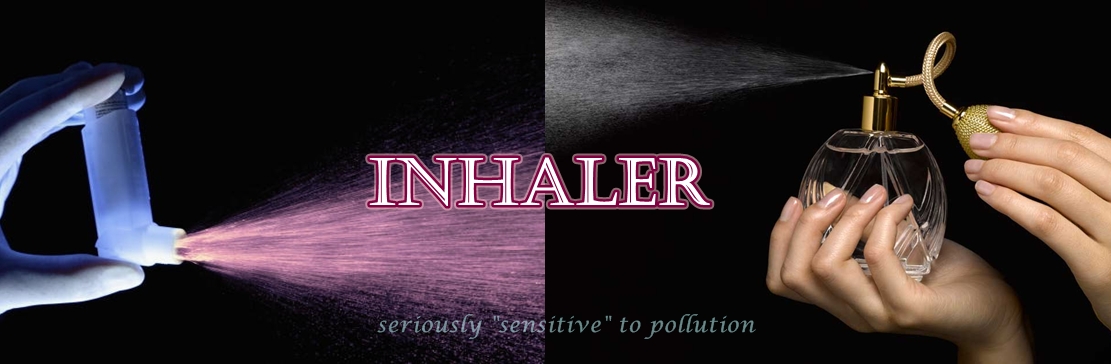
INHALER

Information available:

2017 Fragrances and Work-Related Asthma: Information for Workers (PDF) – fact sheet

2017 Fragrances and Work-Related Asthma: Information for Employers (PDF) – fact sheet

2015 (editable) Workplace Fragrance-Free Policy (Word) – fact sheet

Continue reading