…
How Big Is Your World?
The following questions are to help us think about how much space we have to enjoy, and what if it were to be taken away.

…
The following questions are to help us think about how much space we have to enjoy, and what if it were to be taken away.
I saw this photograph on facebook of Richard Gere and Roshi Joan Halifax hugging (at the Mind and Life “Power and Care” conference), which to me exemplifies the best kind of (adult to adult) hug we humans could have.

Richard Gere and Roshi Joan Halifax
I haven’t been able to stop looking at it… and it made me start trying to remember when the last time I was able to hug someone was.
I don’t think it was in 2010 when I left Toronto, as I was so sick then, and I didn’t have any spare clothes to risk contaminating them with 2nd and 3rd hand fragrance chemicals. Continue reading
Posted in Accessibility, Air Quality, Chemicals, Community, Disability, Environmental Health, Fragrance, Human Rights, Pollution, Toxic Trespass
Tagged chemical sensitivity, environmental sensitivities, hazardous air pollutants, invisible disabilities, isolation, laundry, MCS, MCS/ES, pesticides, petrochemicals, solitary

How many people have peanut allergies?
“In the U.S., approximately three million people report allergies to peanuts and tree nuts. Studies show the number of children living with peanut allergy appears to have tripled between 1997 and 2008.”
The rise in peanut (and other food) allergies has been linked to the rise of toxic chemicals used by the food industry. Fragrances are also full of toxic chemicals.
How many people have fragrance allergies or “sensitivities”?
Why do people who lose their health from being polluted and poisoned for profit end up being forced into isolation and invisibility in order to try to remain alive?

Why?
Posted in Accessibility, Air Quality, Disability, Environmental Health, Environmental Sensitivities, Pollution
Tagged allergies, asthma, cancer, chemical sensitivity, Chemicals, fibromyalgia, Fragrance, hazardous air pollutants, Human Rights, invisible disabilities, MCS, MCS/ES, petrochemicals, toxic trespass, VOCs
As more people become chemically “sensitive”, different types of human rights scenarios emerge. In their latest elearning module, the Ontario Human Rights Commission has included a case study with someone who “has been diagnosed with a chemical sensitivity disability”.
Some people think that our need for clean air interferes or competes with their imagined right to use toxic products, especially those with fragrances, but no, there is no inherent right to wear perfume or use other fragranced products!
Sometimes, though, someone may need to use a product for a disabling condition of their own. The problems arise if that product has fragrances (or some other problematic ingredients) added which cause disabling effects on another person, as the following case study from the Ontario Human Rights Commission (OHRC) shows.

Competing rights at the office
Continue reading
If you prefer getting your research information by watching and listening instead of reading, here are a couple of video presentations by the esteemed Dr Stephen J. Genuis, who is one of the leading experts on environmental health.
In these presentations he discusses the increases in chronic illness and mental health problems, chemical and other causes and effects, shortcomings in our health care systems, as well as some treatment options to improve health.
I’ve also linked to related research for those of you who like to read.

Posted in Disability, Education, Environmental Health, Health, Public Health, Research
Tagged allergies, autism, cancer, chronic illness, exposures, fibromyalgia, invisible disabilities, MCS, MCS/ES, mental health, multimorbidity, pain, petrochemicals, sensitivities, Stephen J. Genuis, toxic chemicals, video
The Public Service Alliance of Canada (PSAC) has created a video about MCS and job accommodation featuring Dr John Molot.

Video: Demystifying Multiple Chemical Sensitivity
Posted in Accessibility, Disability, Environmental Health, Environmental Sensitivities, Human Rights, Multiple Chemical Sensitivities
Tagged accommodation, Chemicals, hazardous air pollutants, IAQ, invisible disabilities, MCS, MCS/ES, petrochemicals, PSAC, sensitive to pollution, toxic trespass, video
The Government of the Province of Ontario, specifically the Ministry of Health and Long-Term Care (MOHLTC) finally announced the establishment of a Task Force on Environmental Health.
Let’s hope this new project creates the long overdue and effective changes and access to basic services that are needed by people with environmentally linked, disabling, chronic health conditions like MCS/ES, unlike the 1985 project which created a 600+ page report with recommendations that were largely ignored (see links below), which allowed these and other problems to fester and increase in severity and magnitude.

The news release about the new task force follows:
Posted in Environmental Health, Environmental Sensitivities, Government, Health, Health Care, Human Rights, Policy
Tagged chemical sensitivity, fibromyalgia, health care access for people with MCS/ES, health effects, MCS, MCS/ES, multiple chemical sensitivities, Myalgic Encephalomyelitis/Chronic Fatigue Syndrome, Ontario, petrochemicals, toxic
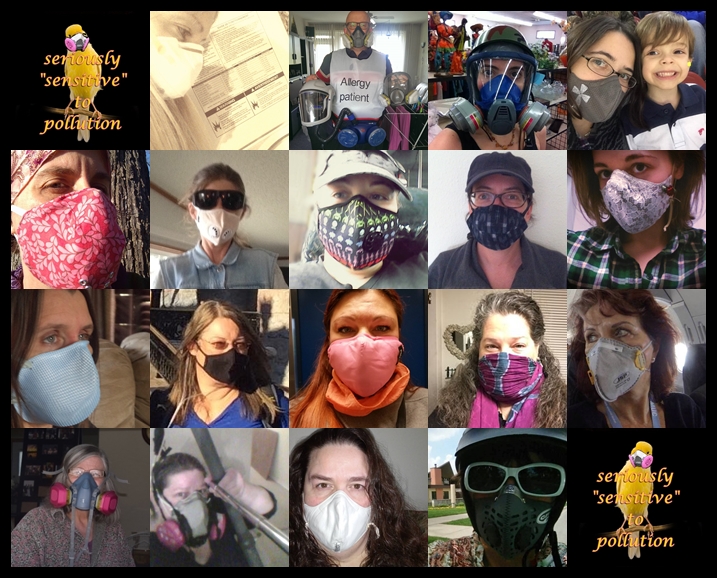 ♥
♥Many thanks to the Courageous Canaries of MCS/ES (and mask)
Awareness Month 2016!
Your courage, kindness, and willingness to share your photos and stories in the “What I Wear in Bad Air” series generated a lot of discussion in various support groups, and will benefit so many others who can see some of the options that are available, as worn by their peers, and that it’s more than ok to be visible. Continue reading
Posted in Air Quality, Disability, Environmental Health, Environmental Sensitivities, Fashion, Fragrance, Human Rights
Tagged allergies, asthma, chemical sensitivity, Fragrance, hazardous air pollutants, invisible disabilities, masks, MCS, MCS/ES, multiple chemical sensitivities, petrochemicals, Products, toxic trespass, VOCs
 | linda @ Seriously "S… on MCS/ES |
| linda @ Seriously "S… on The CDC and MCS |
 | Tabatha Schnorr on MCS/ES |
| Tabatha Schnorr on The CDC and MCS |
| linda @ Seriously "S… on MCS and Housing |
| linda @ Seriously "S… on Hospital Protocols for People… |


 Seriously "Sensitive" to Pollution