Tag Archives: multiple chemical sensitivities

MCS Awareness Month and Masks

May is MCS/ES Awareness Month

Due to the wide variety of chemical pollutants in our air these days, many people with MCS/ES have to wear a mask when leaving home (and sometimes even at  home) to prevent or reduce debilitating and disabling symptoms.

may is mcs es awareness month

Having an invisible (and inconvenient, or so we are told) disability is difficult, especially when many of the adverse effects are delayed and we have to deal with them in isolation, out of sight, out of mind, and without witness to our suffering.

If there’s any good that comes from wearing a mask or respirator in public (in addition to protecting our health a bit) wearing one when we have an invisible disability helps make us visible, and alerts other people that they too are at risk.

Breathing is not optional.

Pollution is!

Wearing a protective breathing device can minimize some of the damaging effects exposures to pollutants cause, but people often feel self conscious about wearing a mask, especially if we can’t find a “pretty” one that we are able to use, Continue reading

MCS/ES and Mental Health

Living with MCS/ES creates challenges that seem unimaginable to most people. Despite some progress (more awareness), due in large part to so many more people being affected, the barriers and obstacles to living in the world as it currently is, can be never-ending when there is industry generated denial that everyday chemicals (or wireless) exposures are hurting and disabling people.

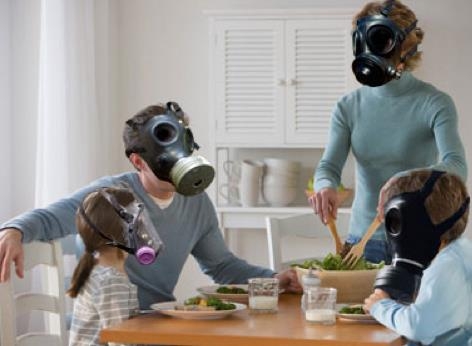
dinner time“Remember, don’t talk or breathe when you take your masks off to eat”

It is exhausting to have to constantly ask for accommodations just to be able to exist in a world where safe solutions are often hard to find, or when they do exist, they are not affordable. It can be like living in a world that wishes we’d just go away and leave them all alone, yet… there is no safe place to go away to…

Is it any wonder then, that people develop mental health problems?

When health problems (mental or otherwise) related to circumstances and experiences arise, one is (usually) only truly helped by people who have an understanding of the issues related to the circumstances that are connected to the problems. When that understanding doesn’t exist, appearances can create erroneous assumptions that perpetuate the kinds of harms that caused the problems in the first place.

For people with MCS/ES, exposures can  trigger temporary or long term brain and behavior issues that look like mental health problems to people who don’t know how toxic chemicals, molds, food sensitivities, or wireless exposures can affect our brains and bodies. And sometimes we are capable of doing some things, yet completely incapable of doing others, as exposures can affect different parts of our bodies and brains, and for varying amounts of time.

What people also don’t understand, is that when we are able to live free of those exposures, we can be free of the brain or behavior problems the exposures cause.

Finding ways to access goods and services without being subjected to disabling levels of exposures can take 10 to 100 times more effort than people normally have to extend for the same goods and services. Sometimes, despite our best efforts, we cannot safely access the goods and services everyone else takes for granted. These challenges can mean we may need to turn to others for help with survival and coping , yet not only is it difficult to receive practical support,

new research  also proves that access to knowledgeable mental health care providers is rare for people with MCS/ES!


“When asked to evaluate their provider’s knowledge of MCS on a scale of “not knowledgeable”, “somewhat knowledgeable”, or “highly knowledgeable”,

Continue reading

Fume Enclosure Boxes for Reading, Computers, and Appliances

Since papers, inks, and computers can release fumes that are too toxic for some of us to breathe, adversely affecting our ability to remain functional, and since there’s no getting away from papers and technology in modern society, an assistive device was invented some decades ago that could be useful to bring back as a more popular accessory: the reading box!

I recently ran across an ad on Craigslist for one that was for sale in the US, and then someone found an old catalogue (2002 PDF) with a few other pics, so I thought I’d share the info and images here in case they can help anyone else.

A reading box is basically a box made of wood, glass, or metal, with an opening in the front, and glass on top to read through. A vented box will also have a dryer hose out the back, and a fan of some sort to push the air through the hose and out of a window. A barrier with a vent sized exhaust hole would also be needed to cover the window opening being used.

reading box for computer 1This computer box is from the catalogue.

Continue reading

Loneliness, Posttraumatic Growth, and Invisible Disabilities

Amelia Hill shared an eloquent post about enduring and working with loneliness (see below).  Amelia and I are both  housebound (and have been so for years), but she is currently confined to a much smaller space in her home than I am in mine.

loneliness - Amelia HillFrom Heal Amelia’s Life:

Loneliness. I’ve kinda learned to override the often relentless waves of loneliness one feels living an isolated existence like mine.I don’t deny the feelings of loneliness or push them down in an unhealthy way. But it’s more like a repetitive cycle of acknowledging it & letting it go, acknowledging it & letting it go. It’s how I survive.

Continue reading

First Municipal Government Adopts Life Saving Plan for People With MCS/ES, CFS/ME, and FM

Good news for some people who have MCS/ES, CFS/ME, and FM

Tarragona SPAIN

RESCUE PLAN FOR PEOPLE WITH CENTRAL SENSITIVITY SYNDROMES:

THE CITY OF TARRAGONA (CATALONIA, SPAIN) IS THE FIRST MUNICIPAL GOVERNMENT THAT IMPLEMENTS IT!

The first municipal government that has stepped forward to implement this plan, is the City of Tarragona Municipal Government (Tarragona is a major city 100 kilometres south of Barcelona). In the plenary session held last November 30th, the “Institutional Declaration of support for people with Central Sensitivity Syndromes” was approved, which consists of a concrete programme of measures. This is a historical step.

In part, the agreement includes:

Continue reading

The Fragrance Industry’s Toxic Secrets

If you want to learn more about why so many people are suffering adverse health effects and making a stink about fragrance use, then the recent report from Women’s Voices for the Earth is a great place to get informed

Unpacking the Fragrance Industry: Policy Failures, the Trade Secret Myth and Public Health.

It’s must read material if you are at all unfamiliar with the issues surrounding fragrance.

Like this:

And that’s only the ones that have been tested. Many have not been tested for human health effects. Scientists also recently discovered that chemical cocktails can become carcinogenic even when individual chemicals themselves weren’t carcinogenic, but chemicals are tested individually (if at all), and not in the cocktails we get exposed to.

Please read the research and articles from WVE, and then take action.

Not surprisingly, the fragrance industry took issue with the report and shared some standard industry generated marketing responses. You can read about that here:

Continue reading

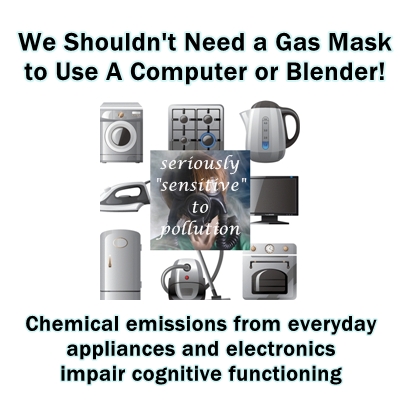
We Shouldn’t Need a Gas Mask to Use A Computer or Blender!

Ever notice how when you buy a new appliance or electronic device, and take it out of the box, or plug it in, the smell makes you nauseous, dizzy, and gives you a headache? Or worse?

That smell is made up of some really toxic chemical fumes. Benzene, styrene, and toluene, among others… in everyday technology!

.

New research from the Exposure, Epidemiology & Risk Program, Department of Environmental Health, Harvard T.H. Chan School of Public Health, on how the pollutants in indoor environments affect people’s cognitive functioning (people who are still able to work in polluted offices, not the people who are already too disabled to work in polluted offices) discovered that

Green office environments linked with higher cognitive function scores

…”People who work in well-ventilated offices with below-average levels of indoor pollutants and carbon dioxide (CO2) have significantly higher cognitive functioning scores–in crucial areas such as responding to a crisis or developing strategy–than those who work in offices with typical levels, according to a new study from the Harvard T.H. Chan School of Public Health’s Center for Health and the Global Environment, SUNY Upstate Medical University, and Syracuse University.

“We have been ignoring the 90%. We spend 90% of our time indoors and 90% of the cost of a building are the occupants, yet indoor environmental quality and its impact on health and productivity are often an afterthought,” said Joseph Allen, assistant professor of exposure assessment science, director of the Healthy Buildings Program at the Harvard Center for Health and the Global Environment, and lead author of the study.

“These results suggest that even modest improvements to indoor environmental quality may have a profound impact on the decision-making performance of workers.”

Researchers wanted to look at the impact of ventilation, chemicals, and carbon dioxide on workers’ cognitive function because, as buildings have become more energy efficient, they have also become more airtight, increasing the potential for poor indoor environmental quality.

Building-related illnesses and “sick building syndrome” were first reported in the 1980s as ventilation rates decreased. In response, there has been an emphasis on sustainable design–“green” buildings that are energy efficient and are also designed to enhance indoor environmental quality. The researchers designed this study to identify the specific attributes of green building design that influence cognitive function, an objective measure of productivity.

“The major significance of this finding lies in the fact that these are the critical decision making parameters that are linked to optimal and productive functioning. Losing components of these skills impacts how people handle their day to day lives.”

In other words, pollution prevents people from being smart!

appliance gas mask

Here are just some of the harmful emissions from computers:

Continue reading

Why We Need “Sensitive” Human Canaries

“Sensitive” humans are not defective or here to inconvenience you.

maybe it is not me

Some canary history:

“Carbon monoxide, a potentially deadly gas devoid of color, taste or smell, can form underground during a mine fire or after a mine explosion.

Today’s coal miners must rely on carbon monoxide detectors and monitors to recognize its presence underground. However, before the availability of modern detection devices, miners turned to Mother Nature for assistance.

Canaries — and sometimes mice — were used to alert miners to the presence of the poisonous gas. Following a mine fire or explosion, mine rescuers would descend into the mine carrying a canary in a small wooden or metal cage.


Any sign of distress from the canary was a clear signal that the conditions underground were unsafe, prompting a hasty return to the surface.


Continue reading

Who Wants to Help Me Get New Air Purifier Filters?

I need several air purifiers to clean the air of pollutants from unavoidable everyday products and materials (like the mail, receipts, product labels, food packaging, replacement of any basic essentials, etc) and also the neighbourhood pollution (trains, planes, laundry products, pesticides, BBQs, fireplace smoke, etc) from my indoor air so that my brain and body can work more like they were intended to.

To cook, clean, and take care of my very basic needs, (nothing extra going on here, I am housebound) I am dependent on clean air to be able to function. My filters need to be changed annually or every other year (depending on what the air quality has been like) and mine were last changed in 2012, three years ago.

I have looked all over the place for funding to purchase new filters and there just isn’t anyone out there with a mandate to provide clean air to those who require it for medical reasons.

! ! !

IAQ help

Last summer was a disaster for me, this year was even worse. I’ve had a horrid three  months from area roadwork and pesticide use (there was massive spraying of Wild Parsnip around this part of Ontario during the summer, and the pesticide drift got to me really bad), and now other simpler exposures that hadn’t been bothering me as much as they used to, are again having more serious adverse effects on me because my indoor air is not being filtered anymore.

Continue reading

The Effort and “Inconvenience” of Single-Handedly Trying to Remove Systemic Barriers to Access

.

When she needed accommodation, you won’t believe the rigmarole that ensued.

(unless you have MCS/ES)

equal opportunity 1

“They should not have to make significantly more effort to access or obtain service. They should also not have to accept lesser quality or more inconvenience.”

.

Someone with MCS (who wishes to remain anonymous) was asked about how her efforts to receive appropriate, safe, accommodation were going, so she could see a health care provider. She is one of a growing number of people who become disabled from exposures to toxic chemicals found in many everyday products and materials, especially in fragrances.

This is pretty much how the story goes:

She contacted a health care provider by phone and talked to a receptionist.

She asked her if they had a scent-free policy and was told they didn’t.

Continue reading