Tag Archives: petrochemicals

We Know (Some of You) Try


Guest post poetry by Sandy Lippert

You probably think you are all fragrance free,

But it doesn’t wash away so easily.

I’m certain of all your efforts and know how hard you try,

But when you come to visit, I’m just getting by.

I probably look just fine to you Continue reading

And The Winning Answer Is…

About a year ago I decided to give away an electronic item of some value that had belonged to my kids as they no longer wanted it and it had some chemical residues that prevented me from enjoying it (more too toxic tech issues). I posted it to a community giving group that is similar to Buy Nothing or Freecycle, where there are a lot of things given and received, for free (mostly clothing, toys, and small items).


community

As it was permitted to ask questions of respondents, I also decided to ask a question that people had to answer to be considered as a potential recipient.

Along with the description of the item, I posted:

*Please answer one of the following questions

1. Has anyone ever told you a product you use made them sick, and if so, how did you handle it?
or
2. If it hasn’t happened yet, how would you handle it if it did happen?

The responses included:

Continue reading

The Fragrance Industry’s Toxic Secrets

If you want to learn more about why so many people are suffering adverse health effects and making a stink about fragrance use, then the recent report from Women’s Voices for the Earth is a great place to get informed

Unpacking the Fragrance Industry: Policy Failures, the Trade Secret Myth and Public Health.

It’s must read material if you are at all unfamiliar with the issues surrounding fragrance.

Like this:

And that’s only the ones that have been tested. Many have not been tested for human health effects. Scientists also recently discovered that chemical cocktails can become carcinogenic even when individual chemicals themselves weren’t carcinogenic, but chemicals are tested individually (if at all), and not in the cocktails we get exposed to.

Please read the research and articles from WVE, and then take action.

Not surprisingly, the fragrance industry took issue with the report and shared some standard industry generated marketing responses. You can read about that here:

Continue reading

An Open Letter to the Scented

Guest post by Debbie Clark Seely

Dear friends,

I wanted to take the time to write this letter because we (the “unscented” community) are concerned for you. With it being the holiday season we are seeing multiple reports of friends and family members choosing to cut ties to their unscented loved ones rather than make the effort to visit them unscented. This perplexes us. It makes us feel like you are choosing scent over a human being. Continue reading

Research Shows Harmful Chemicals Can Remain In Clothing Even After Washing

“Exposure to these chemicals increases the risk of allergic dermatitis, but more severe health effect for humans as well as the environment could possibly be related to these chemicals. Some of them are suspected or proved carcinogens and some have aquatic toxicity,”

textile chemical release

Giovanna Luongo found that there are harmful chemical residues left in clothing even after 10 washes and presents the information in her Doctoral Thesis, Chemicals in textiles A potential source for human exposure and environmental pollution.

This scientifically validates what some of us have been saying for years, that some harmful chemical residues can be extremely difficult if not impossible to remove, (as the rigmarole we have to go through in an attempt to have safe to wear clothing to wear attests), and that normally undetectable trace levels can cause disabling effects.

Many chemicals present in clothing (and bedding) enter the human body via dermal absorption, and can be detected in urine hours later!

This poster shows how chemicals enter our bodies:

Continue reading

Scent Marketing or Scented Drugging?

The May June 2015 issue of Costco’s magazine had an article about scent marketing.

The Economist had an interesting article in 2007 regarding manipulative chemical use.

Women’s Voices For the Earth has several reports about fragrances and the fragrance industry.

Why should you be concerned? Read on:

Continue reading

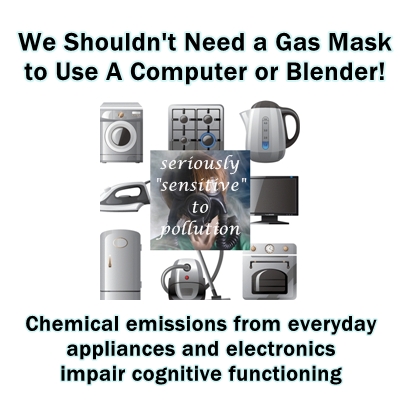
We Shouldn’t Need a Gas Mask to Use A Computer or Blender!

Ever notice how when you buy a new appliance or electronic device, and take it out of the box, or plug it in, the smell makes you nauseous, dizzy, and gives you a headache? Or worse?

That smell is made up of some really toxic chemical fumes. Benzene, styrene, and toluene, among others… in everyday technology!

.

New research from the Exposure, Epidemiology & Risk Program, Department of Environmental Health, Harvard T.H. Chan School of Public Health, on how the pollutants in indoor environments affect people’s cognitive functioning (people who are still able to work in polluted offices, not the people who are already too disabled to work in polluted offices) discovered that

Green office environments linked with higher cognitive function scores

…”People who work in well-ventilated offices with below-average levels of indoor pollutants and carbon dioxide (CO2) have significantly higher cognitive functioning scores–in crucial areas such as responding to a crisis or developing strategy–than those who work in offices with typical levels, according to a new study from the Harvard T.H. Chan School of Public Health’s Center for Health and the Global Environment, SUNY Upstate Medical University, and Syracuse University.

“We have been ignoring the 90%. We spend 90% of our time indoors and 90% of the cost of a building are the occupants, yet indoor environmental quality and its impact on health and productivity are often an afterthought,” said Joseph Allen, assistant professor of exposure assessment science, director of the Healthy Buildings Program at the Harvard Center for Health and the Global Environment, and lead author of the study.

“These results suggest that even modest improvements to indoor environmental quality may have a profound impact on the decision-making performance of workers.”

Researchers wanted to look at the impact of ventilation, chemicals, and carbon dioxide on workers’ cognitive function because, as buildings have become more energy efficient, they have also become more airtight, increasing the potential for poor indoor environmental quality.

Building-related illnesses and “sick building syndrome” were first reported in the 1980s as ventilation rates decreased. In response, there has been an emphasis on sustainable design–“green” buildings that are energy efficient and are also designed to enhance indoor environmental quality. The researchers designed this study to identify the specific attributes of green building design that influence cognitive function, an objective measure of productivity.

“The major significance of this finding lies in the fact that these are the critical decision making parameters that are linked to optimal and productive functioning. Losing components of these skills impacts how people handle their day to day lives.”

In other words, pollution prevents people from being smart!

appliance gas mask

Here are just some of the harmful emissions from computers:

Continue reading

Healthy Living Tips 101

Here are three simple Top Tips For Healthy Living (printable) PDFs, with clear information on things we must do to live healthier lives, including things to do and things to avoid, in order to prevent cancer and other health problems that are linked to all the everyday toxic exposures we are currently subjected to. Continue reading

Scent-Free Buildings Guide from CCIAQB

From The Canadian Committee on Indoor Air Quality (CCIAQB) 

“This Module provides building owners and managers with information about the sources and effects of scents and fragrances. It also suggests ways to move toward scent-free buildings. The information covers scents and fragrances brought into a workplace by people wearing personal products such as perfume as well as those scents and fragrances that originate from custodial products such as washroom hand soap.”

scent-free buildings guide banner

Continue reading

Down is Harder After Up

Alternate title: Be Grateful or Be Miserable!

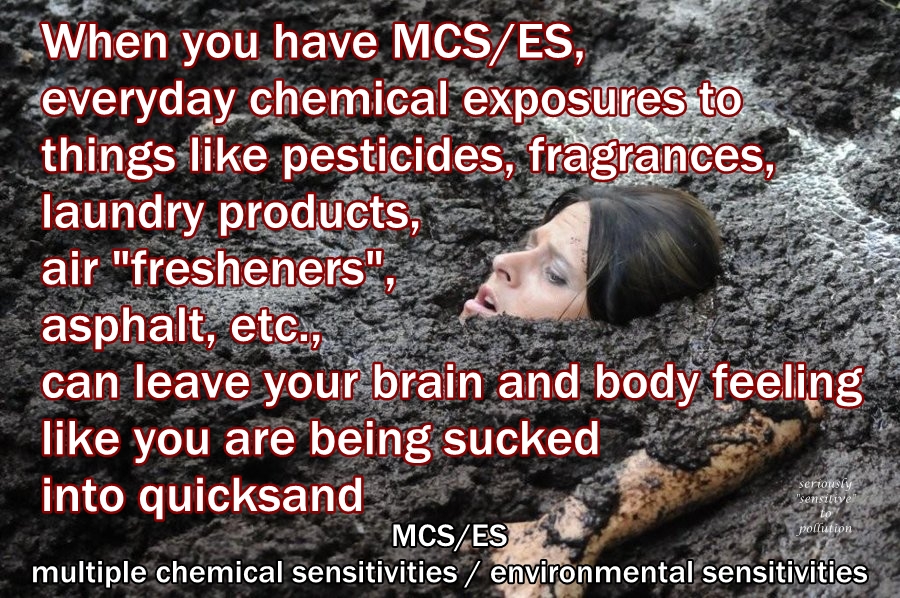
I had some really good brain and body days in the early spring, enough that they left an imprint on me of how it felt to feel (relatively, and almost) normal. instead of the usual:

feels like quicksand-3

Then shit happened… (sorry, I don’t usually use language like that, but I’ve lost access to some parts of my vocabulary lately as a result of the toxic stuff I was exposed to).

Pesticides, dental infections and extractions, toxic products and materials (including trying to replace a SS kitchen kettle -simple, yes? Actually, NO), summer road work, more and more pesticides, heat,  VOCs, lack of ventilation and air filtration, which meant no ability to cook, and more…all of which resulted in some serious brain fog, cognitive problems,  and drastically reduced physical abilities.

Back to the drawing board…

After having some good days this year, I crashed again, and I haven’t been able to recover… much… There can be a few better mini-moments here and there if the outdoor air quality is exceptional and the breezes have been blowing the “right” way, but nothing like how well I was doing for a while in the spring.

Which makes it so much harder now, because I can actually remember what it was like to be more functional. It was so long ago before, that it didn’t really come into play or into my thoughts, as for so many years, I couldn’t remember what it was like to think clearly, or to function without effort, with relative ease.

Is it really too much to ask to be able to function with relative ease? To not have every thought, every action be like climbing a mountain or navigating an obstacle course?

Continue reading