Category Archives: Environmental Sensitivities

When Keeping Your Job Depends On What Other People Do

When we develop MCS/ES, one of the first concerns we have is how to keep our job when other people keep using products and materials that disable us.

Some people are able to negotiate a legally required accommodation  policy, but sadly, too many people find these policies are rarely or effectively enforced as they should be.

no enforcement lost my job

Recent research from Dr Anne Steinemann shows there are serious adverse  impacts due to fragrance use:

“Significantly, 15.1 % of the general population reported that exposure to fragranced products in their work environment has caused them to become sick, lose workdays, or lose a job. Also, 20.2 % of the population reported that if they enter a business, and smell air fresheners or some fragranced product, they want to leave as quickly as possible.
http://link.springer.com/article/10.1007%2Fs11869-016-0442-z

.

Here are some Human Rights resources on various laws, regulations, and solutions that, when enforced, can help people remain employed without losing their health and abilities:

Continue reading

Fume Enclosure Boxes for Reading, Computers, and Appliances

Since papers, inks, and computers can release fumes that are too toxic for some of us to breathe, adversely affecting our ability to remain functional, and since there’s no getting away from papers and technology in modern society, an assistive device was invented some decades ago that could be useful to bring back as a more popular accessory: the reading box!

I recently ran across an ad on Craigslist for one that was for sale in the US, and then someone found an old catalogue (2002 PDF) with a few other pics, so I thought I’d share the info and images here in case they can help anyone else.

A reading box is basically a box made of wood, glass, or metal, with an opening in the front, and glass on top to read through. A vented box will also have a dryer hose out the back, and a fan of some sort to push the air through the hose and out of a window. A barrier with a vent sized exhaust hole would also be needed to cover the window opening being used.

reading box for computer 1This computer box is from the catalogue.

Continue reading

What Do You Think About Accommodating Someone With MCS/ES or Allergies?

Some people think they have the right to do whatever they want, regardless of how it affects anyone else around them. Sometimes what they do is from ignorance (not knowing or understanding causes and effects), sometimes it’s a deliberately hurtful, even criminal action. Either way, what they do causes all kinds of suffering that is fully preventable.

Here are a few images you can think about and share if they “speak” to you:

telling 1

Continue reading

Lynn Lawson Received NCEHS EI Pioneer Award Weeks Before Her Death

1-2 Lawson - Lynn Lawson Holding NCEHS Award December 14, 2015 Lynn Lawson with award, December 14, 2015

Ninety year old Lynn Lawson of Evanston, IL passed away on January 30, 2016

In September, 2015, Mary Lamielle, Executive Director  of the National Center for Environmental Health Strategies,  named Lynn Lawson the first recipient of the NCEHS EI Pioneer Award:

Continue reading

Fragrance, Flying, and “Sensitivities”

Progress is being made!

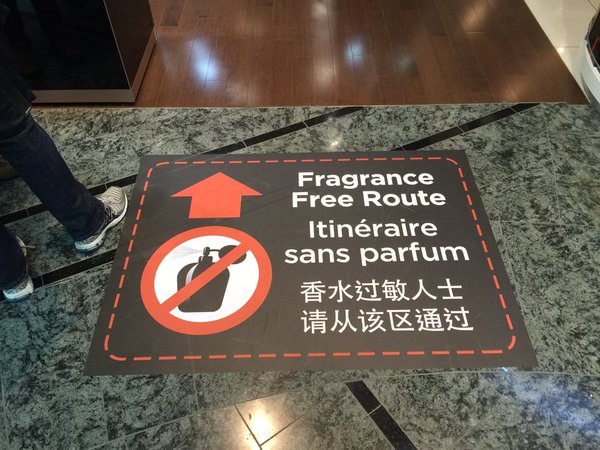
Even if you can’t actually get a fragrance-free flight, you can now get to the plane along a fragrance-free route if you are in Vancouver, BC!

from Vancouver Airport's twitter account

Maybe it needs some work to make the English language portion clear?

Right now, it could be taken to mean that they have a free route to fragrance!

So, once they get the English fixed for those who don’t understand French (where it’s clear they mean without perfume, but then again, how many people actually read their box or bottle of laundry detergent to see that there’s parfum in there? and in their deodorant? and in their shampoo?)  we can (maybe) get to the plane without being assaulted by fragrance chemicals (but, oh, it’s only “free” from the duty free shops with fragrance).  Still, I guess it IS progress… kind of…   Right?

Assuming we can actually get there without a life threatening (or merely disabling) reaction,  what happens once we are in the actual plane?

Continue reading

Are You A Woman Over the Age Of 65 With MCS/ES?

IF SO, WOULD YOU PARTICIPATE IN A STUDY OF WOMEN’S NEEDS AS YOU GROW OLDER WITH ENVIRONMENTAL SENSITIVITIES?

The James Madison University Environmental Sensitivities Research Team is inviting women aged 65 and older who have experienced environmental sensitivities (chemical and/or electrical) to participate in an online study of how your needs are being met as you grow older with sensitivities.

If you are interested in participating, please click on the link below to see the consent form and learn more about the study. Continue reading

2015 – A Retrospective

I was hoping to be able to share some good news with you all, and here it is. We ARE making progress! It is unfortunate that it has taken this long, but I believe we are almost at the point where we will see an “overnight” shift happen.
Here’s what Dr John Molot (the author of “12,000 Canaries Can’t Be Wrong”) has to say:

johnmolot's avatarJohn Molot

2015-summaryIt’s the end of 2015, a time to celebrate the promise of the coming year but also a time to reflect on the 12 months that have just passed. It was an incredibly exciting year for me professionally. As a physician who advocated for my patients for so many years, I no longer feel that I am paddling upstream against the hardline, medically conservative current that has discredited environmental medicine for decades. The patient groups that I work with have realistic hope for improved care in the near future.

My 2015 :: Science :: Media
Medical Profession :: Insurance Companies :: The Canaries
What’s to come?

My 2015

This year, I have had several opportunities to effectively represent the people with environmentally linked conditions. I have been actively involved with the Ontario Ministry of Health and Long Term Care in the development of the promised (2014) Task Force on Environmental…

View original post 1,577 more words

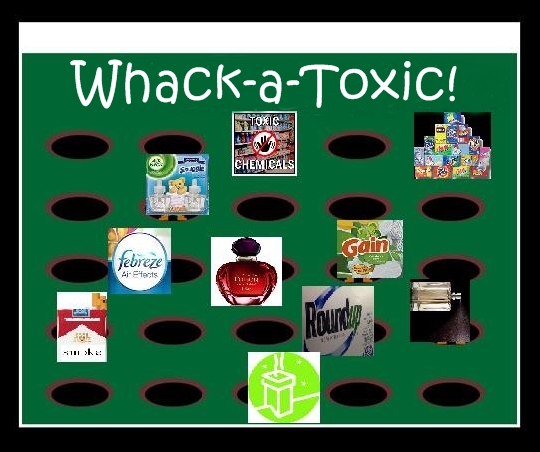
Wanted: Whack-A-Toxic Game Maker

Some of us find online computer games to be a good way to keep our brains from atrophying when we are disabled by all the toxic chemicals allowed to be used in everyday products and materials.

Here’s a game idea that we’d like developed:

whackatoxic

It would have to have an adjustable, variable speed (some of our brains are very slow), as well as an on-off switch for sounds (some of us are also sound “sensitive” when our CNS has been fried from exposures).

The products that pop up can be virtually all regular laundry, cleaning, and personal care products, pesticides, new clothing, shoes, furniture, new electronics, most plastics, in fact, almost anything new. Toxic, health-harming petrochemicals are everywhere now!

The game could be turned into an educational tool too (instead of just a therapeutic tool) by including hyperlinks that inform what the known and suspected to-be-harmful and still-questionable chemicals are in each product, and what health effects they can cause! Scoring could be based on whacking (eliminating) the most toxic products first!

Can someone please make us this game?

In the meantime, here’s an existing way to be active in learning and changing the toxic world we currently live in to a safer one:

 Mind the Store


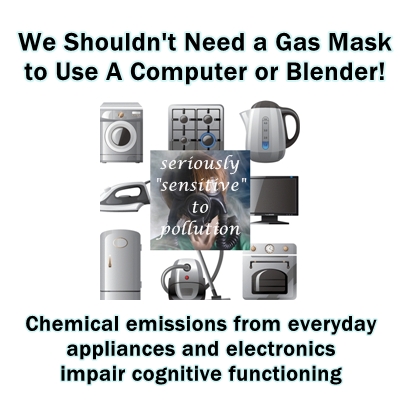
We Shouldn’t Need a Gas Mask to Use A Computer or Blender!

Ever notice how when you buy a new appliance or electronic device, and take it out of the box, or plug it in, the smell makes you nauseous, dizzy, and gives you a headache? Or worse?

That smell is made up of some really toxic chemical fumes. Benzene, styrene, and toluene, among others… in everyday technology!

.

New research from the Exposure, Epidemiology & Risk Program, Department of Environmental Health, Harvard T.H. Chan School of Public Health, on how the pollutants in indoor environments affect people’s cognitive functioning (people who are still able to work in polluted offices, not the people who are already too disabled to work in polluted offices) discovered that

Green office environments linked with higher cognitive function scores

…”People who work in well-ventilated offices with below-average levels of indoor pollutants and carbon dioxide (CO2) have significantly higher cognitive functioning scores–in crucial areas such as responding to a crisis or developing strategy–than those who work in offices with typical levels, according to a new study from the Harvard T.H. Chan School of Public Health’s Center for Health and the Global Environment, SUNY Upstate Medical University, and Syracuse University.

“We have been ignoring the 90%. We spend 90% of our time indoors and 90% of the cost of a building are the occupants, yet indoor environmental quality and its impact on health and productivity are often an afterthought,” said Joseph Allen, assistant professor of exposure assessment science, director of the Healthy Buildings Program at the Harvard Center for Health and the Global Environment, and lead author of the study.

“These results suggest that even modest improvements to indoor environmental quality may have a profound impact on the decision-making performance of workers.”

Researchers wanted to look at the impact of ventilation, chemicals, and carbon dioxide on workers’ cognitive function because, as buildings have become more energy efficient, they have also become more airtight, increasing the potential for poor indoor environmental quality.

Building-related illnesses and “sick building syndrome” were first reported in the 1980s as ventilation rates decreased. In response, there has been an emphasis on sustainable design–“green” buildings that are energy efficient and are also designed to enhance indoor environmental quality. The researchers designed this study to identify the specific attributes of green building design that influence cognitive function, an objective measure of productivity.

“The major significance of this finding lies in the fact that these are the critical decision making parameters that are linked to optimal and productive functioning. Losing components of these skills impacts how people handle their day to day lives.”

In other words, pollution prevents people from being smart!

appliance gas mask

Here are just some of the harmful emissions from computers:

Continue reading

Scent-Free Buildings Guide from CCIAQB

From The Canadian Committee on Indoor Air Quality (CCIAQB) 

“This Module provides building owners and managers with information about the sources and effects of scents and fragrances. It also suggests ways to move toward scent-free buildings. The information covers scents and fragrances brought into a workplace by people wearing personal products such as perfume as well as those scents and fragrances that originate from custodial products such as washroom hand soap.”

scent-free buildings guide banner

Continue reading