Category Archives: Human Rights

Optional “Inconvenience”

Guest post and images by Laura J Mac

What always strikes me during conversations about how to persuade service providers to accommodate our disability is how much extra work we have to do just to participate in simple survival stuff. I mean, “simply” tracking down professionals who are willing to accommodate is a chore and a half. The luxury of “having a good relationship” with a service provider falls way down on the list because it’s usually one or the other.

Laura J Mac 1

Nobody would think twice about someone who uses a mobility device asking if there are ramps and elevators but it seems that our need for fragrance-free and reduced chemical exposure is perceived as a “preference” rather than a medical necessity. That perception leads to the idea that accommodation of our disability is an “option” (and generally it’s an “option” that service providers aren’t willing to make available.) It’s not that we don’t “like” fragrance, these chemical exposures cause neurological and physiological problems that interfere with our ability to function on a daily basis.

Continue reading

Report: RF EMR and the Health of Canadians

The_Canadian_Flag
… “Numerous concerns relating to radiofrequency (RF) exposure were raised by witnesses during Committee meetings on Safety Code 6 as well as in the briefs that were submitted. …
Witnesses also spoke to possible links between RF exposure and cancer, reproductive issues and autism.These concerns tied in to other testimony that expressed unease about RF exposure in schools as a result of the use of Wi-Fi; the need for RF exposure limits and guidelines to protect vulnerable populations such as pregnant women, infants and children, and others who may be more susceptible to the effects of RF exposure; and electromagnetic hypersensitivity (EHS).
While witness testimony and briefs often emphasized the need for Health Canada to take a precautionary approach to RF exposure by reducing the limits established by Safety Code 6 (and sometimes provided examples of limits and other measures taken to protect populations from RF exposure in other jurisdictions), they also referred to steps that individuals can take to reduce their own RF exposure. Finally, some witnesses stated that industry should play a role in reducing RF exposure.” …
RADIOFREQUENCY ELECTROMAGNETIC RADIATION AND THE HEALTH OF CANADIANS
 ∴
Report of the Standing Committee on Health
This much awaited report contains 12 major recommendations by effectively echoing the expert evidence heard by eight MPs during the recent hearings this Committee.
 
 ∴
The List of Recommendations:

Continue reading

Scientists Call for Immediate Precaution With Wireless Technology

On Monday May 11th, 190 scientists from 39 nations submitted an appeal to the United Nations, UN member states and the World Health Organization (WHO) requesting they adopt more protective exposure guidelines for electromagnetic fields (EMF) and wireless technology in the face of increasing evidence of risk. These exposures are a rapidly growing form of environmental pollution worldwide. Continue reading

MCS and EHS Included in New National Council on Disability Transportation Report

Press Release from National Center for Environmental Health Strategies

~ Mary Lamielle

Transportation Update NCD

… excerpts …

National Council on Disability Transportation Report Addresses Chemical and Electrical Sensitivities; Recommends Changes in Policies and Practices to Improve Access

Continue reading

Asthma, Fragrance, and Job Accommodation

Fragrances Can Cause or Trigger Work-related Asthma

The Work-Related Asthma Prevention Program (WRAPP) of the California Department of Public Health released new fact sheets on fragrances and work-related asthma.

INHALER

Information available:

2017 Fragrances and Work-Related Asthma: Information for Workers (PDF) – fact sheet

2017 Fragrances and Work-Related Asthma: Information for Employers (PDF) – fact sheet

2015 (editable) Workplace Fragrance-Free Policy (Word) – fact sheet

Continue reading

MCS is International

People all over the industrialized world have been developing Multiple Chemical Sensitivities and Environmental Sensitivities, or Environmental Illnesses. We are exposed to so many petrochemical pollutants, in our air, water, foods, clothes, furnishings, homes, and elsewhere in daily life, substances which are now known to cause many kinds of adverse health effects, and some of us just have the epigenetic disposition to feel the effects faster and more extremely than others who may develop cancer or some other condition many years later.

Amelia Hill (aka the Amazing Amelia Hill) lives in Australia and developed very severe, or extreme MCS after not being properly diagnosed for too many years. A lack of proper diagnosis and precautionary measures usually results in a debilitating worsening of the condition, which is best addressed with avoidance of the triggering substances, and building up health in very targeted ways. This is much more difficult to do the longer one isn’t able to take the steps to avoid exposures and rebuild life with safe alternatives.

Amelia’s life is probably unlike any you have ever heard of (even mine) although there are many similarities between the experiences those of us who have severe MCS/ES share. Amelia is known as “amazing” because of the ways she handles her life.

You will see why here.

Amelia 01

Amelia’s story has been featured as the cover story in what may be South Australia’s most popular newspaper weekend magazine: Continue reading

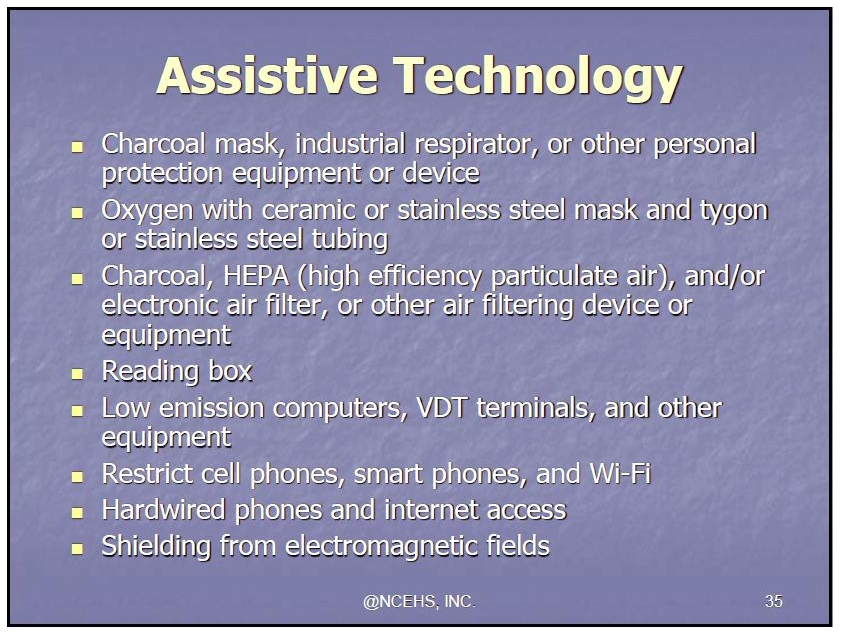
Assistive Devices For People With MCS/ES

For people with MCS/ES, assistive devices can allow us to remain functional, independent, and able when we can’t control everything in our environments.

MCS ES assistive technologySlide with a few options from New MCS/ES Accommodation Resource

In addition to fragrance, chemical, and wireless free policies, these and other devices can help reduce or eliminate exposures to the pollutants that can otherwise completely disable people with MCS/ES. They can make the difference for people to remain employed when provided early enough, effectively minimizing the effects of MCS/ES.

Continue reading

Home Dental Extraction SUCCESS (#2)!

Another One Bit the Dust

I survived my second home extraction on the weekend. It was a very infected tooth, an upper rear molar, one that I had somehow managed to retain a year longer than expected. It was actually the first one to get infected last year, but then the other tooth went ballistic, and by the time that extraction site healed, this tooth had calmed down enough to be very useful for eating with.

In hindsight, waiting so long may not have been such a great idea, as in the end, the infection was nasty. Very nasty. It put me into a terrible funk that was really difficult to push my way through, similar to the depression some kinds of mold can cause, and created the same challenges MCS/ES exposures cause, like brain fog, difficulty thinking and doing things, and a real lack of energy. And it stank when pulled. Really stank.

I am so grateful for the home visiting dentist in this area. Not only is he fragrance-free, but he is willing (and able!) to take other precautions to make things safe for me.

Last year, before my first home extraction, we discussed everything that was needed for the procedure, and what was necessary to make it as safe as possible for me.

This year I couldn’t find my old list (despite seeing it a month or 2 ago) and hoped he remembered his. This is what I do remember, and what we did:

Continue reading

Wendy is NOT a Widget and She Shouldn’t be Treated Like One

Wendy is NOT a widget. Widgets can go anywhere. Wendy can’t.

“Widget” is used in texts and speech, especially in the context of accounting, to indicate a hypothetical “any-product”. Companies in such texts will frequently be given names such as “ABC Widgets” or “Acme Widget Corp.” to indicate that the particular business of the hypothetical company is not relevant to the topic of discussion.
(Widget economics – wikipedia)

“Economists often use the term widget to refer to an abstract unit of production.”

Wendy is NOT a widget as her local housing authority seems to believe. They have a capacity problem, but instead of addressing the need for improved (and accessible) capacity, they want to re-arrange people’s lives as if they were widgets, with little to no regard or understanding of the consequences.

INVESTOPEDIA EXPLAINS ‘Capacity’

“The widget manufacturer may be able to produce 150,000 widgets in a month. However, due to downtime because of equipment maintenance and worker illness, only about 130,000 widgets can actually be produced per month. Over the long run, a business can increase its capacity and output by acquiring more factors of productions. For example, if market demand for widgets spikes, the widget manufacturer can buy more equipment and hire more workers, and thus increase its capacity to 175,000 widgets per month.”

Wendy is not a widget. She is a living, breathing, human being, a human being with a complex, chronic environmentally linked condition and disability related needs, needs that widgets don’t have.

Wendy Kearly photo by ADAM MACINNIS – THE NEWS

Wendy Kearly photo by ADAM MACINNIS – THE NEWS

The housing authority from which Wendy rents her safe home has deemed her over-housed, and are in the process of evicting her, despite the fact that Wendy has no other option for medically required, safe housing available, and no safe access to any of the other places most people take for granted (see below).

In the following audio interview with Wendy, among other things, she talks about the process her grown children take to detox themselves enough to be able to safely visit with her, so that she is able to safely hug them when they come to town.

Continue reading

What If an Industry was Allowed to Disable Us and Keep Us Housebound?

Something Is Really Wrong With This Picture

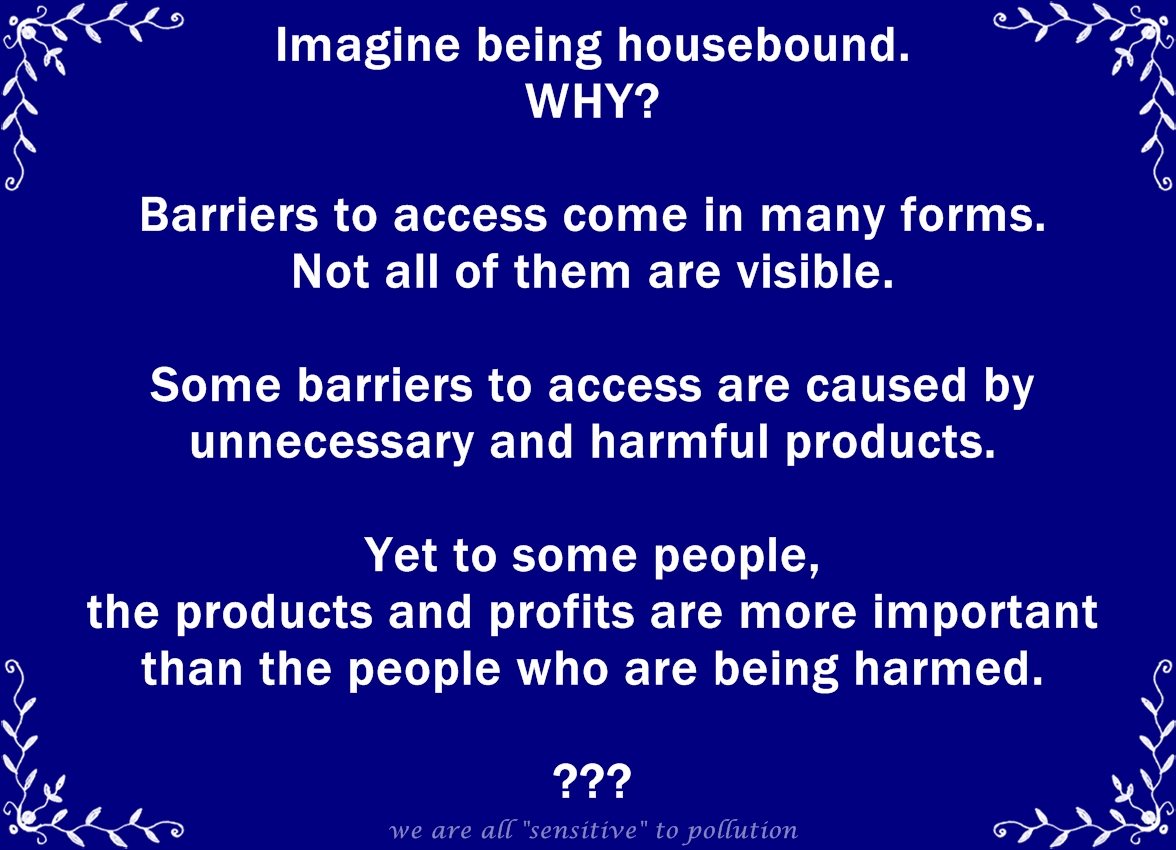
Imagine this 1

There’s a global proliferation of artificial fragrance and methods of dispersing it. Fragrance concoctions are added to almost everything imaginable (with more ridiculous ideas emerging all the time). They are sold and used everywhere at the same time as more people are developing adverse health effects from them, effects like serious allergies, disabling “sensitivities”, migraines, asthma, neurological disorders, lowered IQ, birth defects, etc. (the list keeps growing).

These health problems are due to unregulated and secret ingredients, ingredients which pollute our bodies, our air, and the waterways they get washed into from our sinks, tubs, and showers, ingredients that are impossible to avoid now, even when we don’t want them in our lives.

If you or your child had celiac disease or a severe peanut allergy, it would be the same as the peanut and gluten industries adding peanuts and gluten or peanut and gluten mist along with doses of mood altering drugs to every product imaginable, including building materials. That would be in addition to having peanut and gluten essences worn by everyone (in their hair, armpits, clothing …), pumped out of air ducts, automated devices in public washrooms, transportation, stores, apartments, offices, hotels, even medical offices, and your neighbours burning peanuts and gluten in their fireplaces, washing with laundry with them, and then pumping the residues out of their dryer vents 24/7.

You could imagine cat allergies too, but they are usually more inconvenient than life threatening and disabling.

The fragrance industry is very aware of the adverse effects its products have on people and the environment, yet they continue to look for more ways to pollute us and every product and environment conceivably possible. They knowingly create concoctions that harm and act like drugs! Yet they consider these risks reasonable and acceptable, and choose to dismiss or ridicule those who have problems, using similar tactics the tobacco industry used to deny there are problems and to continue to profit from them.

Continue reading