Tag Archives: toxic chemicals

What I Wear in Bad Air :: Lisa T

2016 Lisa Mary T

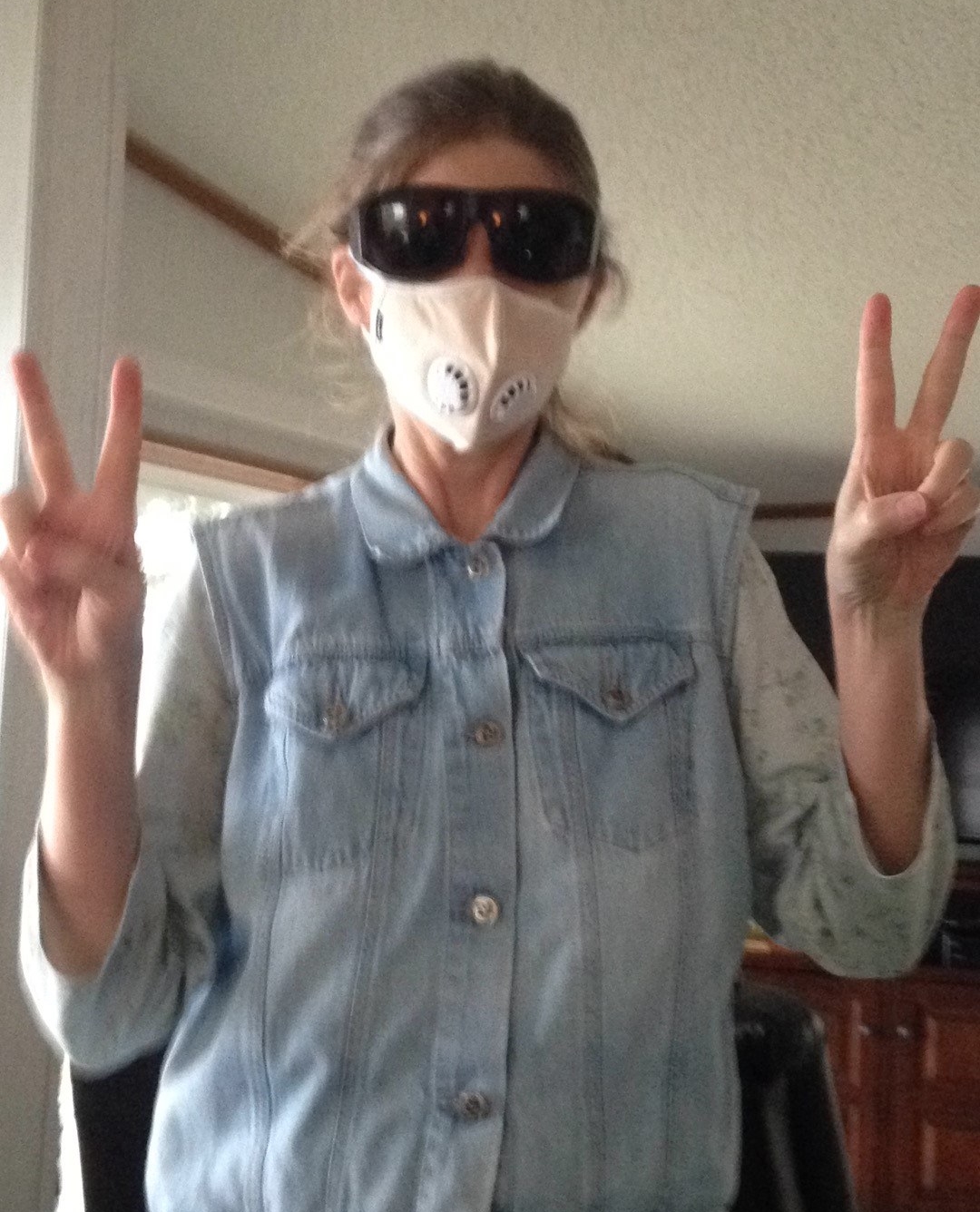
This photo was taken of me at my parent’s home, to demonstrate how I attempted to protect myself to be able to visit them, 2000 miles away.

When I can’t avoid exposures, I wear a mask to try to keep as functional as possible. Exposures affect my brain, my breathing, and I get more exhausted, etc. Even without the mask, I have challenges with my brain, breathing, energy, etc. Wearing the mask weakens me but not as much as a direct exposure would.

I am sensitive to chemicals in perfume, cologne, aftershave, hair care products, hand sanitizer, sunblock, air “freshener”, chlorine, white board and markers, building materials, cleaning products, laundry soap, dryer sheets, paints, pesticides, gasoline fumes, gas appliances, some plants, new asphalt, etc.

Continue reading

Update: Wendy is NOT a Widget and She Shouldn’t be Treated Like One

UPDATE:
The bureaucrats expect Wendy to leave the only safe and accessible home Wendy has access to, the sherriffs could be there any day, and there is still no other safe and accessible place for Wendy to move to!

In a kind and sane society, disabled people would be treated with respect and dignity, and safe and accessible housing would not be taken from them when there is no place else to go to.

We need to treat people with invisible, inconvenient disabilities better!

Wendy has a safe-for-her-home, the ONLY place she can now be and remain functional, but the bureaucrats only see that it is a 3 bedroom home and not the 2 bedroom home her doctors have said she (at minimum) needs.

She cannot go to the mall, to the hospital, to a library, or to an apartment where people smoke, use fragrances, pesticides, or have dryer vents spewing toxic laundry products her way.

The only kind, humane, and sane solution is that she should be allowed to remain where she is, until the province has built MCS/ES accessible housing that is safe for her to move to…

2016 W.K. 1


UPDATE May 3rd:

According to this CBC interview, the housing authority has extended Wendy’s stay until the end of July, although a week or so ago they had told Wendy that she only had until April 30th, and they have not informed Wendy or her lawyer about this news (she learned via the CBC).

Hers is the 1st interview: http://www.cbc.ca/maritimenoon/2016/05/03/chemical-sensitivity-eviction-pot-pardons-your-thoughts/

∴ Wendy is NOT a widget. Widgets can go anywhere. Wendy can’t. “Widget” is used in texts and speech, especially in the context of accounting, to indicate a hypothetical “any…

Source: Wendy is NOT a Widget and She Shouldn’t be Treated Like One

When We HAVE to Wear A Mask to Breathe and Function

When breathing the air hurts…

When we have to filter and “purify” the air just to breathe…

What options do we have?

2016 MCS-ES Awareness Month Compilation

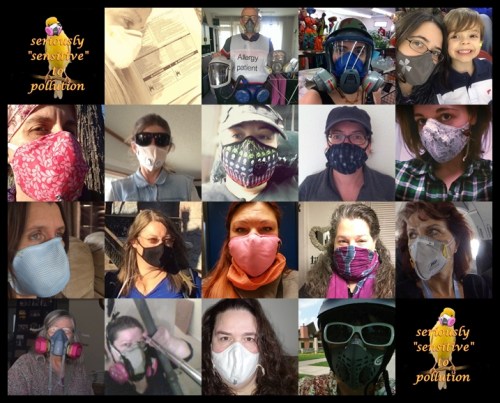
The Courageous Canaries of MCS/ES (and mask) Awareness Month 2016

Having an invisible disability is difficult, especially when many of the adverse effects are delayed and we have to deal with them in isolation.  Some people feel  self conscious about wearing a mask, especially if we can’t find a “pretty” one that we are able to use, despite how they can reduce adverse effects. If there’s any good that comes from wearing one (in addition to protecting our health a bit) wearing a mask when we have an invisible disability helps make us visible.

The type of mask we benefit most from will depend on our “sensitivities” and circumstances. Masks will filter the air we breathe in various degrees, but unless we have a full face respirator and wear a hazmat suit, our eyes and skin will still absorb chemicals that can have an adverse effect on our health and well-being. For this reason, they should not be thought of as complete protection from pollution, and are therefore best used only when absolutely necessary.

Information and resources about masks that filter out some of the different types of daily pollutants we are subjected to, and what kinds of filter materials are needed to purify what kinds of pollutants follows.

Continue reading

A Seriously Inappropriate Ad Shown Here!

I was informed by someone that they saw this seriously inappropriate ad from KOHL’s, selling perfume for Valentine’s Day, on one of the posts they read on this blog!!!

resist ads and toxic chemicalsScreenshot of (modified) toxic fragrance ad

I have no control over what ads get shown here, I don’t even see them!

If anyone ever sees an ad like that here again, please let WordPress know that it is seriously inappropriate for them to place ads for things made of toxic chemicals on this site (if you are new here, look around, and you’ll see why)!

Here’s what to do if you see something advertised here that is harmful for human and environmental health: Continue reading

My LOVE: Resist Toxic Chemicals

My LOVE!

Be fragrance-free!

valentine splatter RESIST 1

What’s love got to do with it?

Everything!

Who among us wants to harm another? Modern fragrances cause harm. Stop them!

Continue reading

Gifts of Love and Health

Guest post by T.M. Canary

Valentines Day has a different meaning for me. Three years ago in February 2013 my life changed forever. I was diagnosed with Reactive Airway Disease due to the use of air fresheners at the clinic where I worked. There is no way to describe how my life has been permanently changed in just a few words. My severe asthma is permanent and likely progressive. Those that care about me have the power do something about this though. You can make the effort to choose products that do not pollute the air we all breathe.

1. Avoid fragranced body products [perfume, body creams, sun screens, deodorant, shower gels, shampoo/conditioner, hair products, hand soaps lotions, and sanitizers]


2. Avoid fragranced laundry products [detergent, fabric softener and dryer sheets]

Continue reading

‘Conceptual Breakthrough’ Regarding the Chemicals We’re Stewing In

This is BIG news in the everyday chemicals and human health research front!

This explains what many of us who have MCS/ES experience – we can feel these processes as they occur, we don’t have to wait for the cancer that will kill us if we don’t get away from the exposures and find tools to heal the already occurring damage.

chemical effects

‘Conceptual breakthrough’

“This is the first time scientists have figured out how widespread this is, and how many different layers of machinery within the cells themselves are being impacted by these chemicals.”

.

“We found definite evidence that chemicals that are unavoidable in the environment can produce a wide range of low-dose effects that are directly related to carcinogenesis. So the way we’ve been testing chemical safety is really quite out-of-date.”

“Every day we are exposed to an environmental ‘chemical soup’ and we need testing to evaluate the effects of our ongoing exposure to the mixtures in this soup.”

~ William Goodson III, a senior scientist at the California Pacific Medical Center in San Francisco.


“This research backs up the idea that chemicals not considered harmful by themselves are combining and accumulating in our bodies to trigger cancer and might lie behind the global cancer epidemic we are witnessing.

~ Cancer Biologist Dr Hemad Yasaei from Brunel University London

.

This would be all kinds of everyday chemicals, such as those that trigger MCS – they included chemicals found in items such as mobile phones, detergents and cooking pans, and pesticides used on fruits and vegetables!

Read the research or check out some of the media reports:

Continue reading

The Fragrance Industry’s Toxic Secrets

If you want to learn more about why so many people are suffering adverse health effects and making a stink about fragrance use, then the recent report from Women’s Voices for the Earth is a great place to get informed

Unpacking the Fragrance Industry: Policy Failures, the Trade Secret Myth and Public Health.

It’s must read material if you are at all unfamiliar with the issues surrounding fragrance.

Like this:

And that’s only the ones that have been tested. Many have not been tested for human health effects. Scientists also recently discovered that chemical cocktails can become carcinogenic even when individual chemicals themselves weren’t carcinogenic, but chemicals are tested individually (if at all), and not in the cocktails we get exposed to.

Please read the research and articles from WVE, and then take action.

Not surprisingly, the fragrance industry took issue with the report and shared some standard industry generated marketing responses. You can read about that here:

Continue reading

Research Shows Harmful Chemicals Can Remain In Clothing Even After Washing

“Exposure to these chemicals increases the risk of allergic dermatitis, but more severe health effect for humans as well as the environment could possibly be related to these chemicals. Some of them are suspected or proved carcinogens and some have aquatic toxicity,”

textile chemical release

Giovanna Luongo found that there are harmful chemical residues left in clothing even after 10 washes and presents the information in her Doctoral Thesis, Chemicals in textiles A potential source for human exposure and environmental pollution.

This scientifically validates what some of us have been saying for years, that some harmful chemical residues can be extremely difficult if not impossible to remove, (as the rigmarole we have to go through in an attempt to have safe to wear clothing to wear attests), and that normally undetectable trace levels can cause disabling effects.

Many chemicals present in clothing (and bedding) enter the human body via dermal absorption, and can be detected in urine hours later!

This poster shows how chemicals enter our bodies:

Continue reading

We Shouldn’t Need a Gas Mask to Use A Computer or Blender!

Ever notice how when you buy a new appliance or electronic device, and take it out of the box, or plug it in, the smell makes you nauseous, dizzy, and gives you a headache? Or worse?

That smell is made up of some really toxic chemical fumes. Benzene, styrene, and toluene, among others… in everyday technology!

.

New research from the Exposure, Epidemiology & Risk Program, Department of Environmental Health, Harvard T.H. Chan School of Public Health, on how the pollutants in indoor environments affect people’s cognitive functioning (people who are still able to work in polluted offices, not the people who are already too disabled to work in polluted offices) discovered that

Green office environments linked with higher cognitive function scores

…”People who work in well-ventilated offices with below-average levels of indoor pollutants and carbon dioxide (CO2) have significantly higher cognitive functioning scores–in crucial areas such as responding to a crisis or developing strategy–than those who work in offices with typical levels, according to a new study from the Harvard T.H. Chan School of Public Health’s Center for Health and the Global Environment, SUNY Upstate Medical University, and Syracuse University.

“We have been ignoring the 90%. We spend 90% of our time indoors and 90% of the cost of a building are the occupants, yet indoor environmental quality and its impact on health and productivity are often an afterthought,” said Joseph Allen, assistant professor of exposure assessment science, director of the Healthy Buildings Program at the Harvard Center for Health and the Global Environment, and lead author of the study.

“These results suggest that even modest improvements to indoor environmental quality may have a profound impact on the decision-making performance of workers.”

Researchers wanted to look at the impact of ventilation, chemicals, and carbon dioxide on workers’ cognitive function because, as buildings have become more energy efficient, they have also become more airtight, increasing the potential for poor indoor environmental quality.

Building-related illnesses and “sick building syndrome” were first reported in the 1980s as ventilation rates decreased. In response, there has been an emphasis on sustainable design–“green” buildings that are energy efficient and are also designed to enhance indoor environmental quality. The researchers designed this study to identify the specific attributes of green building design that influence cognitive function, an objective measure of productivity.

“The major significance of this finding lies in the fact that these are the critical decision making parameters that are linked to optimal and productive functioning. Losing components of these skills impacts how people handle their day to day lives.”

In other words, pollution prevents people from being smart!

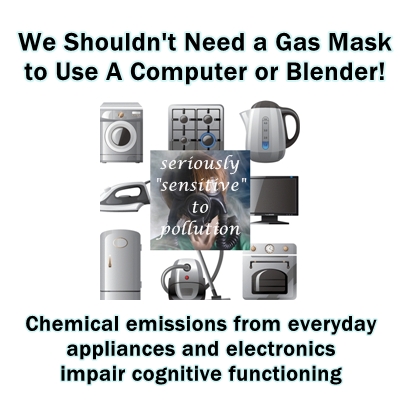
appliance gas mask

Here are just some of the harmful emissions from computers:

Continue reading